Introduction
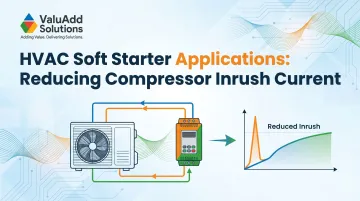
Every time a commercial HVAC compressor starts direct-on-line, it draws five to ten times its normal running current — a destructive surge that hammers bearings, sags voltage across the facility, and risks nuisance trips that halt production without warning. According to industry benchmarking data, distribution utility customers experience an average of 18 voltage sag events annually, many of which originate from uncontrolled motor starts within their own facilities.
Soft starters show up in plenty of product catalogs, but their actual value shows up in compressor service life, electrical infrastructure costs, and uptime records. This article breaks down why HVAC soft starters matter for industrial and commercial facilities — covering the operational and financial outcomes that result from proper specification and installation.
Key Takeaways
- An HVAC soft starter gradually ramps voltage at compressor startup using SCR-based control, limiting inrush current by up to 60%
- Protects compressors from mechanical shock, extends bearing and winding life, and prevents premature failures
- Reduces electrical infrastructure stress, enabling smaller transformers, cables, and switchgear
- Most valuable in high-cycle applications, backup-power-dependent facilities, and operations where downtime carries direct production costs
- Incompatible with variable-speed compressors — value lies in capital cost avoidance and uptime, not steady-state energy savings
What Is an HVAC Soft Starter?
An HVAC soft starter is a solid-state electronic device that uses silicon-controlled rectifiers (SCRs) to control the voltage ramp applied to a compressor motor during startup. Instead of applying full line voltage instantaneously — which triggers a violent inrush current spike — the soft starter progressively activates its SCRs, accelerating the motor smoothly to full speed, typically over 200–500 milliseconds.
Soft starters apply to single-phase and three-phase fixed-speed HVAC compressors across a range of systems:
- Commercial rooftop units
- Water-cooled and air-cooled chillers
- Heat pumps and refrigeration condensing units
- Industrial process cooling systems
- District cooling plants
One important boundary: soft starters are not compatible with variable-speed or inverter-driven compressors. Those systems already incorporate internal motor control electronics that manage startup current. Adding an external soft starter would be redundant and could interfere with the inverter's operation.
In practice, soft starters prevent three costly outcomes: mechanical shock damage from repeated hard starts, oversized electrical infrastructure to handle peak inrush, and unplanned downtime in facilities where cooling cannot be interrupted.
Key Advantages of HVAC Soft Starters in Industrial Applications
Each advantage below translates directly into outcomes that facility engineers, system integrators, and plant managers measure — compressor life, infrastructure cost, and unplanned downtime.
Advantage 1: Compressor Protection Through Controlled Inrush Reduction
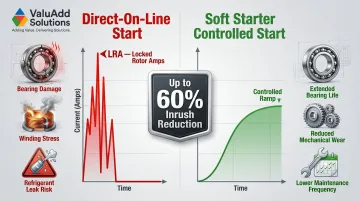
When a compressor starts direct-on-line, the Locked Rotor Amps (LRA) surge creates a violent mechanical jolt. Full torque is instantaneously applied to the motor shaft, stressing:
- Bearings and seals
- Motor windings and insulation
- Refrigerant piping connections
- Compressor internal components
Every hard start cycle compounds this damage.
By progressively firing SCRs to ramp voltage over a controlled period, the soft starter eliminates the torque spike. The motor accelerates smoothly to full speed without mechanical shock. Documented case studies show soft starters reducing scroll compressor inrush currents by 60%, while maintaining the short starting time the application requires.
The measurable outcomes are direct:
- Extended compressor service life (MTBF), as reduced starting stress delays bearing and winding wear
- Lower maintenance frequency — fewer bearing replacements, coupling failures, and refrigerant leak repairs
- Avoided capital expense on compressor replacement, which in commercial chillers and industrial systems represents significant ROI
This advantage is most pronounced in high-cycle-rate applications — data centers, process cooling, food manufacturing — where compressors start and stop frequently. Older reciprocating compressors starting against elevated head pressure are particularly vulnerable to hard-start damage. Any facility where compressor replacement means significant downtime should treat inrush control as a reliability requirement, not an option.
The mechanical protection soft starters provide is only part of the picture. The same inrush surge that stresses compressor internals also propagates upstream through your electrical distribution system.
Advantage 2: Reduced Electrical System Stress and Infrastructure Cost Savings
Unchecked inrush current causes voltage sag across the facility's electrical circuit, stresses transformers and switchgear, and trips breakers. Engineers respond by oversizing cables, transformers, and protection devices to handle peak startup demand — not running load. That oversizing carries a real cost.
By limiting peak inrush draw, a soft starter reduces momentary demand on upstream infrastructure. Transformers, cables, and switchgear can be sized for actual operating conditions rather than worst-case startup spikes.
Three outcomes follow directly:
- Lower capital costs on new construction and retrofits — smaller transformers, reduced cable ampacity, appropriately rated switchgear
- Fewer voltage sag incidents — voltage sags can cause motor contactors to drop out and sensitive electronics to reset or fail, disrupting operations across shared circuits
- Accurate system design from the outset — for system integrators specifying medium voltage soft starters, defined starting current limits eliminate guesswork. ValuAdd's medium voltage soft starter line covers 2.3 kV to 15 kV and 110 A to 1200 A, giving engineers the specification data needed to right-size distribution infrastructure at design stage.
This advantage is most relevant during new construction and major retrofits, in multi-unit HVAC installations on shared distribution, and in facilities with sensitive electronic equipment on the same circuits as HVAC loads.
Properly sized electrical infrastructure reduces upfront cost — but the ongoing reliability benefit extends beyond the one-time design decision.
Advantage 3: Improved Operational Reliability and Reduced Unplanned Downtime
In industrial facilities, nuisance breaker trips from inrush surges, generator overloads during power events, and compressor stall faults on aging equipment all translate into HVAC downtime. In process manufacturing, cold storage, or data center environments, that downtime has a direct production cost — not a theoretical one.
Soft starters address this by preventing over-inrush from triggering breaker instantaneous elements in the first place. They also enable HVAC systems to start on generators or UPS-backed power with reduced surge demand, and incorporate built-in protections including:
- Over/under-voltage monitoring
- Stall detection
- Compressor fault lockout
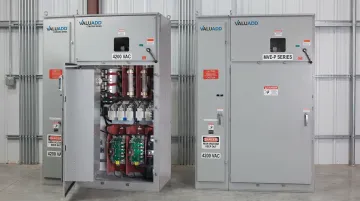
ValuAdd's medium voltage soft starter line — including the CFMVRMX and MVE-P Series — provides coordinated line monitoring and comprehensive motor protection that catches damaging operating conditions before they cause failures.
The reliability outcomes span three areas:
- Fewer unplanned downtime events (lower HVAC-related downtime hours and fault trip frequency) by eliminating the conditions that cause nuisance trips
- Reduced generator and UPS surge capacity requirements for starting commercial HVAC compressors, allowing appropriately sized backup systems
- Early fault detection via event logging — models like the RX3E and MVRXE record up to 99 events, enabling proactive maintenance before failures escalate
This advantage matters most in facilities where HVAC must stay operational during grid events, in 24/7 operations where any downtime has direct production cost consequences, and in installations where long cable runs increase impedance and compound voltage drop during hard starts.
What Happens When Soft Starters Are Skipped or Ignored
Direct Operational Consequences:
- Accelerated bearing and winding wear compounds with each start cycle
- Nuisance trips interrupt operations without warning
- Voltage sag from inrush disturbs other equipment on shared circuits
- Reactive maintenance cycles replace planned maintenance schedules
Oversized Electrical Infrastructure:
Electrical systems designed without accounting for soft-start inrush reduction are oversized by default. Engineers specify larger transformers, heavier cable, and higher-rated switchgear than would be required if startup current were properly managed, locking in unnecessary capital costs.
Hidden Deterioration in Aging Equipment:
As compressors age, their starting characteristics change. Without a soft starter providing consistent controlled acceleration and built-in fault protection, deteriorating performance goes undetected. The result is a catastrophic failure — unplanned, disruptive, and far more expensive than a controlled maintenance intervention would have been.
How to Get the Most Value from an HVAC Soft Starter
Correct Application Matching
Sizing must be based on the compressor's Rated Load Amps (RLA) from the equipment nameplate — not tonnage or LRA. The selected device must be compatible with:
- Compressor type (scroll or reciprocating)
- Phase configuration (single-phase or three-phase)
- Voltage class of the installation
For industrial and medium voltage applications requiring custom engineering, ValuAdd's technical support team provides application-specific guidance to ensure correct selection and integration.
Installation Quality
- Wire the soft starter according to manufacturer terminal diagrams — incorrect phasing causes immediate protection failures
- Remove any existing hard start kits before installation; running both in parallel creates conflicting inrush events
- Commission ramp time settings to match the specific compressor load profile, not a generic default
Skipping any of these steps negates the protective benefits and can introduce new failure modes.
Outcomes Verification
- Measure starting current before and after to confirm the reduction achieved
- Review fault logs periodically — diagnostic features on models like the RX3E and MVRXE surface early signs of compressor degradation before they become failures
Used this way, the soft starter gives maintenance teams a real data trail for trending compressor health over time.
Conclusion
HVAC soft starters reduce compressor inrush current, and that single function produces measurable benefits across the system:
- Longer compressor service life through reduced mechanical stress
- Right-sized electrical infrastructure with lower peak demand requirements
- Fewer unplanned shutdowns from thermal and voltage disturbances
- More reliable operation on backup power systems with limited capacity
These benefits build over time when the device is correctly specified, properly installed, and applied consistently across HVAC assets. Skipping this step in commercial or industrial HVAC design introduces preventable costs that accumulate with every start cycle — premature compressor replacements, oversized electrical infrastructure, and downtime that a properly sized soft starter would have prevented.
Frequently Asked Questions
What is an HVAC soft starter?
An HVAC soft starter is an electronic device that gradually ramps voltage to a compressor motor at startup, limiting the inrush current surge (LRA) that occurs when full voltage is applied directly. This protects the compressor, the electrical system, and connected equipment from the mechanical and electrical shock of a direct-on-line start.
Can you use a soft starter on a refrigerant compressor?
Yes, soft starters are compatible with single-phase and three-phase refrigerant compressors — both scroll and reciprocating types — used in HVAC and refrigeration systems. They are not suitable for variable-speed or inverter-driven compressors; see the question below for details.
How to decrease inrush current?
The most effective method is installing a soft starter that uses SCR-based voltage ramping to limit the peak current drawn at startup. Proper electrical system design — adequate cable sizing and correct transformer selection — also helps manage inrush effects, but the soft starter is the most direct and effective solution for compressor-driven HVAC systems.
What is the difference between a soft starter and a hard start kit for HVAC?
A hard start kit (start capacitor and potential relay) increases inrush current to deliver a higher torque spike for difficult-to-start compressors. A soft starter does the opposite — reducing inrush current through controlled voltage ramping. Hard start kits worsen electrical stress; soft starters eliminate it.
Do soft starters work with variable-speed HVAC compressors?
No. Variable-speed (inverter-driven) compressors already include built-in motor control electronics that manage startup current internally — adding an external soft starter would be redundant and could interfere with the inverter's operation. Soft starters are designed for single- and two-stage fixed-speed compressors only.
How do I size a soft starter for a commercial HVAC compressor?
Sizing is based on the compressor's Rated Load Amps (RLA), found on the outdoor unit's nameplate — not on tonnage or LRA. The selected soft starter must be rated to handle the compressor's RLA at the installation's supply voltage. For industrial or medium voltage applications, consulting with a qualified engineer or ValuAdd's technical support team is recommended to ensure correct selection and compliance with applicable standards.