Introduction
When a 75 HP conveyor motor fires up direct-on-line at a food processing plant, it pulls 450 amps in the first half-second—six times its rated current. Across the facility, lights flicker, a VFD fault-trips on a packaging line, and in the motor control center, contactors slam closed under forces they'll repeat 8,000 times this year. Each cycle shaves weeks off bearing life, stresses stator windings, and leaves maintenance teams wondering which motor will fail next.
Low voltage soft starters—Reduced Voltage Soft Starters (RVSS) rated for 208V–600V industrial environments—solve this problem by controlling voltage ramp-up during starts and ramp-down during stops. Properly configured units cut inrush current from 600–700% down to 300–400% of rated current.
This guide covers how they work, what they protect, and how to select the right unit for your application.
TLDR:
- SCR pairs ramp voltage progressively, cutting inrush from 600–700% down to 300–400% of motor FLA
- At 50% voltage, torque drops 75%—eliminating mechanical shock on couplings, belts, and driven equipment
- Post-start bypass contactors keep SCRs out of the circuit: >99% efficiency, zero harmonic distortion
- Best fit for pumps, fans, compressors, and conveyors needing fixed-speed operation with controlled starts
- For high-inertia loads like crushers, size one frame larger to handle extended thermal duty
How Low Voltage Soft Starters Work
The Power Circuit — SCRs, Thyristors, and Voltage Ramping
At the heart of every soft starter sit three pairs of Silicon Controlled Rectifiers (SCRs) — semiconductor switches connected in anti-parallel configuration, one pair per phase. Unlike a contactor that snaps closed to apply full line voltage instantly, these thyristors act as electronically adjustable resistors.
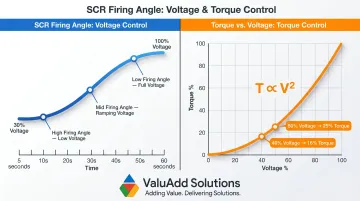
The soft starter controls the firing angle of each SCR on every half-cycle of the AC waveform, progressively increasing the voltage delivered to the motor from a reduced initial level (typically 30–50% of line voltage) up to 100% over a configurable ramp time of 5 to 60 seconds.
This voltage control exploits a fundamental motor physics principle: torque is proportional to the square of applied voltage (T ∝ V²). Reducing voltage to 50% of nominal doesn't just cut torque in half—it drops it to roughly 25% of full torque. A motor started at 40% voltage generates only 16% of its locked-rotor torque, enough to overcome static friction in most loads without the violent jerk of a full-voltage start.
The Control Circuit — Firing Angle Regulation and Bypass
A microcontroller-based control circuit governs the precise firing angle of the thyristors every half-cycle. Engineers adjust three critical parameters to match load characteristics:
- Initial voltage (30–70% of line voltage)
- Ramp time (5–60 seconds, longer for high-inertia loads)
- Current limit (150–400% of motor FLA)
Once the motor reaches full speed, leaving SCRs in the circuit permanently would generate continuous heat loss and introduce impedance. Modern hybrid soft starters solve this with a bypass contactor.
After the ramp completes, this contactor pulls in to route power directly to the motor, taking the SCRs out of the circuit entirely. The result: eliminated running losses, reduced enclosure cooling requirements, and over 99% efficiency during normal operation.
Key Benefits for Industrial Motor Control
Inrush Current Reduction
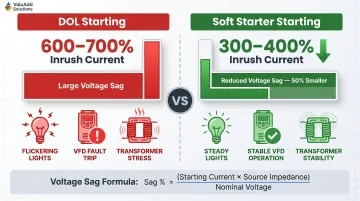
DOL starting pulls 600–700% of a motor's rated current for several seconds during acceleration. Properly configured low voltage soft starters reduce this to approximately 300–400% of FLA, cutting peak electrical demand. This reduces thermal stress on motor windings—governed by the Arrhenius "Rule of 10," where every 10°C temperature rise halves insulation life expectancy. It also protects against nuisance breaker trips and minimizes voltage sags that destabilize sensitive equipment on shared circuits.
Mechanical Shock Elimination
The controlled torque ramp protects every component in the drivetrain. Field data shows soft starters reduce impact vibration amplitude by over 60%, and can extend equipment overhaul cycles by 30–50%. For applications with frequent starts—conveyors cycling 10 times per hour, compressors responding to pressure switches—this shock reduction directly translates to:
- Fewer coupling failures
- Reduced bearing wear
- Longer belt and idler life
Controlled Soft Stop Capability
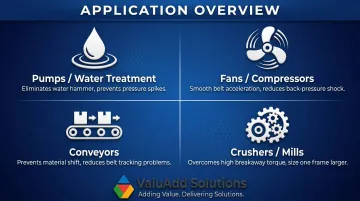
Many modern soft starters offer voltage ramp-down on stopping, not just starting. In conveyor systems, this eliminates reverse-shock that misaligns belts and damages idlers. In pump applications, gradual deceleration prevents water hammer—the pressure surge that cracks pipe joints and destroys valve seats when liquid momentum changes abruptly.
Grid and Infrastructure Protection
Beyond protecting individual motors, soft starters stabilize the broader electrical infrastructure. Voltage sag follows a direct relationship: percentage drop equals (starting current × source impedance) / nominal voltage. Halving starting current halves the dip. This matters in facilities running multiple large motors, operating on limited-capacity generators, or sharing transformers with sensitive CNC equipment or lighting systems that fault during voltage dips.
Compliance and Certification Relevance
In regulated sectors, specifying UL Listed soft starters that meet applicable NEMA enclosure standards isn't optional—it's a baseline requirement. This applies across:
- Water treatment facilities governed by EPA standards
- Oil and gas operations under OSHA jurisdiction
- Manufacturing plants with NFPA 70E compliance obligations
ValuAdd supplies UL Listed, CE Certified low voltage soft starters engineered for these environments. NEMA 12 enclosures cover standard indoor industrial installations; NEMA 4X enclosures handle outdoor and corrosive-atmosphere applications.
Where Low Voltage Soft Starters Excel: Industrial Applications
Pumps and Water Treatment
Water hammer is the primary failure mode in abruptly started or stopped pump systems. When fluid velocity changes suddenly, momentum creates pressure spikes that exceed pipe design limits—cracking fittings, rupturing diaphragms, and destroying check valves. The US Army Corps of Engineers identifies soft start motor starters as a primary mitigating measure for hydraulic transients, and municipalities increasingly mandate them. The City of Seattle requires RVSS for all constant-speed motors 15 HP and larger, specifically mandating solid-state designs with bypass contactors to minimize inrush current.
Advanced soft starters use torque control algorithms during deceleration to gradually reduce motor speed, eliminating the pressure surge entirely. This protection is essential in municipal water treatment, wastewater lift stations, and industrial fluid handling systems where pipe infrastructure is aging or operating near pressure limits.
Compressors, Fans, and Blowers
Compressor motors fight back-pressure build-up during startup—refrigerant or compressed air systems can present 200–300% of normal running load during the first seconds of acceleration. DOL starting under this condition overloads motor shafts and strains couplings. Soft starters allow the motor to build speed gradually while load pressure equalizes, protecting both the motor and compressor internals.
Belt-driven fans and blowers face a different set of risks. Sudden full-voltage starts cause belt slip, bearing shock loads, and structural vibration that propagates through duct systems. High-inertia centrifugal fans with large-diameter wheels are particularly vulnerable. A gradual torque ramp lets the belt drive accelerate smoothly without slip and allows the fan wheel to gain momentum without shocking its mounting structure.
Conveyors, Crushers, and Heavy Process Equipment
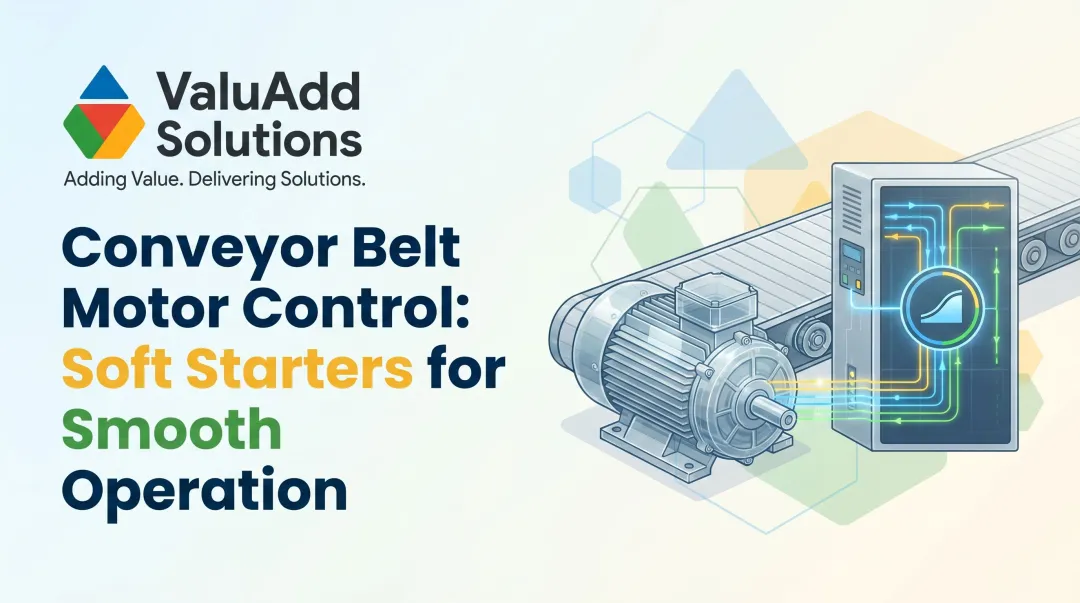
Loaded belt conveyors are especially sensitive to jerk-starts. Material riding on the belt has inertia—when the belt snaps to full speed instantly, material shifts, creating misalignment that causes edge wear and tracking problems. In mine conveyors or aggregate handling systems carrying tons of material, this misalignment accelerates belt replacement cycles dramatically.
Crushers, ball mills, and grinding equipment present the opposite challenge: very high breakaway torque combined with massive rotating inertia. DOL starting these machines causes real mechanical damage:
- Shaft keys shear under instantaneous torque loads
- Gear teeth crack from repeated startup shock
- Mounting bolts loosen over time from vibration and jerk
Soft starters allow these machines to overcome static friction gradually and accelerate smoothly under load. When specifying for this application, use Class 30 overload protection and oversize the soft starter by one frame to ensure adequate thermal capacity for extended ramp times.
Oil, Gas, and Processing Plant Environments
Oil and gas operations present specific challenges: motors that start infrequently but must perform reliably after months of inactivity, in environments with dust, moisture, temperature extremes, and corrosive atmospheres. Soft starters reduce electrical stress on aged or long-run wiring infrastructure common in these facilities—branch circuits installed decades ago with insulation degraded by heat cycling.
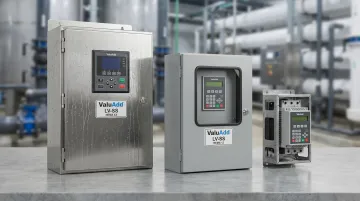
Enclosure selection directly determines whether a soft starter survives the environment. NEMA Type 4X enclosures with gasketed doors and stainless steel construction protect against salt spray on offshore platforms and chemical exposure in refineries. NEMA Type 12 enclosures suit indoor installations where oil mist and dust are present. ValuAdd's RX3E and RX4E Series soft starters are available in both NEMA 12 and NEMA 3R (outdoor) configurations, with the SW Series offering NEMA Type 4X protection for the most demanding environments.
Soft Starter vs. VFD: Choosing the Right Motor Control Solution
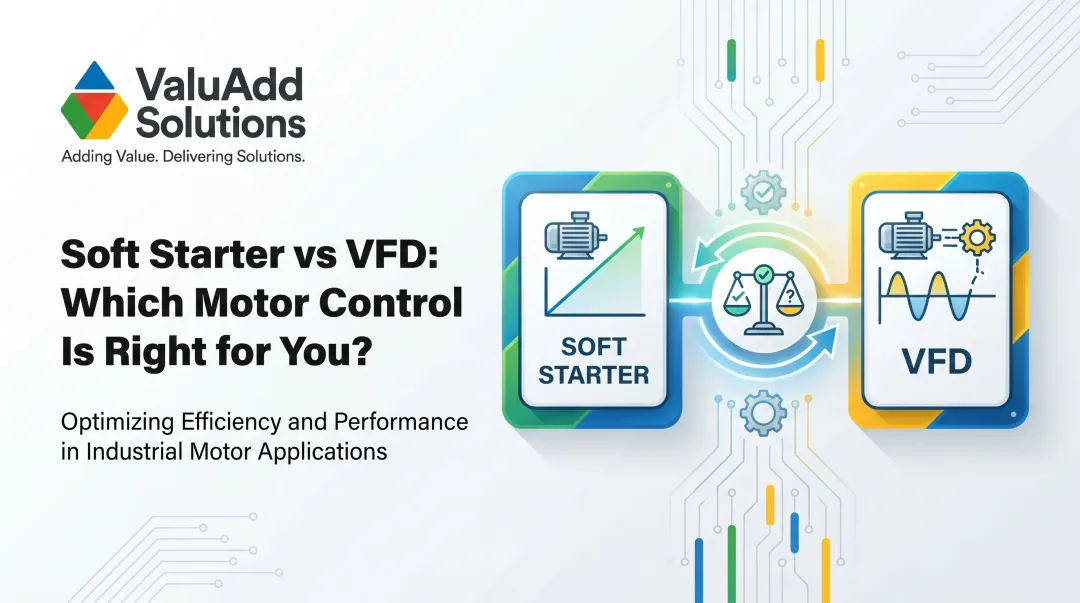
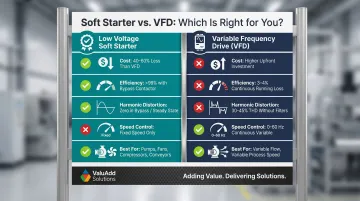
The fundamental distinction is simple: a soft starter controls only the acceleration and deceleration phases—the motor always runs at a single, fixed speed determined by line frequency (60 Hz in the US). A VFD controls motor speed continuously throughout operation by varying output frequency from 0–60 Hz or beyond. If your application requires variable speed at any point during operation—adjusting pump flow, matching conveyor speed to production rate, ramping fan speed with temperature—a VFD is the correct choice, not a soft starter.
For fixed-speed applications, however, soft starters offer compelling advantages across cost, efficiency, and power quality.
Cost, Complexity, and Efficiency
Soft starters cost 40–60% less than equivalent VFDs. Installation is simpler—no output reactors, no harmonic filters, no special motor cables. A soft starter with a closed bypass contactor operates at over 99% efficiency with negligible heat loss, while VFDs exhibit 3–4% continuous running losses due to AC-DC-AC conversion and switching losses.
Harmonic Distortion
VFDs generate continuous harmonic distortion. Base-model 6-pulse VFDs without mitigation exhibit 30–45% Total Harmonic Distortion (THD), requiring expensive harmonic filters to meet IEEE 519 limits. Soft starters generate harmonics only during the brief starting ramp; in steady-state bypassed operation, harmonic distortion is zero.
Practical Decision Framework
Choose a soft starter when:
- Application requires fixed-speed operation (rated-speed pumps, exhaust fans, fixed-ratio compressors)
- Starts are infrequent (below 10 per hour for standard-duty units)
- Speed control is not required during running operation
- Harmonic distortion must be minimized without added filter costs
- Installation and maintenance simplicity are priorities
A VFD is the better fit when:
- Application requires variable flow with speed adjustment based on demand
- Conveyor or process speed must match variable production line rates
- Continuous speed modulation is required for precise process control
- Energy savings from reduced-speed operation outweigh the efficiency loss at full speed
How to Select the Right Low Voltage Soft Starter
Primary Sizing Rule
The soft starter's continuous current rating must equal or exceed the motor's Full Load Ampere (FLA) rating found on the motor nameplate. For standard-duty applications—pumps, fans, and compressors with normal starting torque—select the soft starter based on motor rated power.
For heavy-duty loads with high breakaway torque or extended acceleration times—crushers, ball mills, loaded conveyors, high-inertia centrifugal equipment—specify one frame size larger than the motor's rated power to provide adequate thermal margin for the SCRs.
Secondary Selection Checklist
| Parameter | Specification Requirement |
|---|---|
| Voltage Rating | Match supply voltage: 208V, 230V, 460/480V, 575/600V (common US ratings) |
| Starts per Hour | Verify model's thermal capacity matches application duty cycle (typically 10–20 starts/hour for standard units) |
| Bypass Contactor | Built-in bypass standard in most units; confirm if external bypass is required for specific installations |
| Protection Functions | Overload, phase-loss, phase-reversal, ground fault; thermistor input for external temperature monitoring |
| Communication Interface | RS-485/Modbus-RTU for PLC or SCADA integration (standard in modern industrial facilities) |
Application Environment and Certification
In water treatment, oil and gas, or outdoor industrial installations, confirm the unit's enclosure rating matches environmental exposure:
- NEMA 12: Indoor, dust-tight, protects against oil and coolant seepage (standard for manufacturing)
- NEMA 3R: Outdoor, rain-tight, ice-resistant (suitable for exposed installations)
- NEMA 4X: Corrosion-resistant stainless steel, hose-down capable (required for chemical plants, offshore platforms)
Verify applicable certifications: UL Listing for US installations, CE marking for international compliance. ValuAdd's CSXi Series carries both certifications, supports motor currents up to 60A with control voltages of 380/440 VAC, and includes built-in motor protection that eliminates the need for external overload devices.
For non-standard applications—multiple motors on a single starter, cable runs exceeding 300 feet, or motors with unusual service factors—consult ValuAdd's engineering team for specification validation. Territory-based technical support is available to review application requirements before finalizing your selection.
Frequently Asked Questions
How do reduced voltage soft starters work?
Reduced voltage soft starters use thyristors (SCRs) connected in anti-parallel pairs to deliver progressively increasing voltage to the motor during startup, beginning below full line voltage and ramping up over a configurable time period. This controls the rate of current and torque buildup rather than applying full voltage instantly.
Do soft starters really work?
Yes, properly sized and configured soft starters work. They reduce inrush current from the 600–700% typical of DOL starts down to approximately 300–400% of rated current, measurably reducing mechanical wear on driven equipment and electrical stress on supply systems. Field data confirms soft starters can extend equipment life by 20–30%.
Can a soft start damage a motor?
A correctly sized and configured soft starter protects motors rather than damaging them. Damage occurs only when the unit is undersized, ramp settings are misconfigured, or starts-per-hour limits are exceeded — all of which proper specification avoids.
What is the difference between a soft starter and a VFD?
A soft starter manages only the start and stop phases; the motor then runs at a fixed speed set by line frequency. A VFD varies frequency to control speed continuously throughout operation. Choose a VFD when variable speed is required during running; choose a soft starter when fixed-speed operation with controlled starts is sufficient.
How do you size a low voltage soft starter for a motor?
The soft starter's rated current must match or exceed the motor's Full Load Ampere (FLA) rating — for high-inertia loads like crushers or loaded conveyors, go one frame size larger. Also confirm voltage rating, starts-per-hour capacity, and required protection features align with the application.