Introduction
Starting a large 2.3kV–15kV induction motor across-the-line creates a significant electrical and mechanical challenge. Direct-on-line (DOL) starting draws enormous inrush current, typically 6 to 8 times the motor's rated full load current, with values occasionally exceeding 10 times FLC.
This surge causes voltage dips that destabilize nearby equipment. Research shows that sequential DOL starting of eight 1,795 kW, 11kV motors produces a cumulative voltage sag of up to 4.5%, enough to disrupt sensitive instrumentation and trip protective devices.
The mechanical consequences are equally severe. DOL starting generates peak torque of 200% nominal, producing violent shocks that accelerate wear on couplings, shafts, gearboxes, and driven loads.
Vibration amplitude at the motor base increases by approximately 35% compared to soft starting methods, shortening equipment life and increasing unplanned downtime.
This guide explains how medium voltage soft starters solve both problems—using silicon controlled rectifier (SCR) technology to ramp voltage gradually, limiting inrush current and eliminating torque transients. We'll cover how these devices work, how they compare to VFDs and electromechanical starters, and how engineers and system integrators can select the right unit for 2.3kV to 15kV applications.
TLDR:
- SCR-based voltage ramping limits inrush current to 3–4× FLC vs. 6–8× with DOL starting
- Reduces voltage sag, mechanical shock, and vibration by up to 35% compared to across-the-line starting
- Best suited for fixed-speed loads (pumps, fans, compressors) where variable speed isn't needed
- Selection hinges on voltage class, current rating, control mode, and protection features for your duty cycle
What Is a Medium Voltage Soft Starter and How Does It Work?
A medium voltage soft starter is an electronic motor controller using silicon controlled rectifiers (SCRs or thyristors) to gradually ramp the voltage—and therefore current—supplied to a three-phase squirrel cage induction motor during start and stop cycles. Unlike across-the-line starters that apply full line voltage instantly, soft starters deliver a controlled voltage increase from near-zero to 100%, eliminating the inrush current spike and impulsive torque that damage equipment.
Medium voltage encompasses motors operating between 2.3kV and 15kV. IEEE and ANSI standards define medium voltage as greater than 1,000V and less than 100kV, but the practical industrial range for motor control covers 2.3kV, 4.16kV, 6.6kV, 11kV, 13.8kV, and 15kV—voltage classes standardized by NEMA MG-1.
Motors in this range typically start at 250 HP and scale upward, serving high-power applications where low voltage motors would require impractically high currents.
ValuAdd's MVE-P Series soft starters support the full 2.3kV to 15kV range (±10% tolerance), with models rated for motors up to 25,000 HP at 13.8kV in the CBMVRX Series, addressing the heaviest industrial loads.
SCR Configuration and Phase Angle Control
Each phase of a medium voltage soft starter uses a back-to-back SCR pair—two thyristors wired in antiparallel (one for each half-cycle of the AC waveform). This arrangement allows the control module to regulate the voltage waveform in both directions, enabling stepless voltage control from near-zero to full line voltage.
The control system uses phase-angle firing: during each half-period of the voltage sine wave, the firing signal is sent progressively earlier. Early in the start sequence, the SCRs fire late in each half-cycle, allowing only a small portion of the voltage waveform through. As the start progresses, the firing angle advances, passing more voltage until the full sine wave reaches the motor. Because voltage controls current, this method eliminates the current and torque transients that plague electromechanical reduced-voltage starters.
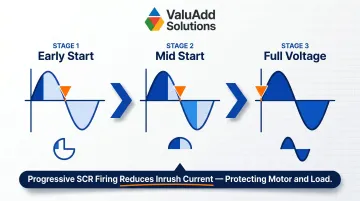
ValuAdd's MVE-P Series soft starters limit inrush to a maximum of 400% FLC for up to 30 seconds, versus the 600–800% inrush of DOL starting.
Open Loop vs. Closed Loop Control Modes
Open loop control follows a preset voltage ramp or voltage step without feedback. The user defines a start voltage (typically 30–50% of line voltage) and a ramp time (e.g., 10–60 seconds), and the soft starter increases voltage linearly over that interval. This method is simple and works well for low-to-moderate inertia loads.
Its key limitation: acceleration rate depends entirely on motor and load characteristics. If load inertia exceeds expectations, the motor may not reach full speed before the voltage ramp completes—leaving it running below synchronous speed with insufficient voltage for stable operation.
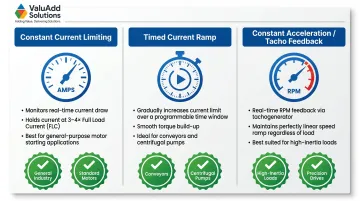
Closed loop control adds one or more feedback loops—typically current transformers (CTs) on the motor leads—that allow the starter to dynamically adjust output voltage to maintain a target parameter. Three common closed loop modes are:
- Constant current limiting: The starter monitors motor current and adjusts voltage to hold current at a user-defined multiple of FLC (e.g., 3× or 4× FLC). This protects upstream electrical infrastructure from excessive inrush and is the most common mode for general-purpose applications.
- Timed current ramp: The starter gradually increases the current limit over the start interval, delivering gentle acceleration ideal for conveyors, pumps, and loads sensitive to sudden torque changes.
- Constant acceleration (tachogenerator feedback): A speed sensor provides real-time RPM data, enabling the soft starter to deliver a linear speed ramp. This mode is best for high-inertia loads (flywheels, large fans, ball mills) where precise control of acceleration rate is critical.
Bypass Contactor Role
Once the motor reaches full running speed and voltage, a bypass contactor (or circuit breaker in some designs) closes to connect the motor directly to the line. This removes the SCRs from the power path, eliminating switching losses and heat generation during steady-state operation. The bypass function extends soft starter component life by limiting SCR duty cycle to the short start and stop intervals—typically 30–90 seconds per start—rather than continuous operation.
ValuAdd's MVE-P Series includes integrated bypass contactors with fiber-optic isolation, ensuring safe transitions and zero steady-state losses.
Key Benefits of Medium Voltage Soft Starters for 2.3kV–15kV Applications
Electrical System Protection
Soft starters limit starting current to a selectable multiple of motor FLC—typically 3× to 4× instead of the 6–8× inrush of DOL starting. This prevents supply voltage dips that affect other equipment on the same bus, eliminating nuisance trips and process interruptions.
Lower inrush current delivers infrastructure cost savings across the distribution system:
- Specify transformers with lower short-circuit capacity due to reduced starting kVA
- Downsize feeder cable conductors where lower peak current allows it
- Rate circuit breakers and contactors closer to running current rather than peak inrush
Together, these reductions cut both capital cost and installation complexity—often enough to offset a significant portion of the soft starter's purchase price.
Mechanical Drivetrain Protection
Smooth, stepless torque buildup eliminates the impulsive transients of star-delta or autotransformer starting. Research shows that soft starting reduces peak torque from 200% (DOL) to approximately 120% of nominal, and cuts vibration amplitude by roughly 35%. This directly translates to:
- Extended coupling and gearbox life (fewer shock loads)
- Reduced belt slip and wear on belt-driven loads
- Lower stress on pump impellers, fan blades, and conveyor systems
- Fewer emergency repairs and longer intervals between scheduled maintenance
Soft Stop Capability
Controlled voltage ramp-down during stopping eliminates water hammer in pipeline and pumping systems—a critical advantage in water treatment and process industries. Soft stop extends the deceleration time, gradually reducing motor speed and torque to minimize sudden changes in flow velocity. Left unchecked, those pressure surges can rupture piping and destroy valves—costly failures that soft stop directly prevents.
Soft stop vs. coast-to-stop: Soft stop actively controls deceleration by ramping voltage down over a set interval (e.g., 10–30 seconds). Coast-to-stop simply removes power and allows the motor to decelerate under load inertia alone. Use soft stop for fluid systems sensitive to pressure transients; use coast-to-stop for mechanical loads where controlled deceleration isn't required.
Integrated Motor Protection
Modern MV soft starters include comprehensive protection functions that reduce the need for external relay devices:
- Thermal overload (Classes 10, 20, 30) using electronic thermal models
- Phase loss and imbalance detection
- Ground fault protection (residual current method)
- Stall and locked rotor protection
- Start time supervision (prevents prolonged high-current conditions)
- Undercurrent/load loss detection
- Shorted SCR detection
ValuAdd's MVE-P Series incorporates all of these functions in a single unit, with a color touchscreen interface that walks technicians through commissioning step by step and displays live fault diagnostics without requiring external test equipment.
Compliance and Enclosure Options
MV soft starters designed to IEEE 519 harmonic standards and housed in NEMA-rated enclosures address utility interconnection requirements and harsh-environment installations. SCR soft starters generate harmonics only during short start and stop transients, and produce zero harmonics once bypassed. As a result, they generally stay well within IEEE 519 long-term operational limits, which set a 5.0% voltage THD ceiling for buses rated 1kV–69kV.
ValuAdd offers IEEE 519-compliant, UL Listed MV soft starter solutions in NEMA 1, NEMA 12, and NEMA 3R enclosures, with outdoor-rated options for outdoor installations.
Medium Voltage Soft Starters vs. VFDs vs. Reduced Voltage Starters
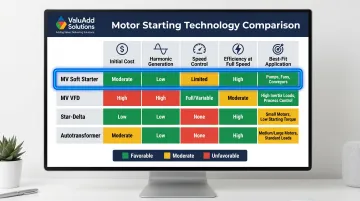
Engineers choosing motor starting technology for 2.3kV–15kV motors must weigh starting performance, steady-state efficiency, harmonic impact, cost, and maintenance complexity.
| Technology | Initial Cost | Harmonic Generation | Speed Control | Energy Efficiency at Full Speed | Complexity | Best-Fit Application |
|---|---|---|---|---|---|---|
| MV Soft Starter | Baseline | Transient only (during start/stop) | None (fixed speed) | Zero added loss (bypassed) | Low | Fixed-speed pumps, fans, compressors |
| MV VFD | 2–3× soft starter | Continuous (requires mitigation) | Full variable speed | High (when running at reduced speed) | High | Variable flow/pressure control, energy savings at part load |
| Star-Delta | Low | None | None | Zero added loss | Moderate | Low-torque loads, ≤33% starting torque acceptable |
| Autotransformer | Moderate | None | None | Zero added loss | Moderate | Moderate-torque loads, limited tap selection |
When to Choose a Soft Starter Over a VFD
Choose a soft starter for fixed-speed applications where the motor runs at rated speed continuously: municipal water booster pumps, constant-flow HVAC fans, fixed-speed compressors, and conveyor drives. Soft starters are 2 to 3 times less expensive than MV VFDs and produce transient harmonics only during starting, eliminating the need for active harmonic filters.
The maintenance profile is simpler than a VFD by design: no DC bus capacitors, no PWM switching components, no continuously running cooling fans. After bypass, the soft starter introduces zero additional loss in the power path.
When a VFD Is the Better Choice
Select a VFD for process-driven applications requiring continuous speed variation: variable flow control in HVAC systems, variable pressure in pipeline networks, or processes where energy savings from reduced-speed operation justify the higher capital cost. VFDs continuously control both voltage and frequency, enabling precise speed regulation—and for centrifugal loads, power consumption scales with the cube of speed, which drives real savings at part load.
However, unfiltered 6-pulse VFD input current THID can reach up to 90%, requiring harmonic mitigation to meet IEEE 519 limits.
ValuAdd offers medium voltage VFD solutions—the MVH2 Series (up to 1,500 HP at 4.16kV) and M2L Series (300–12,000 HP, up to 7.2kV)—using H-Bridge multi-level technology for applications where variable speed control is the priority. Where variable speed isn't required, electromechanical reduced voltage starters remain an option—though each comes with meaningful tradeoffs.
Why Electromechanical Reduced Voltage Starters Fall Short
Star-delta starters reduce voltage to 58% (1/√3) during the star configuration, delivering approximately 33% of DOL starting torque. Switching from star to delta causes a momentary power interruption and rapid current change, generating high torque peaks and the characteristic transition "clunk" that stresses mechanical components. Star-delta starters cannot match the stepless control of SCR-based soft starters and offer no integrated protection or communication features.
Autotransformer starters provide taps at 50%, 65%, and 80% of line voltage, delivering 25%, 42%, and 64% starting torque respectively. Unlike SCR soft starters, autotransformers provide stepped voltage rather than stepless acceleration, and involve large, costly transformer banks that increase footprint and maintenance requirements.
Key Industries and Special Applications
Water and Wastewater Treatment
Large vertical turbine pumps, submersible pumps, and booster station motors in the 2.3kV–13.8kV range benefit from soft start to limit current transients on utility feeders and from soft stop to prevent water hammer in distribution mains.
One desalination plant case study illustrates the impact: eight 3,000 kW, 6.6kV pumps equipped with closed-loop MV soft starters maintained starting current at 2.5× FLC, supported 300-second ramp times, and held water pressure increases to ≤1 bar/sec — protecting both piping and reverse osmosis membranes.
ValuAdd's MVE-P Series addresses this application with NEMA 3R outdoor enclosures and motor protection designed for municipal water infrastructure.
Oil and Gas, Mining, and Heavy Industry
MV soft starters serve large compressors, induced draft fans, ball mills, conveyors, and shredders across these sectors. Two special application cases stand out in this sector:
Forward/Reverse Operation
Two interlocked circuit breakers pre-select phase sequence, enabling direction changes through a single soft starter:
- One breaker feeds phases A-B-C for forward rotation; the second feeds A-C-B for reverse
- Electrical interlocks prevent simultaneous closure
- Eliminates the need for separate soft starters per direction, reducing capital cost
Multi-Motor Sequential Starting
A single soft starter can sequentially start multiple motors of equal rating, each bypassed after reaching full speed:
- A PLC master controller manages the start sequence
- Supports up to five motors per soft starter
- Cuts equipment costs significantly while retaining individual overload protection per motor
Manufacturing and Processing Plants
Slip-ring (wound rotor) motor control using a soft starter's dual-ramp function modernizes aging mechanical resistance starter systems. The control sequence involves:
- Ramp voltage with rotor resistance in circuit
- Transition to a second ramp once rotor resistance is shorted
- Achieve smooth acceleration with fewer maintenance demands than traditional liquid or grid resistors
ValuAdd's standard MV soft starter controllers include dual-ramp starting for wound rotor applications, extending soft starter capability beyond squirrel cage motors.
How to Select and Size a Medium Voltage Soft Starter
Selecting the right MV soft starter involves three areas: matching electrical ratings to your motor, specifying protection and communication needs, and planning for installation. Each step directly affects long-term reliability.
Core Sizing Parameters
The soft starter's rated voltage must match the motor nameplate exactly—2.3kV, 4.16kV, 6.6kV, 11kV, 13.8kV, or 15kV. ValuAdd's MVE-P Series covers the full range with ±10% tolerance.
Base current selection on motor full load current (FLC) from the nameplate, then apply margin for starting duty cycle. Key considerations include:
- Number of starts per hour: NEMA MG-1 Section 12.54 requires motors to withstand 2 consecutive cold starts and 1 hot start
- Start duration: Longer ramp times (30–90 seconds) impose higher thermal stress on SCRs
- Load inertia: High-inertia loads require extended acceleration times, increasing soft starter duty
Manufacturer specifications indicate that heavy-duty MV soft starters should provide overload capacity of 500% for 60 seconds and 600% for 30 seconds. For high-inertia or frequent-start applications, oversizing by one current class is standard practice. ValuAdd's technical team provides application-specific sizing tables on request.
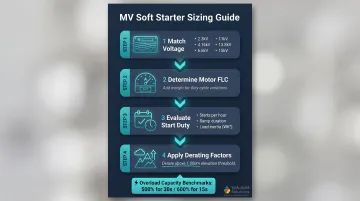
Above 1,000 meters, apply current derating — thinner air reduces cooling efficiency enough to affect SCR thermal limits at rated load.
Protection, Communication, and Enclosure Requirements
Specify protection features before ordering — not all soft starters include the same relay functions. ValuAdd's MVE-P Series includes:
- Electronic thermal overload (Classes 10, 20, 30)
- Phase imbalance, phase loss, and phase reversal detection
- Ground fault protection (residual current method)
- Undercurrent/load loss detection
- Stall and locked rotor protection
- Start time supervision
- Shorted SCR detection
Relevant standards include IEC 60947-4-2 for semiconductor motor controllers and IEEE C37.96 for AC motor protection.
Communication protocols: ValuAdd's MVE-P Series supports Modbus, Profibus, and Ethernet/IP — confirm which protocol your DCS or SCADA system requires before specifying a model. Contact ValuAdd's team to verify compatibility with your specific configuration.
Match the enclosure rating to the installation environment before finalizing the order:
- NEMA 1: Indoor, general purpose
- NEMA 12: Indoor, dust and drip protection
- NEMA 3R: Outdoor, rain/sleet/snow protection
ValuAdd's MVE-P Series is available in all three ratings. Washdown or hazardous-area applications (NEC Class I/II) require additional enclosure specifications — contact ValuAdd for those configurations.
Installation and Commissioning Best Practices
Pre-energization checks:
- Verify correct phase rotation before energizing (incorrect rotation can damage driven equipment)
- Set initial voltage (30–50% line voltage) and ramp time (10–60 seconds) appropriate for load inertia
- Confirm bypass contactor timing sequence
- Complete pre-start protection relay coordination with upstream devices
Preventive maintenance program:
- Periodic inspection of SCR assemblies (thermal imaging for hot spots)
- Cooling system verification (fan operation, filter cleaning)
- Control wiring termination checks (torque verification)
- Protection function testing (trip point verification)
The MVE-P Series uses a modular SCR assembly design, so individual power modules can be swapped without disturbing the full enclosure. Built-in test modes let technicians simulate control circuit faults without applying high-voltage power.
Frequently Asked Questions
What is considered a medium voltage motor?
Medium voltage motors generally operate between 2.3kV and 15kV, though some standards define the range as 1kV–35kV. These motors are used for high-power industrial loads typically above 250–300 HP and are governed by standards such as NEMA MG-1 and IEC 60034.
How does a medium voltage soft starter differ from a variable frequency drive (VFD)?
A soft starter only controls voltage during starting and stopping; the SCRs are bypassed at full speed, eliminating steady-state losses. A VFD continuously controls both voltage and frequency to vary motor speed throughout operation, making soft starters the lower-cost choice for fixed-speed applications.
Can a medium voltage soft starter be bypassed after the motor reaches full speed?
Yes. A bypass contactor or circuit breaker closes once the motor reaches rated speed, routing current directly from the supply to the motor and removing the SCRs from the power path. This eliminates switching losses during steady-state operation and extends component life.
What built-in protection features should a medium voltage soft starter include?
Key protection functions include thermal overload (electronic thermal models), phase loss and imbalance detection, ground fault protection, stall and locked rotor protection, and start time supervision. Integrated protection reduces the number of external relays, wiring connections, and panel space required in the motor control assembly.
How do I size a medium voltage soft starter for my motor?
The soft starter must match the motor's voltage class and rated current, with additional derating for high-inertia loads or frequent starts. Reference the motor nameplate FLC and consult manufacturer sizing tables or IEC/NEMA guidelines for duty cycle. ValuAdd's engineers can review your motor nameplate data and duty cycle to recommend the correct starter rating.
What are the most common applications for medium voltage soft starters?
Common applications include centrifugal pumps in water and wastewater treatment, large compressors and fans in oil and gas, conveyors and mills in mining, and multi-motor starting systems in processing plants.