
Selecting the right busbar isn't just a procurement decision. It affects energy losses, thermal stress on downstream equipment, maintenance access, and compliance with standards governing everything from enclosure ratings to harmonic distortion. Get it wrong, and the consequences show up in heat, voltage drop, and unplanned downtime.
This guide covers what a busbar is, the four main types, copper versus aluminum trade-offs, and how to match the right configuration to your specific application — whether that's a motor control center, outdoor substation, or power electronics cabinet.
Key Takeaways
- A busbar is a rigid metallic conductor that distributes electrical current from a single source to multiple circuits within switchgear, panels, and power distribution systems.
- Four primary types exist: flat strip, tubular, sandwich/laminated, and plug-in busway, each suited to different current ranges, environments, and installation needs.
- Aluminum conducts at roughly 61% of copper's capacity by cross-section, requiring about 1.6× the area for equivalent current capacity.
- Loose or dirty connections account for more than 30% of electrical failures, making joint integrity as important as conductor selection.
- Match type, material, current rating, and enclosure rating to the operating environment, not just the load schedule.
What Is a Busbar?
A busbar is a rigid metallic strip or bar (typically copper or aluminum) that acts as a central conductor, distributing electrical current from a source to multiple circuits simultaneously. You'll find them inside switchgear, panel boards, motor control centers, substations, and data center power distribution units.
Core Components of a Busbar System
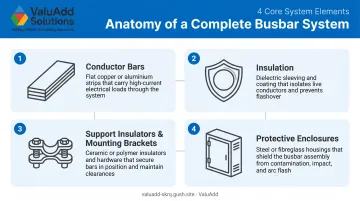
A complete busbar system isn't just the conductor. It includes:
- Conductor bars in flat strip, tubular, or laminated form, sized to the current rating
- Insulation via air gap separation, epoxy coating, or thermoplastic housing, depending on voltage class
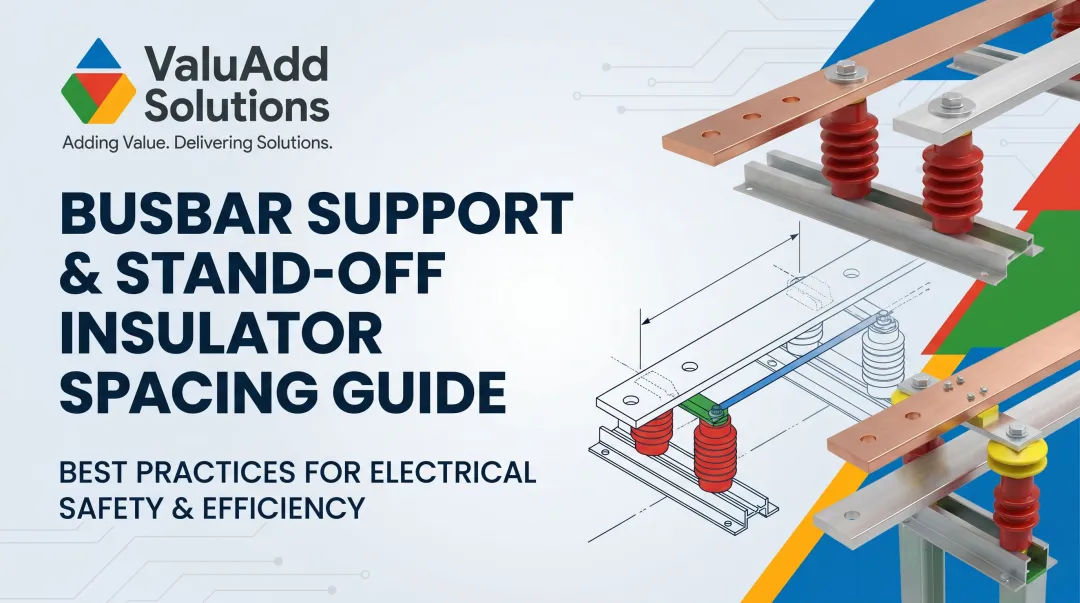
- Support insulators and mounting brackets that maintain phase spacing and absorb mechanical forces under fault conditions
- Protective enclosures rated for the installation environment: indoor, outdoor, washdown, or corrosive
Current ratings span a wide range. CDA's copper busbar ampacity tables cover dimension-specific ratings for low-voltage panel work, while Eaton's Pow-R-Way III low-voltage busway handles 225A to 5,000A, and IEEE C37.23 metal-enclosed bus assemblies cover DC applications up to 15,000A. ValuAdd's own portfolio, including the NOARK MxS Series switchboards, supports main bus ratings to 5,000A, covering small industrial panels through heavy feeder applications.
Why Busbars Are Critical in Industrial Power Distribution
The physics is straightforward. A busbar's large cross-sectional area minimizes resistance, which reduces heat generation and keeps voltage stable across high-demand systems — something a bundle of parallel cable runs struggles to match at scale.
Eaton notes that solid-phase busway bars produce lower impedance than cable and conduit, translating to lower voltage drop across the run. In facilities running variable frequency drives, soft starters, and motor control centers, that directly affects harmonic compliance margins. IEEE 519 sets harmonic voltage and current distortion limits at the point of common coupling — and a poorly designed distribution path that introduces additional impedance makes harmonic compliance harder to achieve.
The Real Cost of Poorly Specified Busbars
Without properly designed busbars, industrial systems face:
- Higher voltage drops across distribution runs
- Excessive heat buildup at connection points
- More termination points per circuit — each a potential failure mode
- Reduced flexibility when adding or moving equipment loads
HSB's electrical maintenance data shows it clearly: loose and dirty connections create high-resistance paths responsible for more than 30% of electrical failures. That figure applies directly to busbar joints and terminations, not just wire connections — which is why connection integrity is as important as conductor sizing in any busbar specification.
Types of Busbars Explained
Busbar configurations aren't interchangeable. Each type is engineered for a specific range of current, physical environment, and installation requirement. Using the wrong type creates performance gaps, not just cost inefficiency.
Flat Strip Busbars
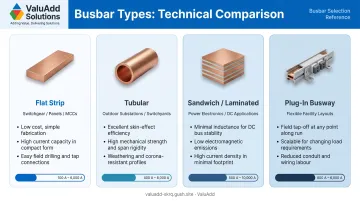
Flat strip busbars are rectangular conductors arranged in parallel, separated by air gaps or insulation spacers. They're the most common configuration in switchgear, distribution panels, and motor control centers.
Strengths:
- Easy to fabricate, inspect, and maintain
- Flat geometry maximizes surface area for natural convection cooling
- Straightforward to tap and terminate
- Cost-effective for standard panel builds
Limitations:
- Less mechanically rigid over long unsupported spans
- The AC skin effect (verified by CDA's 60Hz ampacity correction factors) reduces efficiency in very thick cross-sections at higher current levels
- Require careful phase spacing to manage magnetic forces under fault conditions
Tubular Busbars
Tubular busbars are hollow cylindrical conductors (round or square in cross-section) used primarily in outdoor substations, switchyards, and high-current applications where mechanical strength and span length matter as much as current capacity.
AFL specifies 6063-T6 aluminum alloy as the standard material for outdoor tubular bus, citing its balance of mechanical rigidity and electrical conductivity. That material choice enables a wide ampacity range: an IEEE 605 substation design example references a tubular aluminum bus rated at 1,889A — proof that tubular designs serve mid-range applications, not just ultra-high-current installations.
Strengths:
- Superior mechanical rigidity allows longer spans between supports
- Hollow design improves stiffness-to-weight ratio
- Even current distribution around the circumference reduces hot spots
Limitations:
- Higher fabrication cost and more complex connection hardware
- Less practical for compact indoor panel environments
Sandwich (Laminated) Busbars
Sandwich busbars stack multiple flat conductors with thin dielectric insulation layers between them, bonded into a compact, low-profile assembly. They're the standard choice for power electronics cabinets, inverter assemblies, and high-current DC applications.
IEEE Transactions on Power Electronics identifies wiring inductance as having critical effects on electrical, thermal, and EMC performance in inverters, describing low stray-inductance laminated busbars as a primary pathway interface. Mersen's laminated IGBT busbar designs deliver low-inductance DC power within confined areas. The close conductor spacing is what suppresses voltage spikes in switching applications.
ValuAdd offers two laminated busbar formats built for demanding environments:
- Isoflexx® laminated busbars — cross-sections from 21.6 to 1,200 mm², heat resistance to 190°C (Premium), UL 758 and UL 508 approved, with a 40% smaller cross-section vs. equivalent cables
- Ultraflexx® flexible busbars — Cu-ETP1 copper mesh with press-welded connections, rated -55°C to +125°C and up to 1,500VDC for high-vibration or thermally demanding installations
Limitations:
- More complex and expensive to manufacture than flat strip
- Typically factory-built to specification — field modifications are costly
Plug-In (Busway) Busbars
Plug-in busway systems are enclosed, modular busbar runs with tapping points distributed along their length. Equipment connects or disconnects at any tap point without interrupting the full system.
UL 857 covers construction and manufacturing requirements for certified busway designs. Eaton's track busway reaches up to 1,000A at 600V, while industrial feeder busway like Pow-R-Way III reaches 5,000A — so the right comparison depends on whether you're specifying a flexible tap-off system or a high-capacity feeder run.
Strengths:
- Exceptional flexibility for facilities with evolving equipment layouts
- Circuits added, moved, or removed without major electrical work
- Supports incremental capacity expansion
Limitations:
- Higher upfront system cost than fixed configurations
- Tap-off units add connection points requiring ongoing maintenance
- Requires careful layout planning at the design stage
Copper vs. Aluminum Busbars: What the Material Choice Really Means
Material choice directly affects installation space, maintenance frequency, and long-term connection reliability — not just upfront cost.
Conductivity and Size
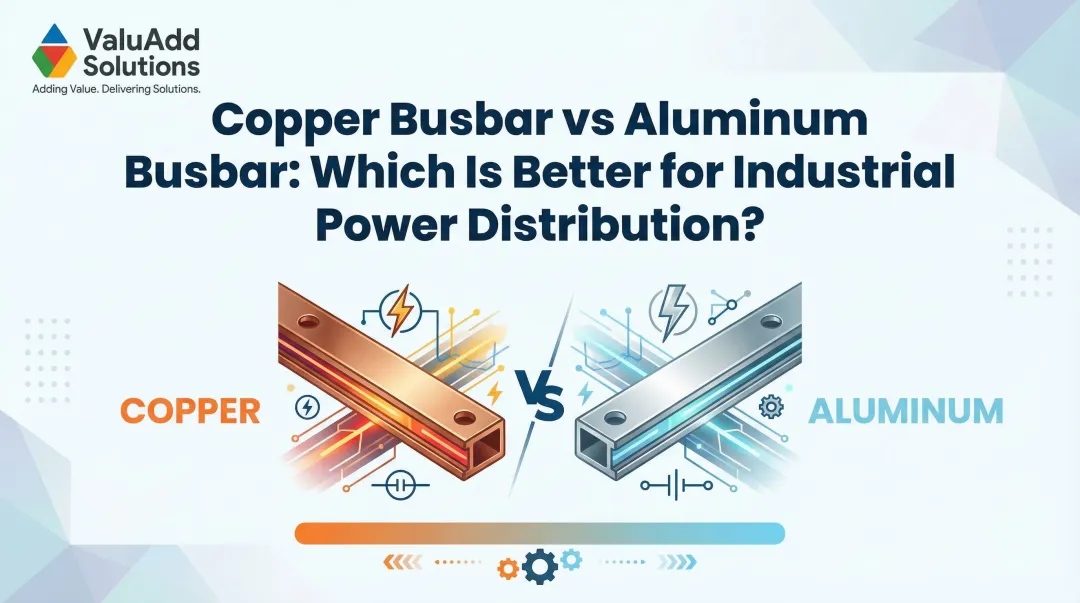
CDA data establishes that aluminum conductivity is 61% that of copper. To carry equivalent current, an aluminum busbar needs roughly 1.6× the cross-sectional area of a copper equivalent. In a tight panel or switchgear enclosure, that extra volume has real consequences for layout.
Weight and Cost
Wesco reports that equal-conductivity aluminum conductors weigh about half as much as copper. That weight advantage matters in large outdoor installations and applications where structural load is a constraint. Aluminum's lower material cost per unit of current-carrying capacity also makes it attractive for budget-sensitive projects and long distribution runs.
Connection Reliability: What Testing Shows
This is where aluminum's advantages have a real cost. CDA's Powertech Labs testing (60 samples, 1,500 heating/cooling cycles at 280A) found:
- Copper wire with copper connectors: No failures
- Aluminum wire with AL/CU mechanical connectors: Over 90% failure or elevated resistance/temperature

The best aluminum connection performance required wire-brushing the conductor surface, applying oxide inhibitor, and using 125% rated torque. For facilities running continuous processes, that preparation protocol adds real labor overhead at every connection point.
Practical Selection Guideline
| Application | Recommended Material |
|---|---|
| Indoor industrial panels, MCCs | Copper |
| Corrosive environments (oil and gas, water treatment, coastal) | Copper |
| High-vibration applications | Copper (or flexible copper busbar) |
| Large outdoor distribution runs | Aluminum |
| Budget-sensitive long feeder runs in controlled environments | Aluminum |
| Applications where structural load matters | Aluminum |
ValuAdd's rigid copper bars (Socomec) specify 58 MS/m electrical conductivity — aligned with ETP copper's verified 101% IACS rating — making them well-suited for the high-reliability indoor panel and MCC applications common in manufacturing and water treatment facilities.
How to Choose the Right Busbar for Your Application
Start with Current Rating and Voltage Class
NEC 210.20(A) requires that overcurrent devices — and by extension, the busbar systems they protect — be rated for noncontinuous load plus 125% of continuous load. Always base selection on verified load studies, not equipment nameplates. For busway installations, confirm compliance with UL 857 and applicable NEMA enclosure requirements for the installation environment.
Match Busbar Type to Physical and Operational Demands
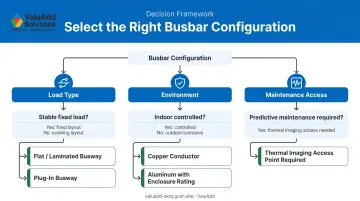
- Flat strip — standard indoor panel work, MCCs, switchgear
- Tubular — long outdoor spans, substations, switchyards
- Sandwich/laminated — compact power electronics cabinets, high-current DC applications, VFD and inverter assemblies
- Plug-in busway — facilities with frequently changing equipment layouts
Busbar type selection also affects power quality downstream. When integrating with VFD and soft starter products — including Benshaw's IEEE 519-compliant drives — the busbar system must deliver stable, low-impedance power to prevent harmonic distortion from compounding at the point of common coupling. This concern is most acute in water treatment and manufacturing facilities where multiple nonlinear loads share the same distribution path. ValuAdd's drive portfolio is built around these requirements.
Match Enclosure Rating to the Environment
| Environment | Minimum Enclosure Rating |
|---|---|
| Indoor, dust and dripping liquids | NEMA Type 12 |
| Indoor/outdoor, corrosion and hose-directed water | NEMA Type 4X |
| Outdoor, dust-tight and water jet exposure | IP65 / IP66 |
| Continuous immersion | IP68 |
ValuAdd's portfolio includes NEMA Type 4X and IP65/66/68-rated components — the same protection levels required for busbar enclosures in washdown, chemical, and outdoor environments.
Factor In Long-Term Maintenance Access
- Fixed loads with stable layouts: optimize on flat strip or laminated designs
- Evolving production layouts: plug-in busway pays back its higher upfront cost through reduced reconfiguration labor
- All installations: ensure thermal imaging access to connection points without full system shutdown — a requirement in any predictive maintenance program
Common Mistakes to Avoid When Specifying a Busbar
Three specification errors account for the majority of busbar failures and cost overruns in industrial installations.
Size to actual demand, not nameplate ratings. Connected load nameplates routinely overstate real demand. Using nameplate data produces either an oversized (costly) or undersized (thermally overloaded) system. Base selection on verified load studies with the 125% continuous load factor applied.
Match enclosure type to the actual environment. NEMA Type 12 and Type 4X provide materially different protection levels — one handles indoor dust and dripping liquids, the other handles corrosion and hose-directed water. Specifying Type 12 for a water treatment chemical room leads to accelerated insulation degradation and corroded connection points.
Treat each project as a fresh evaluation. Industrial retrofits and expansions frequently inherit busbar types that made sense for the original installation but no longer match current ratings, layout flexibility requirements, or environmental conditions. Copy-pasting the last spec is a reliable path to an undersized or non-compliant system.
Frequently Asked Questions
What is the difference between a busbar and a bus duct?
A busbar is the conductor itself — the metal bar or strip that carries current. A bus duct (or busway) is the complete enclosed assembly containing factory-mounted busbars with protective covers and tap-off points along its length. The busbar is a component; the bus duct is the system built around it.
What current ratings do industrial busbars typically handle?
Industrial busbars range from roughly 100A in small panel applications up to 15,000A in heavy DC metal-enclosed bus assemblies per IEEE C37.23. The conductor's cross-sectional area and material type determine the rating — there's no single universal range.
Can busbars be used in outdoor or harsh environments?
Yes, when housed in appropriately rated enclosures — NEMA Type 4X and IP65/66/68 cover outdoor, corrosive, and washdown conditions. Copper outperforms aluminum in corrosive environments, and joint protection compounds are essential for aluminum connections wherever moisture or chemicals are present.
What is the skin effect and why does it matter for busbar design?
At AC frequencies (50–60 Hz), current concentrates near a conductor's outer surface rather than distributing evenly through its cross-section. CDA's 60 Hz ampacity tables apply a skin-effect correction ratio to account for this, which is why flat, hollow tubular, and laminated shapes are standard in higher-current AC applications — they maximize usable surface area.
How does busbar specification connect to IEEE 519 compliance?
IEEE 519 governs harmonic distortion at the point of common coupling. Higher-than-necessary busbar impedance amplifies harmonic effects from nonlinear loads like VFDs, so properly sized, low-impedance busbars are a practical compliance tool, especially where multiple VFDs or soft starters share distribution infrastructure.