Introduction
Short Circuit Current Rating (SCCR) is a safety-critical parameter that determines whether an industrial control panel can survive a fault event without violent failure. It's a compliance requirement and a design constraint — one that directly affects equipment safety, code adherence, and personnel protection.
Panel builders and system integrators face a core challenge: the available fault current at the point of installation must be matched — or exceeded — by the panel's SCCR. Yet many panels in industrial facilities are under-rated or improperly documented, creating serious safety and compliance risks.
According to UL Solutions, installing equipment where available fault current exceeds its SCCR can result in catastrophic failure, extensive damage, and dangerous arc flash situations.
This guide covers what SCCR means, how it's calculated for industrial control panels, and the compliance framework that governs marking and enforcement.
Key Takeaways
- SCCR is the maximum prospective fault current a panel or passive component can withstand without sustaining damage
- It applies to passive equipment like contactors and VFDs—not to fuses or breakers, which carry an interrupting (AIC) rating instead
- NEC 110.10, NEC 409.110, and UL 508A govern how SCCR is determined and marked on every industrial control panel
- UL 508A Supplement SB combination ratings can push system SCCR well above the weakest individual component's rating
- If available fault current exceeds the panel's marked SCCR, a short-circuit event can cause arc flash, catastrophic equipment failure, and code violations
What SCCR Means in Industrial Control Panels
NEC Article 100 defines SCCR as "the prospective symmetrical fault current at a nominal voltage to which an apparatus or system is able to be connected without sustaining damage exceeding defined acceptance criteria." In practical terms, SCCR is a withstand rating, not a clearing rating—it measures how much fault current passive components can survive for the milliseconds it takes an upstream protective device to clear the fault.
Passive Withstand vs. Interrupting Rating
The fundamental distinction to understand:
- Interrupting ratings (AIC) apply to overcurrent protective devices—fuses and circuit breakers—that are designed to stop fault current
- SCCR applies to passive components downstream that cannot protect themselves and must survive the fault energy until the protective device clears
Passive components that carry an SCCR include:
- Motor starters and contactors
- Variable frequency drives (VFDs) and soft starters
- Overload relays and control transformers
- Timers, disconnect switches, and molded case switches
- Terminal blocks and power distribution blocks
Many of these components do not have SCCR physically marked on the device. UL 508A Table SB4.1 provides default values for unmarked components—but these defaults are often very low (5 kA or 10 kA), which can cap the entire panel's system SCCR at those same low values.
SCCR as a System-Level Requirement
That component-level limitation matters because the stakes are system-wide.
NEC 409.110 and UL 508A require the entire assembled industrial control panel to carry a marked system SCCR. The panel as a whole must be rated to handle the fault current available at its supply terminals, not just individual components.
This obligation falls on anyone who assembles panel equipment:
- OEM manufacturers building panels for sale
- Electrical contractors assembling field panels
- System integrators configuring custom control systems
- End users who modify or build panels in-house
Each party is responsible for determining, documenting, and permanently marking the panel's SCCR.
How SCCR Is Determined for an Industrial Panel
The system SCCR of an assembled panel is governed either by the weakest-rated component in the power circuit, or—if proper overcurrent protection coordination is applied—by verified combination ratings that can substantially raise the achievable SCCR.
Weakest Link Method
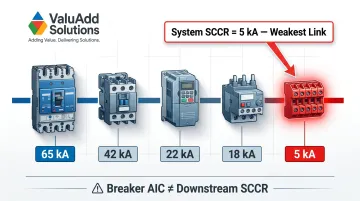
Without a coordinated overcurrent protection scheme, the panel's SCCR defaults to the lowest individual component SCCR in the power circuit. This "weakest link" approach means:
- If a contactor is rated 5 kA and all other components are rated higher, the panel's system SCCR defaults to 5 kA
- The breaker's interrupting rating (e.g., 65 kAIC) does not automatically confer the same SCCR on downstream passive components
- Relying on unmarked components forces the entire panel SCCR down to the default values in UL 508A Table SB4.1
Component Protection Using Listed Combination Ratings
UL 508A Supplement SB provides tested combination motor controller (CMC) ratings showing how pairing specific components with specific upstream fuses or circuit breakers can raise the effective SCCR to levels such as 42 kA, 65 kA, or even 100 kA.
The four main combination types are:
| Type | Core Elements |
|---|---|
| Type A | Disconnect switch, fuses, motor controller, and overload relay |
| Type C | Inverse time circuit breaker, motor controller, and overload relay |
| Type D | Instantaneous trip circuit breaker, motor controller, and overload relay |
| Type E/F | Manual self-protected combination motor controller |
Each combination type carries strict implementation rules:
- All specified components, wiring gauges, and enclosure volume conditions must be followed exactly
- Only the exact listed component models specified in the UL 508A spreadsheets can be used
- Substituting a different contactor model or fuse type invalidates the combination rating and requires separate evaluation
Components with clearly documented individual SCCR ratings — such as UL Listed soft starters and motor control components from ValuAdd — reduce ambiguity during panel-level SCCR determination, making UL 508A compliance more straightforward.
Documenting and Marking the SCCR
Once SCCR is established, two NEC articles govern how it must be recorded and displayed.
NEC 409.110 sets the nameplate marking requirements:
- The panel nameplate must permanently display the SCCR value in kA (or kAIC)
- Manufacturer information, voltage rating, and electrical diagram reference must be included
- The marking must be specific to the actual assembled equipment, not generic
NEC 409.22(B) goes further, requiring that the available fault current at the panel and the date the calculation was performed be documented and kept available for inspectors.
Standard SCCR Ratings and NEC Requirements
A common misconception: the NEC does not mandate a single universal minimum SCCR number for all industrial panels. Instead, NEC 110.10 requires that the equipment's SCCR be equal to or greater than the available fault current at the point of installation. The required SCCR is site-specific, not generic.
Common kAIC Rating Tiers in Industrial Practice
Standard kAIC tiers typically encountered in industrial settings:
- 5 kA / 10 kA – UL 508A Table SB4.1 default values for unmarked passive components; rarely acceptable for industrial 480V service
- 14 kA / 18 kA / 22 kA – Common baseline for industrial panels and standard interrupting ratings for 480V/600V molded case circuit breakers
- 42 kA / 65 kA / 100 kA – High and ultra-high interrupting capacity; common targets for tested CMC assemblies and panels located near large transformers or main switchgear
The transformer fault current table below illustrates why: available fault current varies significantly by transformer size and impedance, which is why distance from the source matters as much as the source itself.
Available Fault Current at 480V Transformer Secondary (Reference Values)
| Transformer Size (480V, 3-Phase) | Assumed Impedance (%Z) | Max Secondary Fault Current (Zero Length) |
|---|---|---|
| 500 kVA | 3.6% | ~16,706 A |
| 1000 kVA | 5.32% | ~22,610 A |
| 1000 kVA | 3.5% | ~38,184 A |
| 1500 kVA | 5.32% | ~33,915 A |
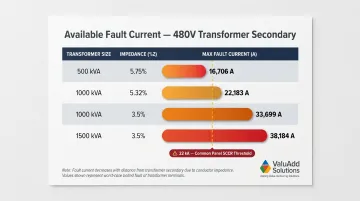
Note: Fault current decreases with distance from the transformer due to conductor impedance. Actual calculations require site-specific evaluation using IEEE 141 (Red Book) or IEEE 3002.3 methodologies.
Key Standards and Code References
These are the standards that govern how SCCR is defined, calculated, marked, and enforced at the installation level:
- NEC Article 100 – Defines SCCR
- NEC 110.10 – Equipment must be rated for available fault current (in code since 1965)
- NEC 409.110 – Industrial control panel marking mandate
- UL 508A with Supplement SB – Accepted calculation and combination rating method
- NFPA 70E – Arc flash hazards and safe work practices
- OSHA 29 CFR 1910.303 – Personnel safety and enforcement implications
For panel builders and integrators, NEC 409.110 and UL 508A are the most operationally relevant — they determine how SCCR gets calculated, documented, and marked on the nameplate before the panel ever leaves the shop.
Consequences of Operating Below the Required SCCR
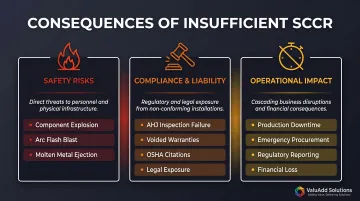
When available fault current exceeds a panel's SCCR, components cannot contain or interrupt the fault energy fast enough. The physical failure mechanisms include:
- Component explosion and enclosure rupture
- Molten metal ejection and arc flash blast
- Fire and cascading damage to connected machinery
- Fault energy that is not safely contained
Compliance and Liability Exposure
A panel with an inadequate SCCR will:
- Fail Authority Having Jurisdiction (AHJ) inspection
- Void equipment warranties
- Result in OSHA citations under 29 CFR 1910.303
- Expose the panel assembler to significant legal and insurance liability in the event of an incident
Operational Consequences
When panel components fail under fault conditions, the operational fallout includes:
- Production downtime and emergency procurement of replacement equipment
- Forced regulatory reporting and insurance claim complications
- Significant financial exposure in continuous-process environments — water treatment and process manufacturing facilities can lose tens of thousands of dollars per hour of unplanned downtime
Common SCCR Misinterpretations in the Field
Confusing SCCR with AIC/Interrupting Rating
A circuit breaker rated 65 kAIC can interrupt 65 kA of fault current — but the contactor or starter it protects may only carry a 5 kA SCCR. The breaker's rating does not automatically extend to downstream components, because AIC and SCCR address different failure modes. Both must be evaluated independently.
Defaulting to the Lowest Component SCCR Without Checking Combination Ratings
Stopping at the lowest individual component rating — without checking whether a tested combination rating applies — leads to one of two problems:
- Unnecessary component replacement, adding cost
- Misidentification of the panel as non-compliant when a specified fuse type could resolve the issue without hardware changes
Applying a Blanket SCCR Across All Panels
Fault current decreases with distance from the transformer as conductor impedance builds up, so remote sub-panels often require a lower SCCR than main distribution panels. Calculating SCCR individually at each distribution point — rather than applying a single blanket specification — lets engineers select more cost-effective components without sacrificing compliance.
Conclusion
SCCR is a governing safety parameter with real consequences when ignored. The compliance framework built around NEC 110.10, NEC 409.110, and UL 508A provides a clear, testable methodology for determining, elevating, and documenting panel-level SCCR in industrial applications.
Engineering judgment in component selection, overcurrent protection coordination, and accurate documentation separates a genuinely safe, code-compliant industrial panel from one that merely appears compliant until a fault event reveals the gap.
Whether you're an OEM panel manufacturer, electrical contractor, system integrator, or facility engineer building panels in-house, getting SCCR right means:
- Selecting components with verified, coordinated ratings
- Applying current-limiting fuses or breakers to elevate system SCCR where needed
- Maintaining accurate SLD documentation tied to the nameplate rating
- Treating SCCR as a living design parameter — not a one-time checkbox
A panel that passes visual inspection but fails under fault conditions is a liability. Applying these standards correctly is what keeps equipment running and personnel safe.
Frequently Asked Questions
How do you determine an SCCR rating?
SCCR is determined by one of two methods: the weakest-link method (using the lowest-rated component in the power circuit) or the UL 508A Supplement SB combination motor controller tables, which allow a higher system SCCR through coordinated overcurrent protection with specific fuses or breakers.
What is an SCCR rating and how does SCCR work?
SCCR is the maximum fault current an industrial panel or passive component can withstand without sustaining damage. It works by ensuring that passive equipment survives long enough for the upstream protective device to clear the fault, typically within milliseconds.
What is the minimum SCCR required by the NEC?
The NEC does not specify a single universal minimum. NEC 110.10 requires the SCCR to equal or exceed the available fault current at the installation point — a value that varies by site based on utility source and transformer capacity.
What is the 80% rule for circuits?
The 80% rule (NEC 210.20, 215.2) limits continuous loads to 80% of a circuit's rated ampacity to prevent sustained overheating. This is a separate loading derating rule from SCCR and is not directly related to short-circuit current withstand ratings.
What does a kAIC (AIC) rating mean, such as 4.5 kA or 10,000 AIC?
AIC (Ampere Interrupting Capacity) or kAIC is the maximum fault current a protective device — fuse or circuit breaker — is rated to safely interrupt. A 10,000 AIC rating means the device can clear up to 10,000 amps. This rating applies to the protective device, not passive downstream equipment.
What is the standard kAIC rating for 480V?
There is no single standard. At 480V, panels near large transformers or main switchgear commonly require 42 kA or higher, while those at the end of long feeder runs may only need 10–22 kA — the correct value must be calculated based on available fault current at the specific installation point.