Introduction
Most engineers spec a soft starter for its startup protection. Far fewer think carefully about the bypass contactor — until they're dealing with overheated SCRs, unexplained energy losses, or a failed unit that ran continuously under full load.
Soft starters protect motors during startup by controlling voltage ramp-up and limiting inrush current. Once the motor reaches operating speed, the bypass contactor takes over — and how it's configured directly affects thermal performance, component lifespan, and long-term operating costs.
This guide explains what a bypass contactor is, how it functions within a soft starter system, the difference between integrated and external configurations, and when each approach makes sense in real-world installations.
Key Takeaways
- Once a motor reaches full speed, a bypass contactor reroutes current around the thyristors — cutting heat and power losses during steady-state operation
- Without bypass, thyristors remain in the circuit indefinitely, generating excessive heat and shortening lifespan
- Most modern soft starters include integrated (internal) bypass contactors; external bypass is used for high-power or severe-duty applications
- Run-up detection algorithms trigger engagement — not fixed speed thresholds
- Typical applications include pumps, fans, compressors, conveyors, and HVAC systems
What Is a Bypass Contactor in a Soft Starter?
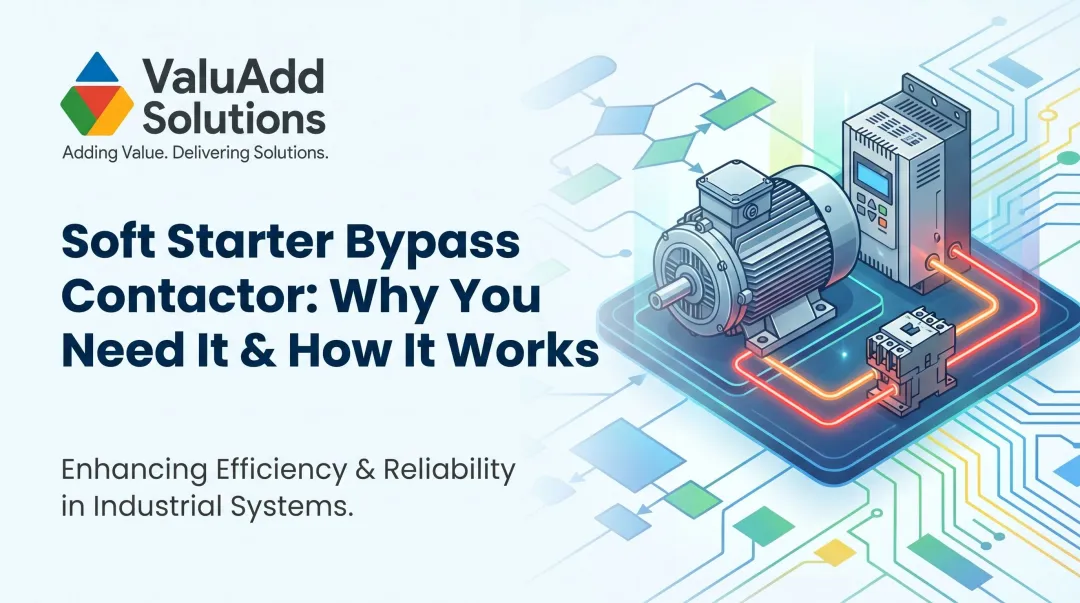
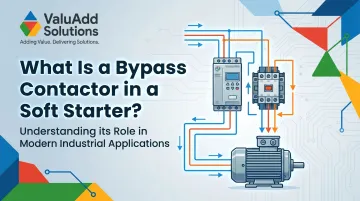
A bypass contactor is an electromechanical switching device connected in parallel with a soft starter's solid-state power section (the thyristors or SCRs). Once the motor reaches rated speed, the bypass contactor closes to connect the motor directly to the power supply, effectively removing the soft starter from the active power path.
This design addresses a fundamental inefficiency: soft starters use thyristors to control voltage during motor acceleration, but thyristors are not built for continuous operation. Even when fully conducting, they introduce a voltage drop of approximately 1.3 to 1.5 V per phase, generating measurable heat losses at every phase.
According to Siemens technical documentation, once the bypass contactor closes, "no power loss has to be taken into account at the power semiconductors (thyristors) after the motor has started up" — enabling more compact enclosure designs and reduced cooling requirements.
What a bypass contactor is NOT:
- Not a safety disconnect or isolation device
- Not a motor protection relay
- Not a substitute for the soft starter itself
- Does not control starting torque or inrush current
The bypass contactor's sole function is thermal and efficiency optimization during steady-state motor operation. ABB documentation shows that continuous operation without bypass can generate hundreds of watts of heat, while bypass engagement reduces losses to approximately 50 W — just enough to power the cooling fans.
That gap — hundreds of watts versus 50 W — explains why bypass contactors appear in virtually every soft starter designed for continuous-duty applications, regardless of how advanced the semiconductor technology becomes.
How Does a Bypass Contactor Work?
A bypass contactor operates as part of a defined sequence tied directly to the motor's acceleration profile. It remains inactive during startup and only engages once specific operating conditions are confirmed.
Startup Phase
When a start command is issued, the soft starter's thyristors take control. They increase voltage applied to the motor terminals over a programmed ramp time — typically 5 to 30 seconds depending on load characteristics — limiting inrush current and reducing mechanical shock to the drivetrain.
During this phase, the bypass contactor remains open. All motor current flows through the thyristors, and the bypass plays no active role.
Bypass Engagement
The soft starter monitors motor behavior throughout the ramp. Siemens 3RW50 models use "internal run-up recognition" — an algorithm that detects when the motor reaches full operating speed by analyzing back-EMF (electromotive force) or voltage feedback. ABB systems engage bypass at "Top of Ramp" when motor voltage reaches 100%.
The transition uses "make-before-break" logic:
- The soft starter keeps thyristors firing as the contactor begins closing
- The contactor creates a parallel path while thyristors are still conducting
- Once the contactor is fully closed, thyristors stop firing
- Current transfers to the low-resistance contactor path without interruption
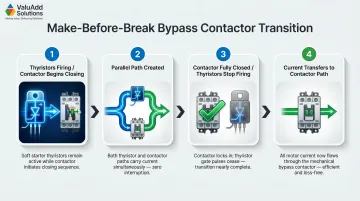
This parallel operation prevents voltage spikes, current surges, and electrical arcing during switchover. Because the thyristors handle the making and breaking of load current, the bypass contactor itself is typically rated AC-1 (non-inductive duty) rather than the more demanding AC-3 (motor switching duty).
Continuous Operation and Shutdown
Once bypassed, the motor runs directly from the power grid through the closed contactor, operating identically to direct-on-line (DOL) conditions with no losses from the solid-state section.
During shutdown, the sequence reverses: the bypass contactor opens first, returning current to the thyristors. The soft starter can then execute a controlled soft-stop ramp if programmed, or the motor coasts to a stop depending on system configuration.
Integrated vs. External Bypass Contactors
Bypass contactors are deployed in two configurations — integrated and external — each optimized for different power ranges and installation requirements.
Integrated Bypass Configuration
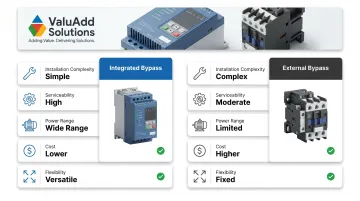
The contactor is factory-installed inside the soft starter enclosure as a single packaged unit. This approach reduces panel space, simplifies wiring, and speeds commissioning. It's ideal for small-to-medium motor applications — typically up to a few hundred kW — where space is limited and system complexity is low.
ValuAdd's CSXi Series compact low voltage soft starters include an integral bypass contactor that allows installation in non-vented enclosures — no external bypass contactors or cooling fans required. This makes them well-suited for fixed-speed pump and fan applications in municipal water treatment facilities.
External Bypass Configuration
The contactor is a discrete, separately mounted device wired in parallel with the soft starter. This setup is preferred for high-power motors, medium voltage applications, or installations requiring individual component serviceability. If the contactor fails, it can be replaced without touching the soft starter itself.
Key Tradeoffs:
| Factor | Integrated Bypass | External Bypass |
|---|---|---|
| Installation | Faster, simpler wiring | More wiring, additional panel space |
| Serviceability | Entire unit may require replacement | Individual component replacement |
| Power Range | Small to medium motors | High-power, medium voltage |
| Cost | Lower installed cost | Higher upfront cost |
| Flexibility | Limited to frame rating | Scalable, supports redundancy |
When to Use External Bypass
Rockwell Automation technical documentation recommends external bypass for applications where current may spike due to product jams or shock loads — such as rock crushers or conveyors in heavy manufacturing. Integrated bypass contactors typically drop out around 120% over frame rating to protect themselves. An external bypass rated AC-3, by contrast, stays pulled in during transient overloads.
External bypass is also required when the contactor must serve as an emergency Direct-On-Line (DOL) starter, bypassing a failed soft starter entirely to maintain production continuity.
Where Bypass Contactors Are Used in Industry
Bypass contactors deliver the greatest value in continuous-duty applications — systems where the motor starts infrequently but runs for extended periods once at speed.
Common Use Cases:
- Centrifugal pumps in water treatment and municipal infrastructure
- Fans and blowers in HVAC and process ventilation
- Compressors in oil and gas operations
- Conveyor drives in manufacturing and processing plants
These applications share a common profile: long run times at constant speed after a controlled startup. The bypass contactor's ability to eliminate thyristor heat generation during steady-state operation is what makes it indispensable here.
The scale of that benefit matters. Electric motor systems account for 53% of global electricity consumption, including 72% of industrial sector electricity. In the U.S. alone, three-phase motor systems consume approximately 29% of total grid load. Shaving even a fraction of a percent off losses in high-run-time motors adds up fast across a facility.
Environmental and Operational Drivers:
Bypass contactors become critical in installations where:
- Panels are enclosed with limited heat dissipation
- Ambient temperatures are high (outdoor installations, desert climates)
- Uptime requirements are stringent and thyristor degradation introduces unacceptable failure risk
In municipal water treatment, oil and gas, and industrial manufacturing, these conditions often converge. Pump stations run continuously. Compressor enclosures trap heat. Any unplanned downtime carries real operational and financial consequences — which is exactly where bypass contactor specification decisions have the most impact.
Conclusion
A bypass contactor is what makes a soft starter viable for continuous-duty motor applications. Once the motor reaches full speed, the bypass contactor takes over — without it, the solid-state components would generate persistent heat and degrade well before their rated service life.
Knowing whether an integrated or external bypass configuration fits your application — and understanding what happens operationally if you get that wrong — directly determines installation reliability and lifecycle costs.
Whether you're specifying a pump station for municipal water treatment or replacing motor control equipment in an oil and gas facility, the bypass contactor choice is a design decision, not a detail. Get it right at the specification stage, and the system will run cleanly for years with minimal intervention.
Frequently Asked Questions
What is the purpose of bypass contacts in an electronic soft starter?
Bypass contacts eliminate thyristor conduction losses once the motor reaches full speed, reducing heat generation and improving energy efficiency during continuous motor operation. Without bypass, thyristors remain in the circuit indefinitely, generating heat and wasting energy.
What are the three types of contactors?
The three main types are standard power contactors (for general load switching), auxiliary contactors (for control circuits), and vacuum contactors (for medium/high voltage applications). Bypass contactors fall under power contactors, typically rated AC-1 for integrated configurations or AC-3 for external configurations.
When does the bypass contactor engage during motor startup?
The soft starter's up-to-speed detection logic triggers engagement — typically when the motor reaches approximately 90–100% of rated speed, confirmed via back-EMF monitoring or timed ramp completion. Exact thresholds vary by manufacturer.
What is the difference between an integrated and external bypass contactor?
Integrated bypass is built into the soft starter unit — compact and simpler to install, but harder to service. External bypass is a separate component that's more flexible and individually replaceable, making it the preferred choice for high-power or critical applications. Choose integrated for standard duty; choose external for severe or high-power loads.
Can a soft starter operate without a bypass contactor?
Yes. Soft starters without bypass — sometimes called "through-type" units rated IEC AC-53a — keep thyristors in the circuit continuously, generating heat and losses. This configuration suits intermittent-duty applications or harsh environments where electromechanical contactors are impractical.
Do all soft starters include a built-in bypass contactor?
No. Bypass availability varies by model — some units include it internally, others require a separately wired external contactor. Always confirm the bypass configuration when specifying a soft starter, especially for continuous-duty applications where heat management matters.