Introduction
Most engineers who specify soft starters know what they do during motor ramp-up. Few give the same attention to the bypass contactor—or to what happens when one isn't included in the design.
Soft starters appear across manufacturing plants, water treatment facilities, oil and gas operations, and processing plants wherever three-phase induction motors need controlled acceleration. But the bypass contactor's role in that same circuit is routinely skipped during system design, and the consequences show up later as thermal failures and premature component degradation.
This gap in understanding leads to thermal problems, oversized enclosures, and premature component failure. According to industry surveys, unplanned downtime in manufacturing and heavy industry averages $260,000 per hour, making proper soft starter configuration essential for operational continuity.
Key Takeaways
- A bypass contactor creates a direct electrical path from supply to motor once startup completes, taking SCRs completely out of the circuit
- Eliminates continuous heat generation—reducing losses from 650W to just 50W for a typical 200A motor
- Closes automatically when motor reaches rated speed and current stabilizes—no manual intervention required
- Integrated (built-in) or external configurations are available—suited to different motor sizes and system needs
- Essential for continuous-duty applications—pumps, fans, compressors, conveyors—not optional equipment
What Is a Soft Starter Bypass Contactor?
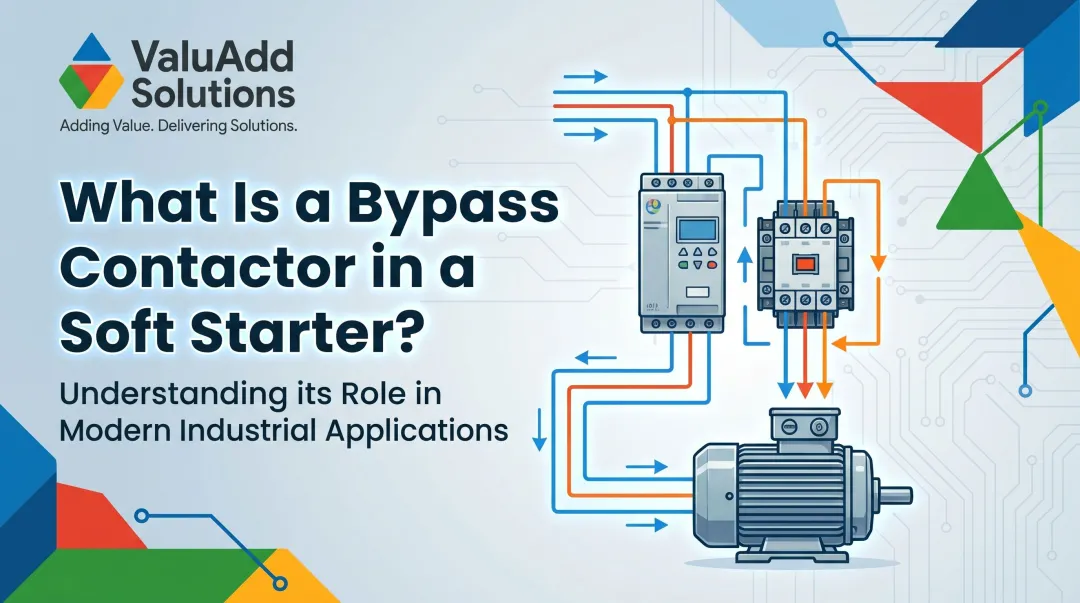
A bypass contactor is an electromechanical switching device wired in parallel with the soft starter's solid-state power section (the SCR/thyristor bridge). When closed, it creates a direct electrical path from the incoming supply to the motor, effectively removing the soft starter from the running circuit.
The 1.0V to 1.5V SCR Voltage Drop Problem
Soft starters use silicon-controlled rectifiers (SCRs) to manage voltage ramp-up during motor acceleration. But SCRs are inherently inefficient as steady-state conductors. Every ampere of motor current passing through an SCR during run-state produces a voltage drop of approximately 1.0V to 1.5V per SCR pair, generating significant heat continuously.
For a 200A motor running continuously:
- Heat dissipated without bypass: 650 watts
- Heat dissipated with bypass: 50 watts
The bypass contactor eliminates this 600W heat loss the moment it closes.
What a Bypass Contactor Is NOT
The bypass contactor is not:
- A motor protection device
- A fault-current interrupter
- A substitute for a main line contactor
- Designed to interrupt starting current
- Rated for fault clearing duty
This is why bypass contactors carry only an AC-1 duty rating (resistive/slightly inductive load) rather than the heavier AC-3 rating required for direct-online motor switching.
AC-1 vs. AC-3: Understanding the Rating Difference
| Utilization Category | Load Characteristics | Typical Application | Switching Stress |
|---|---|---|---|
| AC-1 | Non-inductive or slightly inductive (PF > 0.95) | Heaters, resistive loads, bypass contactors | Current at make/break equals rated current |
| AC-3 | Squirrel-cage induction motors | Direct-on-line motor starting | Handles 6-7x inrush current on start |
Because the soft starter's SCRs handle the high-current starting phase, the bypass contactor never experiences inrush current — which keeps bypass contactor sizing smaller and more cost-effective than a direct-online motor starter.
Integrated vs. External Bypass Types
The two bypass configurations each serve a different installation priority:
| Integrated (Built-In) | External | |
|---|---|---|
| Installation | Factory-installed inside the soft starter housing | Separately wired contactor in parallel |
| Footprint | Compact, simplified wiring | Larger, but individually serviceable |
| Best For | Small-to-medium motors | High-power motors; one-starter-multiple-motor setups |
| Service Consideration | Full unit replacement if contactor fails | Contactor replaced independently |
ValuAdd carries both configurations. The RX2E and RX4E Series feature integrated bypass contactors rated for full voltage, while the MVE-P Series Medium Voltage Soft Starters support external bypass architectures for maximum serviceability in high-demand installations.
How Does a Bypass Contactor Work with a Soft Starter?
The bypass contactor operates as part of a defined, automatic sequence coordinated by the soft starter's control logic—no manual intervention required.
Motor Startup Phase
During soft start, the soft starter's SCRs conduct and gradually increase the voltage applied to the motor stator, controlling the rate of torque and current rise. During this entire ramp-up period:
- All motor current flows through the SCRs
- The bypass contactor remains open (de-energized)
- Duration depends on programmed ramp time and motor load characteristics
The soft starter actively monitors motor current and voltage throughout startup. Typical triggering thresholds include:
- Motor current drops to stabilized value near full-load amperage
- Voltage ramp reaches approximately 90-100% of nominal supply voltage
Bypass Activation
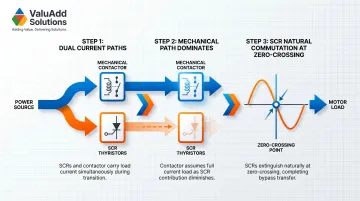
The soft starter's internal logic sends a control signal to close the bypass contactor. Once the contactor closes:
- Current has two parallel paths—through the SCRs and through the contactor
- The low-impedance mechanical contact path immediately dominates current flow
- SCRs naturally cease conducting at the next zero-crossing of the AC waveform
The net electrical result:
- Motor connects directly to full supply voltage through the low-resistance mechanical path
- SCRs no longer carry load current, so heat generation in the power section drops dramatically
- Motor runs at rated voltage as if connected directly online
Natural Commutation at AC Zero-Crossings
SCRs don't switch off instantly when the bypass contactor closes. Instead, they undergo "natural commutation" (also called line commutation). Because the bypass contactor provides a parallel path, current through the SCR drops below its holding current threshold.
At that point, the SCR ceases conduction when anode current falls to zero at the end of a half-cycle and a reverse voltage appears across the device — allowing it to turn off without forced switching.
Shutdown Scenario
The shutdown sequence depends on how the soft starter is configured:
Standard Stop — the bypass contactor opens, power is removed, and the motor coasts to a stop.
Soft-Stop (Controlled Deceleration) — the bypass contactor opens first, SCRs re-engage to carry load, and the soft starter ramps voltage down gradually. This approach is critical in pump systems to prevent water hammer — a destructive pressure surge caused by abrupt flow stoppage.
Why Your Soft Starter Needs a Bypass Contactor
Heat Reduction and Enclosure Sizing
Without a bypass contactor, SCR losses during continuous operation generate substantial heat that must be dissipated—requiring forced-air ventilation, larger enclosures, or derated soft starters.
Quantified Example (200A Motor): Using ABB's published loss formula: $PL_{tot} = [3 \times I_e \times 1.0] + 50$ (W)
- Without bypass: $(3 \times 200 \times 1.0) + 50 = 650$ watts continuous heat
- With bypass: $50$ watts (control circuits only)
With a bypass contactor, the solid-state section runs cool during the motor's run state, allowing installation in sealed enclosures (NEMA 4X or IP65+) without additional cooling infrastructure.
Energy Efficiency During Run State
Eliminating SCR conduction losses directly reduces operating energy consumption. For motors running continuously in pumping and HVAC applications, the cumulative savings across a full year are measurable:
Annual Energy Savings Example:
- 600W continuous loss × 8,760 hours/year = 5,256 kWh/year
- At $0.12/kWh industrial rate = $630/year per motor
For facilities with multiple motors, these savings add up quickly.
Equipment Longevity and Reduced Thermal Stress
Sustained heat cycling degrades SCR junctions, gate trigger circuits, and PCB components over time. By taking the SCRs out of continuous service, the bypass contactor dramatically reduces thermal wear on the soft starter's power electronics—extending service intervals and reducing the likelihood of unplanned failures.
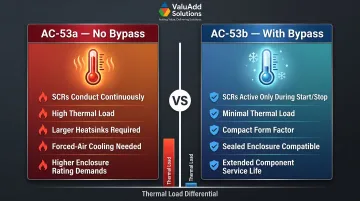
IEC 60947-4-2 Thermal Duty Categories:
| IEC Category | Operational Definition | Thermal Implications |
|---|---|---|
| AC-53a | 8-hour duty / continuous operation without bypass | SCRs fully rated for continuous duty; requires larger form factors and robust heat sinks |
| AC-53b | Intermittent duty with bypass contactor | SCRs only conduct during start/stop phases; allows smaller footprint and cooler operation |
This thermal stress reduction is especially critical in high-duty-cycle applications or environments with limited maintenance access—such as municipal pump stations and remote oil and gas installations.
System Reliability for Critical Operations
In many industrial environments, the bypass contactor provides an additional layer of operational continuity. Some configurations allow the bypass contactor to maintain motor operation even in the event of a soft starter fault signal, preventing process interruption.
In water treatment and oil and gas—where motor downtime carries real operational and safety consequences—engineers particularly value this redundancy. Unplanned downtime in the water and wastewater industry approaches $100,000 per hour, which puts the cost of a missing bypass contactor in sharp perspective.
Integrated vs. External Bypass Contactors
Integrated Bypass (Built-In)
The bypass contactor is factory-installed inside the soft starter housing.
Advantages:
- Simpler installation, smaller panel footprint
- Reduced wiring complexity
- Minimal configuration required
Best Suited For:
- Standard motors in small-to-medium power range
- Applications with limited panel space
- Installations where soft starter won't need independent servicing
One trade-off: if the integrated contactor fails, the entire soft starter unit may need replacement or return for service.
Example Products:
| Manufacturer | Series | Power Range | Key Features |
|---|---|---|---|
| ABB | PSTX | Up to 1250A | AC-1 bypass standard; AC-3 ratings for emergency starting on larger models |
| Schneider | ATS22 | Various | Reduces wiring from 12 terminals to 6 |
| Siemens | 3RW40/44 | Various | Integral bypass enables compact design |
External Bypass
The bypass contactor is a separate device installed in parallel with the soft starter in the panel.
Advantages:
- Individual component replacement without full system shutdown
- Supports one-starter-multiple-motor switching schemes
- Maximum serviceability
Best Suited For:
- High-power motors
- Complex industrial systems requiring redundancy
- Sequential motor starting applications
- Installations where maintenance access is critical
In sequential starting configurations, a single soft starter brings multiple motors up to speed one by one. After each motor reaches full speed, its dedicated external bypass contactor closes and the soft starter disconnects — then the process repeats for the next motor. This architecture can reduce capital costs considerably in multi-motor installations.
Selection Guidance
The right choice depends on motor size, maintenance requirements, and how the system is architected.
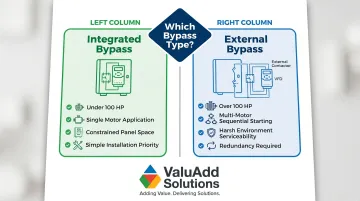
Choose integrated bypass when motor power is under 100 HP (75 kW), panel space is constrained, or installation simplicity takes priority on a single-motor application.
Choose external bypass when motor power exceeds 100 HP (75 kW), sequential starting across multiple motors is required, or contactor replacement frequency in harsh environments makes independent serviceability essential.
For high-power or multi-motor systems, external bypass adds a layer of flexibility that integrated designs simply can't match — and that serviceability difference becomes significant when unplanned downtime carries real production costs.
Where Bypass Contactors Are Used in Industrial Operations
Industries and Applications
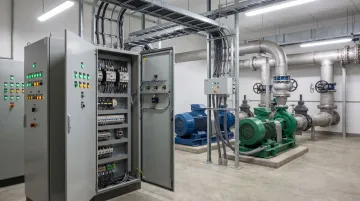
Bypass contactors deliver the most value for motors that start under controlled conditions but then run continuously or for extended periods at constant speed.
Primary Applications:
- Pumps and boosters in water and wastewater treatment
- Fan and blower drives in HVAC and industrial ventilation
- Compressors in oil and gas processing
- Conveyor drives in manufacturing and material handling
Where Operating Conditions Make Bypass Essential
Bypass contactors are especially important in:
Sealed or Hazardous-Area Enclosures:
- Heat dissipation is constrained
- Forced-air cooling may not be feasible
- Bypass eliminates need for aggressive ventilation
Remote Installations:
- Maintenance access is infrequent
- Component reliability directly affects uptime
- Thermal stress reduction extends service intervals
High-Continuity Processes:
- Soft starter component reliability affects uptime
- Process interruption carries severe financial penalties
- Design standards increasingly mandate it — for example, Fairfax County Wastewater design criteria requires soft starters or VFDs with bypass for motors 50 HP and over
Configuration Settings That Make Bypass Work
To realize operational benefits in practice:
- Bypass contactor must be AC-1 rated for motor full-load current
- Activation timing must be correctly programmed (typically 90–100% voltage, <120% current)
- Soft-stop must open bypass before SCR re-engagement (if controlled deceleration needed)
Frequently Asked Questions
Does a soft starter need a contactor?
A bypass contactor is not strictly required for a soft starter to function, but it is strongly recommended for any application where the motor runs continuously after startup. Without it, the SCRs remain in circuit, generating ongoing heat losses and reducing soft starter service life.
Why is bypass contactor used in soft starters?
The bypass contactor removes the soft starter's SCRs from the circuit once the motor reaches full speed, eliminating ongoing voltage drop and heat generation through the solid-state components. This improves energy efficiency and extends the soft starter's service life.
What is a soft starter without bypass contactor?
A soft starter without a bypass contactor is called an "online" type: the SCRs remain in circuit for the full duration of motor operation. This works for infrequent, short-duration runs but is not recommended for continuous-duty applications due to thermal stress on power electronics.
What does internal bypass mean?
"Internal bypass" (also called built-in bypass) means the bypass contactor is integrated inside the soft starter housing rather than wired as a separate device. It reduces installation footprint and wiring, but the contactor cannot be serviced independently from the soft starter.
What is the alternative to a soft starter?
The main alternatives are variable frequency drives (VFDs) and star-delta starters. VFDs suit applications requiring variable speed throughout operation; star-delta starters reduce starting current mechanically at lower cost. Soft starters with bypass contactors are preferred when only controlled startup is needed and the motor runs at constant speed.