Introduction
A joint EPA and CISA fact sheet recently highlighted how internet-exposed HMIs at U.S. water facilities allowed hacktivists to manipulate pump settings and lock out operators, forcing plants to revert to manual operations. The root cause wasn't just a security gap — it was a deployment gap. HMI and SCADA both promise better control and visibility, but deploying the wrong one, or using one when both are needed, creates costly gaps in oversight, compliance failures, and poor operator experience.
This comparison matters specifically for manufacturing facilities, water treatment plants, oil and gas operations, and processing plants—industries where scale and monitoring demands make this choice consequential. According to Markets and Markets research, the global SCADA market is projected to grow from $12.89 billion in 2025 to $20.05 billion by 2030, a signal of how seriously these industries are investing in centralized supervisory control. This article breaks down how HMI and SCADA differ, where each fits, and how to determine what your operation actually needs.
Key Takeaways
- HMI is a local operator panel that lets workers control a specific machine in real time
- SCADA is a plant-wide system that monitors and controls data across many machines from a centralized location
- HMI serves as the front-end interface within SCADA's broader architecture
- Choose HMI for fast, localized machine control; choose SCADA for centralized data logging and multi-site supervision
- Most facilities run both: HMIs handle machine-level control while feeding data up to plant-wide SCADA
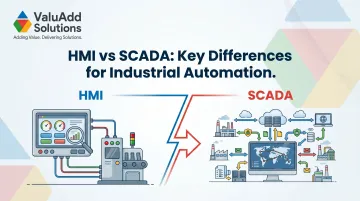
HMI vs SCADA: Quick Comparison
| Dimension | HMI | SCADA |
|---|---|---|
| Scope of Control | Single machine or small equipment cluster; touchscreen panels on the production floor | Entire plants, distributed sites, or multi-location operations from a central control room — NIST SP 800-82r3 defines SCADA specifically around dispersed asset control |
| Data Storage | Minimal or no long-term storage; focused on real-time status display and immediate operator feedback | Historian databases for trend analysis, compliance reporting, and performance benchmarking — essential where audit trails are required |
| Deployment | Mounted at or near machines on the production floor | Installed in central control rooms or accessed remotely via networked servers, no on-site staff required |
| Complexity & Cost | Simpler to configure with lower upfront costs; well-suited to focused, local tasks | Higher infrastructure investment justified by large-scale or multi-site operations needing centralized oversight |
| System Integration | Connects to a single PLC or controller with limited network reach | Integrates with PLCs, RTUs, ERP systems, and MES platforms — built for broad interoperability across industrial architectures |
What is HMI?
Human-Machine Interface (HMI) is the digital or physical interface through which operators interact with specific industrial equipment. This includes touchscreen panels, graphical displays, and physical control surfaces that provide real-time, on-the-floor interaction essential in manufacturing and process industries. The ISA-101 standard defines HMI as the interface for process automation systems, covering safety, usability, and efficiency across the full system lifecycle.
Modern HMIs deliver core operational benefits: immediate visual feedback on machine status (temperatures, pressures, motor states, alarms), faster operator response to faults, and reduced reliance on manual gauges. Many current systems enable basic remote access via web-based interfaces, though their primary function remains local control.
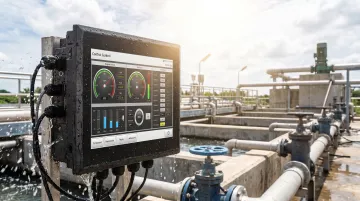
HMI hardware varies significantly—from basic panel-mounted screens to high-brightness ruggedized displays built for harsh environments. Certifications such as IP68, IP66, and IP65 ratings are critical for deployments in water treatment, oil and gas, or outdoor industrial settings.
ValuAdd's high-brightness industrial displays carry IP68 protection, with models reaching 1,200 cd/m² luminance for direct-sunlight readability and reliable operation from -20°C to +70°C.
Use Cases of HMI
HMIs fit best where operators need direct, fast control at the machine level:
- Single-machine control – CNC machines, injection molders, packaging lines where operators need immediate equipment interaction
- OEM machinery – Equipment manufacturers embed HMIs directly into their products for end-user operation
- Localized process control – HVAC stations, motor control centers, and production cells prioritizing fast, intuitive control over centralized analytics
A manufacturing facility might deploy a ruggedized HMI touchscreen at each motor control station to monitor VFD parameters—speed, current, fault codes—enabling real-time adjustments without returning to a central control room. ValuAdd's Michael Johnson, a plant engineer with extensive VFD and motor control experience, has observed this pattern across facilities: an IP65-rated HMI panel on a packaging line maintains touch responsiveness even when operators wear gloves—a small detail that meaningfully reduces line stoppages in high-dust environments.
What is SCADA?
Supervisory Control and Data Acquisition (SCADA) is a comprehensive industrial control architecture combining hardware (PLCs, RTUs, sensors) and software to monitor and control multiple processes across a plant, facility, or distributed field locations. Its defining feature is centralized visibility across dozens or hundreds of remote assets—giving operators full supervisory control from a single control room.
SCADA's core components each play a distinct role:
- Field devices (RTUs/PLCs) collect raw process data at the source
- Communication networks (Ethernet, fiber, cellular, OPC UA, DNP3, MQTT) transmit that data to a central SCADA server
- Historian databases store it long-term for trend analysis and compliance reporting
- SCADA software visualizes everything for supervisory operators
HMI panels serve as the local operator interface within this architecture—giving technicians direct, hands-on access to the broader system.
According to an EPA analysis of Clean Water State Revolving Fund projects, 63.1% of intelligent technology deployments between 2013 and 2023 involved SCADA systems—reflecting their critical role in utility modernization.
Key operational benefits include centralized alarm management, historical trend analysis for predictive maintenance, audit-ready compliance reporting, and remote control of distributed infrastructure without on-site personnel. The Metropolitan Sewer District of Greater Cincinnati put those capabilities to work directly: real-time SCADA controls automated gates and weirs, reducing combined sewer overflow by 61%—saving 557 million gallons annually.
Use Cases of SCADA
SCADA systems are indispensable for:
- Water and wastewater utilities managing remote pumping stations, treatment facilities, and distribution networks from a single control room
- Pipeline operators — 90.7% of hazardous liquid pipeline operators rely on SCADA to monitor pressure, flow, and conditions across hundreds of miles
- Manufacturing facilities tracking Overall Equipment Effectiveness (OEE) plant-wide, where best-in-class operations improve OEE by 10% or more through real-time process monitoring
A wastewater treatment facility that upgraded to a comprehensive SCADA/HMI system decreased downtime by 10% and increased response time by 25% through remote equipment access and centralized alarm management.
HMI vs SCADA: Which is Better for Your Operation?
Neither system is universally superior—the right choice depends on operational scale, data needs, and supervision requirements.
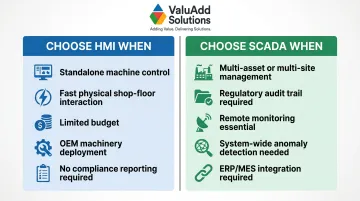
Choose HMI when:
- Managing standalone machines or small equipment clusters
- Operators need fast, physical interaction on the shop floor
- Budget constraints limit infrastructure investment
- Equipping OEM machinery for end-user operation
- Compliance reporting and long-term data retention are not required
Choose SCADA when:
- Managing multiple assets across one or more sites
- Regulatory bodies require long-term data logging and audit trails
- Remote monitoring capabilities are essential
- System-wide anomaly detection is critical
- Integration with enterprise systems (ERP, MES) is needed
Many facilities deploy both systems strategically. HMIs provide local machine control while feeding data into a plant-wide SCADA system through PLCs acting as communication bridges. The result: immediate operator response at the equipment level, plus centralized oversight and historical analysis across the entire facility.
Consider a municipal water treatment facility with multiple remote pumping stations. Relying solely on local HMIs creates dangerous blind spots—operators cannot detect system-wide pressure anomalies until individual stations trigger alarms. Adding SCADA provides the network-wide visibility needed to identify developing issues across the entire distribution network before they escalate.
The architecture decision only holds up if the underlying hardware can support it. ValuAdd supplies certified industrial automation components—UL Listed, IP-rated, IEEE 519 compliant—built for the environmental and electrical demands these systems face. That includes ruggedized HMI displays with IP68 protection and programmable control components supporting Modbus, Ethernet/IP, and OPC UA, giving your HMI-SCADA integration a reliable physical foundation.
Conclusion
HMI and SCADA are not competing technologies but complementary layers of industrial automation. HMI handles machine-level human interaction while SCADA provides centralized supervision and historical intelligence. The best fit depends on operational scale, data requirements, and whether remote supervision is necessary.
For manufacturers, water utilities, and oil and gas operators, getting this architecture right affects uptime, compliance readiness, and long-term cost efficiency. The choice between HMI and SCADA — or how the two work together — is a strategic infrastructure decision, not simply a technical one.
Three factors should drive that decision:
- Operational scale: Single-machine control points toward HMI; multi-site supervision points toward SCADA
- Data requirements: Real-time local feedback vs. historical trending and reporting across facilities
- Security posture: As the joint EPA-CISA guidance makes clear, proper system architecture with defined security controls is essential for protecting critical infrastructure from cyber threats
Frequently Asked Questions
What is the difference between HMI and SCADA?
HMI is a local operator interface for a specific machine, while SCADA is a broader system that monitors and controls multiple machines or sites from a centralized location. HMI typically functions as a component within a SCADA architecture, serving as the operator-facing display layer.
Can a PLC function without HMI or SCADA?
Yes, a PLC can execute its programmed logic autonomously without an HMI or SCADA. However, operators lose real-time visibility and remote control capabilities, making troubleshooting and adjustments far more difficult without these interfaces.
Is HMI a part of SCADA?
In a full SCADA architecture, HMIs sit at the operator interface layer—feeding data up to the SCADA server while providing local control at the machine level. Outside that context, HMIs can also run as standalone interfaces without any SCADA infrastructure behind them.
Can HMI and SCADA work together in the same system?
In most modern industrial setups, HMIs and SCADA systems work together as an integrated pair. HMIs provide local machine control while SCADA aggregates data from multiple HMIs and PLCs for centralized monitoring, historical analysis, and supervisory control.
Which is more expensive: HMI or SCADA?
Standalone HMI panels are generally lower cost and simpler to deploy. Full SCADA systems require servers, networking, historian software, and licensing, which drives up both upfront and ongoing maintenance costs. For large-scale or distributed operations that need centralized oversight, that additional cost is warranted.
What industries use SCADA the most?
SCADA is most widely used in water and wastewater utilities, oil and gas (pipelines, upstream, midstream operations), power generation and distribution, and large-scale manufacturing. These are industries where operators must monitor assets spread across multiple locations from a single control point.