Introduction
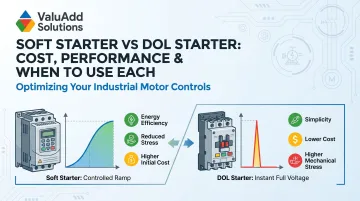
Motor startups represent one of the highest-stress moments in any electrical system. The starter type you choose determines whether that stress is absorbed safely or passed on to the motor, connected equipment, and your utility bill. A Direct-On-Line (DOL) starter draws 6 to 8 times full-load current at startup — enough to cause voltage dips that disrupt other equipment and inflict mechanical shock on couplings, belts, and bearings.
Those startup stresses translate directly into cost: higher demand charges, shorter motor lifespan, and more frequent maintenance. For facilities running motors above 7.5 HP with frequent start cycles, the wrong starter choice can cost thousands of dollars annually in demand penalties alone.
For smaller motors with infrequent starts, DOL remains the most cost-effective solution. What follows breaks down how each starter works, where the cost and performance gaps appear, and which applications justify the switch.
Key Takeaways
- DOL starters apply full voltage instantly — simple and low-cost, but generate high inrush current and mechanical shock that accelerates wear
- Soft starters ramp up voltage gradually using thyristors, reducing inrush current to 2-4× rated current and eliminating mechanical stress
- DOL starters suit small motors (under 5-7.5 HP) with infrequent starts where infrastructure can handle the surge
- Choose soft starters for medium-to-large motors, high-cycle applications, and facilities where equipment protection and energy efficiency matter
- Soft starters typically deliver lower total cost of ownership when energy savings, reduced maintenance, and longer motor life are counted
Soft Starter vs. DOL Starter: Quick Comparison
| Attribute | DOL Starter | Soft Starter |
|---|---|---|
| Startup Method | Full voltage instantly | Gradual voltage ramp-up |
| Inrush Current Level | 6-8× rated current | 2-4× rated current |
| Starting Torque | High (100% available immediately) | Controlled (adjustable) |
| Upfront Cost | $200-$800 for typical sizes | $1,500-$8,000+ depending on HP |
| Protection Features | Basic overload relay only | Thermal overload, phase monitoring, voltage protection, programmable ramps |
| Typical Motor Size Range | Under 5-7.5 HP | 7.5 HP to 500+ HP |
| Acceleration/Deceleration Control | None | Fully programmable |
| Common Applications | Small pumps, fans, compressors with infrequent starts | Centrifugal pumps, conveyors, large HVAC, frequent-start applications |
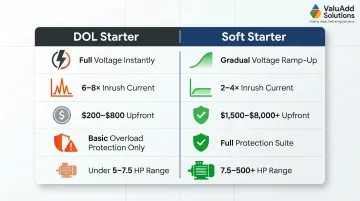
While upfront cost favors DOL, the comparison shifts when lifecycle costs are considered. Utility demand charges penalize facilities for peak current draws — soft starters cut this billing component for facilities with large or frequently started motors. Maintenance intervals, motor longevity, and mechanical wear extend that cost gap further over time.
Key limitation: Neither starter addresses variable-speed operation during running. Applications requiring speed control need a variable frequency drive (VFD), not a starter.
What Is a DOL (Direct-On-Line) Starter?
A DOL starter is the simplest motor starting method: it connects the motor directly to full line voltage the moment the start signal is given. The system consists of three basic components — a contactor, an overload relay, and a pushbutton circuit. When the start button is pressed, the contactor closes and delivers full voltage to the motor windings immediately.
This simplicity makes DOL starters cheap and easy to install, but it creates a real trade-off. The motor draws inrush current of 6-8× its rated full-load amperage, creating voltage dips that can affect other equipment on the same supply line. This surge also inflicts mechanical shock on couplings, belts, and bearings at every start, accelerating wear and shortening equipment life.
Advantages:
- Lowest upfront cost ($200-$800 installed)
- Minimal installation complexity
- Easy troubleshooting with simple components
- Small physical footprint
- Full starting torque available immediately
Disadvantages:
- High inrush current (6-8× FLA)
- No control over acceleration rate
- Mechanical shock at every start
- Limited to smaller motors in most applications
- Higher long-term wear on motor and driven equipment
Use Cases of DOL Starters
DOL starters are the right call for small motors under 5-7.5 HP with infrequent starts — fewer than 2-3 per hour. They suit fixed-speed loads with high starting torque requirements, such as small compressors.
Budget-driven projects also benefit from DOL when the electrical infrastructure can absorb the current surge without affecting other connected equipment.
Industries commonly using DOL for small-motor applications include:
- Light manufacturing (conveyors, small mixers)
- Agricultural equipment (augers, small pumps)
- Small HVAC units (fans, blowers)
- Auxiliary systems in larger facilities
Once motor size climbs or starts become frequent, the mechanical stress and demand charge costs of DOL add up fast — which is where soft starters earn their place.
What Is a Soft Starter?
A soft starter is a semiconductor-based motor controller that uses pairs of back-to-back thyristors (SCRs or TRIACs) in each phase to regulate voltage during startup and shutdown. It controls the thyristor firing angle to deliver a gradually increasing portion of the AC waveform — ramping voltage from a reduced initial level up to full line voltage as the motor accelerates.
Once the motor reaches full speed, a bypass contactor closes to route current around the thyristors. The motor then runs directly on line voltage during steady-state operation, eliminating heat generation in the thyristors and reducing energy losses during steady-state operation.
Performance benefits:
- Inrush current reduced to 2-4× rated current (vs. 6-8× for DOL)
- Mechanical shock at startup eliminated
- Belt, coupling, and bearing wear significantly reduced
- Number of allowable starts per hour increases
- Controlled deceleration prevents water hammer and pressure surges
Built-in protection features:
- Thermal overload protection
- Phase failure and phase imbalance monitoring
- Under-voltage and over-voltage detection
- Programmable acceleration and deceleration ramps
- Ground fault detection (on advanced models)
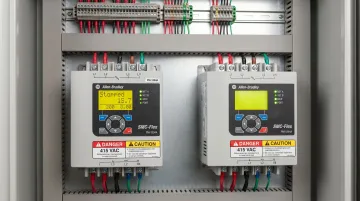
For medium voltage applications — such as large pumps, compressors, and motors in oil and gas or water treatment — medium voltage soft starters deliver the same controlled-start benefits at ratings from 2.3kV to 15kV. ValuAdd's MVE-P Series supports nominal currents from 110A to 1200A, with a maximum start current of 400% FLC for up to 30 seconds — covering motors up to 25,000 HP where DOL starting would stress or destabilize the electrical system.
Use Cases of Soft Starters
Soft starters deliver the most operational value in applications where:
- Centrifugal pumps need protection from water hammer, pipe stress, and pressure surges on abrupt starts
- Conveyor systems require smooth acceleration to prevent product spillage or belt slippage
- Fans and blowers benefit from reduced mechanical stress on drive components
- Compressors require controlled startup to manage torque demand
- High-cycle motors that start and stop frequently throughout a shift
Industries where soft starters are widely preferred:
- Municipal water treatment and wastewater facilities
- Oil and gas operations (pump stations, compressor skids)
- Manufacturing plants with large-motor conveyor systems
- Processing plants (food, chemical, pharmaceutical)
DOL vs. Soft Starter: Which Is Right for Your Operation?
The right starter choice depends on five primary factors:
1. Motor size and HP rating
- DOL: Best for motors under 5-7.5 HP
- Soft starter: Recommended for motors 7.5 HP and above
2. Startup frequency
- DOL: Suitable for fewer than 2-3 starts per hour
- Soft starter: Ideal for frequent starts (10+ per hour)
3. Load sensitivity to mechanical shock
- DOL: Acceptable for robust loads (small compressors, simple drives)
- Soft starter: Essential for pumps, conveyors, precision equipment
4. Electrical infrastructure capacity
- DOL: Requires infrastructure that can handle 6-8× FLA without voltage drop affecting other equipment
- Soft starter: Protects sensitive equipment on shared circuits
5. Total cost of ownership vs. upfront budget
The Demand Charge Reality
Industrial electricity bills include both energy charges (kWh consumed) and demand charges (peak kW draw). Demand charges are typically averaged over 15-minute intervals, meaning a short motor start has a diluted impact on the bill — but the effect scales sharply with motor size.
| Motor Size | Accel. Time | DOL Demand Spike (15-min avg) | Monthly Cost @ $20/kW | Annual Impact |
|---|---|---|---|---|
| 100 HP | 10 sec | ~+1.7 kW | Negligible | ~$40 |
| 500 HP | 30 sec | ~+20 kW | +$400 | ~$4,800 |
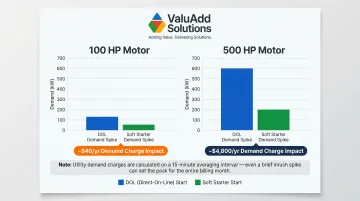
That cost compounds further when utilities apply demand ratchets — billing customers based on a percentage of their peak demand for months after a spike. A single DOL start that sets a new peak can carry financial consequences for nearly a year.
Soft starters limit inrush current, reducing the demand spike and avoiding ratchet penalties. For large motors with frequent starts, the savings can offset the higher upfront cost within 12-18 months.
Situational Recommendation Guide
Choose DOL if:
- Motor is under 5-7.5 HP and starts are infrequent
- Load tolerates sudden torque (fans, small compressors)
- Budget is tightly constrained and electrical infrastructure is dedicated
Choose a soft starter if:
- Motor exceeds 7.5 HP or demand charge exposure is a concern
- Load is shock-sensitive (pumps, conveyors, precision equipment)
- Electrical infrastructure is shared — protecting other equipment matters
- Long-term maintenance cost reduction outweighs the upfront premium
When Neither Is Sufficient
For applications requiring variable-speed control during operation — not just controlled starting — a VFD is the appropriate choice. VFDs provide:
- Precise process control (variable flow, variable speed)
- Energy savings during running (not just startup)
- Full torque control across the speed range
If your process requires flow modulation, speed adjustment under load, or continuous energy optimization during operation, the VFD's higher upfront cost typically pays back faster than a soft starter would in the same application.
Real-World Example: Preventing Pump Failures at a Water Treatment Facility
A municipal water treatment facility operating large centrifugal pumps with DOL starters experienced recurring problems: frequent motor failures, pipe system stress from water hammer, nuisance trips, and high maintenance labor costs. Each hard start subjected the pumps to mechanical shock, gradually damaging bearings, seals, and couplings.
The facility switched to soft starters after a catastrophic pump failure forced an emergency replacement. The transition delivered measurable outcomes:
- Motor repair incidents dropped by 60% in the first year
- Maintenance downtime reduced from an average of 12 hours per month to under 3 hours
- Demand charge reductions of approximately $300-$500 per month due to lower peak current draws
- Motor service life extended by an estimated 3-5 years based on reduced mechanical stress
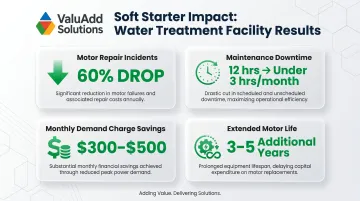
The soft starter investment — approximately $6,500 per motor — paid for itself within 18 months through reduced failures and lower operating costs. Facilities running motors over 10 HP with multiple daily starts tend to see the fastest payback periods.
ValuAdd's RX3E Enclosed Combination Soft Starter and MVRXE Dual Redundant Soft Starters are built for pumping applications like this one, with ANSI protection and smooth acceleration control. Technical support is available to help match the right product to your motor specifications and load profile.
Conclusion
DOL starters remain a legitimate, cost-effective choice for small, infrequently started motors in non-critical applications. For larger motors, high-cycle operations, and environments where equipment longevity and infrastructure stability matter, soft starters offer a compelling operational and financial case.
The key outcomes that matter most to industrial facilities are clear: reduced unplanned downtime, lower utility demand charges, extended motor and mechanical system life, and the ability to protect both equipment and electrical infrastructure in demanding settings. Soft starters deliver these benefits at a higher upfront cost that is quickly offset by operational savings in the right applications.
When selecting a starter, weigh these five factors:
- Motor size — motors above 7.5 HP typically justify the soft starter investment
- Start frequency — high-cycle operations accelerate the ROI on soft starters
- Load characteristics — sensitive mechanical loads (pumps, conveyors, compressors) benefit most from controlled ramp-up
- Infrastructure capacity — facilities with limited transformer capacity or demand charge exposure gain immediate utility savings
- Total cost of ownership — factor in maintenance, downtime risk, and energy costs, not just purchase price
For most motors above 7.5 HP with frequent starts, the soft starter is the right call. For small motors with infrequent starts, DOL keeps things simple and cost-effective — and that's a perfectly valid engineering decision.
Frequently Asked Questions
Which is better, a soft starter or a DOL (direct-on-line) starter?
Neither is universally better. DOL suits small motors (under 5-7.5 HP) with infrequent starts where low upfront cost matters most. Soft starters make more sense for larger motors, frequent cycling, or any application where inrush current and mechanical shock would damage equipment or stress the electrical infrastructure.
Is a DOL starter the same as a soft starter?
They are fundamentally different devices. A DOL starter applies full voltage instantly, drawing 6-8× rated current with no limiting. A soft starter uses thyristors to gradually ramp up voltage, controlling inrush to 2-4× rated current — making them suited to very different motor sizes and application demands.
When should you use a DOL (direct-on-line) starter?
Use a DOL starter for small motors (typically under 5-7.5 HP) with infrequent starts, on loads that can tolerate sudden torque, where simplicity and low upfront cost are the priority — provided your electrical infrastructure can absorb the 6-8× inrush without affecting other equipment.
What motor horsepower range is appropriate for using a DOL starter?
Generally below 5 HP, and up to 7.5 HP in utility-tolerant installations. Grid regulations in many regions cap DOL use above these thresholds specifically because of the voltage dip the 6-8× inrush imposes on the supply network — not just mechanical stress on the motor.
Can a soft starter replace a DOL starter in all applications?
A soft starter can be used in place of a DOL for any motor size, but it is not cost-justified for very small motors with infrequent starts. For applications requiring variable-speed operation during running, a VFD would be more appropriate than either option.
How does inrush current from a DOL starter affect my electricity bill?
Utilities charge industrial customers based on peak current within 15- or 30-minute intervals. The 6-8× inrush from a DOL start can spike demand charges noticeably for large or frequently started motors — soft starters limit that inrush to 2-4× rated current, directly reducing that billing component.