
Introduction
Motor overload protection trip class is not a cosmetic label—it's a binding design parameter that governs how quickly an overload relay will interrupt power when a motor experiences sustained overcurrent. NEMA ICS 2 and UL 508 standards define trip class as the maximum time in seconds a relay will take to trip when subjected to 600% of its full-load ampere (FLA) rating. Class 10 trips in ≤10 seconds, Class 20 in ≤20 seconds, and Class 30 in ≤30 seconds at this test condition.
Getting that number wrong has real consequences. Selecting too fast a class causes nuisance tripping every time the motor starts; too slow, and the relay allows the motor to overheat and fail during an actual overload. Many engineers fall back on a conservative default setting, but that approach either under-protects the motor or creates unnecessary downtime.
What follows breaks down the technical differences between Classes 10, 20, and 30—and how to match each to real industrial applications based on motor starting profiles, load inertia, and thermal withstand limits.
Key Takeaways
- Trip class defines maximum trip time at 600% FLA: Class 10 ≤10 sec, Class 20 ≤20 sec, Class 30 ≤30 sec
- Class 10 provides the tightest protection for standard industrial motors with normal starting profiles
- For high-inrush or extended acceleration applications, Class 20 prevents nuisance tripping
- Class 30 suits very high-inertia loads where motor acceleration runs longer than 20 seconds
- Wrong selection causes either production downtime (too tight) or motor winding failure (too loose)
What Trip Class Represents in Motor Overload Protection
Trip class is a standardized classification per NEMA ICS 2 and UL 508 that specifies the maximum tripping time of an overload relay when subjected to 600% of its set full-load ampere value. The class number represents seconds, not a relative "strength" level. At 600% FLA, a Class 10 relay trips in 10 seconds or less, Class 20 in 20 seconds or less, and Class 30 in 30 seconds or less.
The overload relay sits downstream of the motor starter and contactor, continuously monitoring current draw. When current exceeds a threshold for a duration defined by the trip class time-current curve, the relay opens the control circuit and de-energizes the motor. This protection prevents thermal damage to motor windings under sustained overload conditions.
Trip class is a design specification, not an operating variable. Most thermal (bimetallic) overload relays have a fixed trip class determined by the heater element installed. Modern electronic overload relays from manufacturers like Eaton, Siemens, and Rockwell Automation allow trip class adjustment via DIP switches or software, but once configured, the class defines the relay's time-current characteristic for that installation.
All trip classes follow the inverse-time principle: higher overcurrent magnitudes trigger faster trips regardless of class. Trip class sets the upper time boundary at 600% FLA, but a locked-rotor condition drawing 1000% FLA will trip much faster than the class number suggests. This inverse relationship protects motors across a range of fault severities while accommodating normal starting inrush.
Factors That Drive Trip Class Requirements in Practice
The primary driver of trip class selection is the motor's starting current profile—locked-rotor amperes (LRA) and acceleration time. NEMA Design B motors typically draw 600-700% of rated current during startup. If this elevated current persists for 15 seconds while the motor accelerates a high-inertia load, a Class 10 relay will trip before the motor reaches operating speed—even though no fault exists.
Key application variables that push toward higher trip classes:
- Load inertia — Higher mass requires longer acceleration, sustaining elevated current draw
- Starting frequency — Frequent starts accumulate thermal energy in both motor and relay
- Ambient temperature effects — Thermal relays trip faster above 40°C and slower below 40°C, altering protection behavior
- Starting method — Across-the-line (DOL) starts produce full LRA; soft starters and VFDs reduce inrush and may allow tighter trip classes
When evaluating these factors, always cross-reference the motor's thermal withstand time at locked-rotor current—published by the manufacturer—against your selected trip class. That value sets the absolute ceiling: no trip class should allow protection to outlast the motor's rated thermal tolerance.
Class 10, 20, and 30: What Each Rating Means
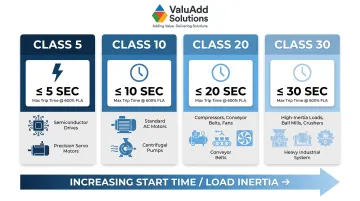
Each trip class defines a distinct time-current band suited to specific motor applications. At 600% FLA, Class 10 trips in ≤10 seconds, Class 20 in ≤20 seconds, and Class 30 in ≤30 seconds. Class 5 also exists, providing ultra-fast protection (≤5 seconds at 600% FLA) for hermetically sealed compressor motors and tightly wound small motors where any sustained overcurrent causes rapid thermal damage.
Class 10: Fast-Response Protection for Standard Motors
Class 10 is the default specification for most industrial motor applications. It suits motors with short acceleration times—typically under 8-10 seconds—including standard NEMA Design B motors in applications like:
- Conveyor lines (unloaded or lightly loaded)
- Centrifugal pumps
- Fans and blowers
- Machine tools (lathes, mills)
- Agitators and chillers
Class 10 provides the tightest thermal protection among common classes. The 10-second window at 600% FLA leaves little room for heat to accumulate in motor windings, interrupting faults before damage occurs. For motors that start quickly and rarely sustain overcurrent, it delivers strong protection without nuisance tripping.
Class 20: Balanced Protection for High-Inrush Applications
Class 20 is the appropriate choice when a motor's starting current remains elevated long enough to trip a Class 10 relay before the motor reaches operating speed. Common applications include:
- Loaded reciprocating compressors
- Large squirrel-cage motors
- Ball mills
- Heavily loaded conveyors
- Positive displacement pumps
- Presses with flywheels
Class 20 is correctly matched to the motor's thermal profile, not a compromise in protection. Using Class 10 on a high-inrush motor causes nuisance tripping with no actual fault present. Class 20 allows the acceleration phase to complete within 10-20 seconds while still intervening before the motor exceeds its thermal limit.
Class 30: Extended Time for High-Inertia and Heavy-Duty Loads
Class 30 is reserved for motors with very long start times or high-inertia loads where the starting cycle legitimately exceeds 20 seconds. Examples include:
- Large ball mills and crushers
- Centrifuges
- High-mass industrial fans (>75 HP)
- Shredders and wood chippers
- Winding equipment in paper and steel mills
Select Class 30 with care. The extended tripping window allows more thermal energy to build in the motor, so it is appropriate only when the motor's thermal withstand rating, confirmed from manufacturer data, supports the longer exposure time.
For severe-duty applications in this category, ValuAdd's MVDH Series Two-High MV Soft Starter and MVRXE Dual Redundant Solid State Soft Starters are designed to handle extended starting cycles, reducing mechanical stress during the prolonged acceleration period that Class 30 loads require.
How to Select the Right Trip Class for Your Application
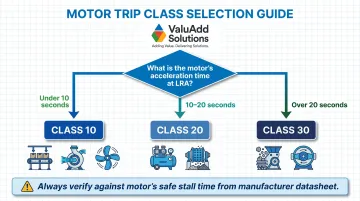
The primary selection criterion is matching the motor's locked-rotor time (the duration the motor draws near-LRA current) against the trip class window. The relay must permit the full starting sequence without tripping, while still intervening before the motor reaches its thermal limit under a true overload.
Practical application-based decision framework:
- Standard NEMA Design B motor with <10 sec start → Class 10
- Motors with high LRA and 10-20 sec acceleration → Class 20
- Very high inertia loads or start times >20 sec → Class 30
- Motor datasheet's safe stall time at operating temperature is the binding upper limit, not the trip class number
Interaction between starting method and trip class:
Motors started via soft starters or VFDs experience a controlled, reduced current ramp rather than full locked-rotor inrush. This softer start profile may allow selection of a lower, more protective trip class than would be required for the same motor started across-the-line.
Starting frequency considerations:
Applications with frequent starts per hour accumulate thermal energy in both the motor and relay. A higher starting frequency may require stepping up in trip class to avoid nuisance tripping — validate this against the motor's thermal model rather than assuming a higher class will suffice.
Electronic overload relays with thermal memory maintain an accurate model across stop/start cycles. ValuAdd's RX2E and RX3E Enclosed Combination Soft Starters include this capability, providing more reliable protection in frequent-start applications than standard bimetallic relays.
Real-World Variables That Affect Trip Class Behavior
Trip class behavior is not static. Several real-world conditions alter how quickly a relay responds to overcurrent, sometimes in ways that appear inconsistent if only nameplate specifications are consulted.
Cold-state versus hot-state trip curves:
A thermally cold relay at ambient temperature takes longer to trip than a hot relay already near its thermal threshold. Motors that cycle frequently operate under hot-state characteristics, receiving faster tripping response during repeated starts. This can cause tripping events that appear unexplained if only the cold-state curve was consulted during selection. Electronic overload relays model this behavior more accurately, maintaining thermal memory even after power removal.
Phase-loss effects on trip timing:
When a three-phase motor loses one phase, the remaining two phases carry 173% of normal current to maintain torque. Standard bimetallic thermal relays respond to the average heating across all three phases. Because one phase is at zero, the average is lower than the actual heating in the two loaded phases, causing slower response — potentially 20 to 40 seconds in a Class 20 relay.
Modern electronic overload relays detect phase loss much faster (typically 2-10 seconds) because they monitor each phase independently rather than averaging. ValuAdd's RX2E and RX3E soft starters include single-phase protection, current imbalance monitoring, and ground fault detection that operate independently of the configured trip class, providing faster response to these specific fault conditions.
Thermal versus electronic overload relays:
Thermal (bimetallic) relays have a fixed bimetallic element whose heating characteristic determines trip class. They are sensitive to ambient temperature and reset to a cold state after each trip — meaning each start begins without thermal history unless the motor has been running recently.
Electronic overload relays offer meaningful advantages for demanding applications:
- Use current transformers and microprocessor-based thermal modeling for accurate heat tracking
- Maintain thermal memory across stop/start cycles, even after power removal
- Allow trip class to be configured via software for flexible commissioning
- Perform consistently across varying ambient temperatures without derating adjustments
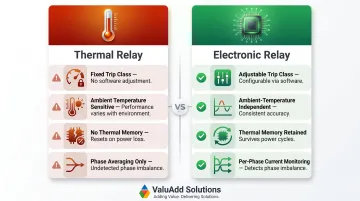
For applications with frequent cycling, high ambient heat, or variable load profiles, electronic relays provide more reliable protection than thermal alternatives.
Consequences of Wrong Trip Class Selection
Selecting a trip class that is too low (under-tolerant) for the application creates operational disruption. The relay trips during every normal startup sequence, requiring manual resets and causing production interruptions. Maintenance teams often incorrectly assume relay malfunction and either bypass the protection or replace it with a higher class unit without diagnosing the root cause. This defeats the purpose of overload protection and exposes the motor to unprotected operation.
Selecting a trip class that is too high (over-tolerant) allows sustained elevated current longer than the motor's thermal withstand permits. In a true overload or stall condition, the delayed response lets heat build in the stator windings unchecked. The downstream consequences include:
- Accelerated insulation degradation
- Winding failure
- Bearing damage
- Motor fire in severe cases
These physical risks carry a compliance dimension as well. Specifying an incorrect trip class may place the motor outside its manufacturer-warranted operating envelope and conflict with NFPA 70 (NEC) requirements for motor branch circuit and overload protection. NEC 430.32 requires overload protection to trip at 125% of FLA for motors with a 1.15 service factor, and 115% FLA for 1.0 service factor motors. The selected trip class must coordinate with these ultimate trip current requirements while accommodating the motor's starting profile.
Common Misinterpretations of Trip Class in Practice
The most common misconception is that a higher trip class number always means "better" or "safer" protection. In reality, using Class 20 or 30 on a standard motor that only needs Class 10 reduces protection against genuine overloads and extends the thermal stress window unnecessarily.
Engineers sometimes treat the trip class number as the only relevant parameter, ignoring the cold versus hot state trip difference, starting frequency, and whether the motor's thermal withstand time actually supports the selection.
Trip class must be evaluated in the context of the full motor system — starting method, duty cycle, ambient conditions, and manufacturer thermal data — not pulled from a default setting or rule of thumb.
Conclusion
Trip class is not a generic setting. It is an application-specific parameter that must be matched to the motor's starting profile, thermal characteristics, duty cycle, and starting method. Defaulting to Class 20 across all applications sacrifices motor protection on motors that only require Class 10, while forcing Class 10 on high-inrush applications causes unnecessary downtime.
Engineering judgment and motor manufacturer data outweigh generalized defaults. When starting times are ambiguous or load profiles are variable, reference the motor's safe stall time curve and work with a qualified system integrator — that combination produces a more reliable protection strategy than any rule-of-thumb class selection.
ValuAdd's technical team provides application review and system design support, helping ensure overload relay selection aligns with your motor's protection requirements and real-world operating conditions.
Frequently Asked Questions
What is motor protection class?
Motor protection class (trip class) is a standardized rating for overload relays that defines the maximum time the relay will take to trip at 600% of its full-load current setting. The class number directly represents that time in seconds.
What do motor protection trip classes 10, 20, and 30 mean?
Each number represents the maximum tripping time in seconds at 600% FLA. Class 10 trips in ≤10 seconds for standard motors with short acceleration times, Class 20 in ≤20 seconds for high-inrush applications with extended starting periods, and Class 30 in ≤30 seconds for very high-inertia or long-start loads like crushers and centrifuges.
What is Class 10 overload protection?
Class 10 is the most common trip class, suited to standard NEMA Design B motors that reach full speed in under 8–10 seconds. Its tight 10-second trip window minimizes heat accumulation in motor windings, making it the default choice for most general industrial applications.
What is Class 20 overload protection?
Class 20 is designed for motors where Class 10 would cause nuisance trips during normal startup—loaded compressors, ball mills, and large pumps with high locked-rotor inrush or acceleration periods of 10–20 seconds. This isn't weaker protection; it's the correct match for motors that legitimately need more time to reach full speed.
What are the different types of overload protection?
Overload protection types include thermal (bimetallic) overload relays, electronic (solid-state) overload relays, and motor protection relays with integrated phase-loss and ground-fault detection. Electronic relays offer greater flexibility across all trip classes, including adjustable trip class settings, thermal memory retention, and immunity to ambient temperature variations.
What is the difference between Class 5 and Class 10 motor trip?
Class 5 trips in ≤5 seconds at 600% FLA and is designed for ultra-fast protection of hermetically sealed compressor motors and tightly wound small motors where any sustained overcurrent causes rapid thermal damage. Class 10 allows twice the time (≤10 seconds) and is suited to a broader range of standard industrial motors with short to moderate acceleration periods.