Introduction
When specifying a VFD, control panel, or motor starter for an industrial facility, the enclosure rating on the nameplate isn't just a formality. Choosing the wrong one can result in equipment failure, safety hazards, or costly downtime. A coastal facility discovered this the hard way when they installed NEMA 4-rated panels that corroded within 18 months due to salt air, resulting in over $50,000 in replacement costs and production downtime.
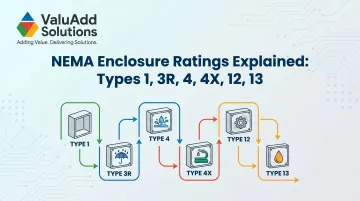
NEMA enclosure ratings exist to remove guesswork by defining exactly what conditions a given enclosure can withstand. This article explains the six most commonly used types—1, 3R, 4, 4X, 12, and 13—and what distinguishes each type so you can select the right one for your environment and application.
Key Takeaways
- NEMA ratings are standardized classifications that specify what environmental conditions an electrical enclosure can safely withstand
- Types 1, 3R, 4, 4X, 12, and 13 are most commonly specified for industrial, commercial, and manufacturing environments
- Type 1 suits basic indoor use; Types 12 and 13 handle indoor industrial dust or oil; Types 3R, 4, and 4X cover outdoor and wash-down environments
- Higher numbers don't guarantee better protection—each type targets specific environmental hazards
- Choose based on location, exposure to moisture, dust, oil, corrosives, and long-term reliability needs
What Are NEMA Enclosure Ratings?
NEMA stands for the National Electrical Manufacturers Association. NEMA enclosure ratings are standardized designations defined in ANSI/NEMA 250 that classify the level of protection an electrical enclosure provides to both personnel and internal equipment against specific environmental hazards.
Ratings account for variables such as:
- Indoor versus outdoor installation
- Dust and water ingress
- Oil and coolant exposure
- Corrosion resistance
- Ice formation
An enclosure only provides its stated protection when correctly installed and maintained.
Using an under-rated enclosure in a wash-down area or corrosive environment can lead to electrical failure, equipment damage, and compliance violations. OSHA requires that live parts operating at 50 volts or more be guarded against accidental contact by approved enclosures, and violations can result in citations and fines. Meanwhile, over-specifying adds cost without practical benefit.
NEMA Enclosure Types Explained: Types 1, 3R, 4, 4X, 12, and 13
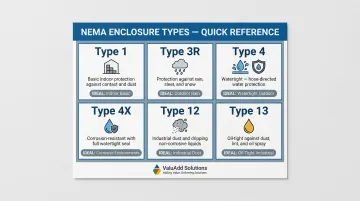
These six types represent the enclosures most commonly specified in industrial control, automation, and electrical distribution applications. Each is optimized for a distinct set of environmental conditions rather than existing on a simple low-to-high scale.
Type 1 — Basic Indoor Protection
Type 1 is a general-purpose indoor enclosure that protects against contact with live parts and provides limited protection against falling dirt, but is not sealed against dust, moisture, or liquids of any kind.
Best-fit use cases:
- Clean, dry indoor environments such as office electrical panels
- Lighting control cabinets in climate-controlled spaces
- Distribution boards in commercial buildings
Type 1 is not appropriate for any setting where moisture, dust, or industrial contaminants are present.
Type 3R — Outdoor Weatherproof (Rain-Rated)
Type 3R is an indoor/outdoor enclosure rated for rain, sleet, and ice, but not windblown dust. ANSI/NEMA 250 includes provisions for drainage openings that allow limited water entry and ventilation, distinguishing it from fully sealed types like 4. These drainage openings range from 1/8 inch to 1/4 inch in diameter.
Best-fit use cases:
- Outdoor utility boxes and metering equipment
- Rooftop electrical panels
- Distribution enclosures in partially sheltered locations
Type 3R is not suitable for dusty environments or wash-down applications. For outdoor pump installations where this rating is the right fit, ValuAdd's CSXi Series Pump Panels are built to NEMA 3R specs for rooftop and exposed-location deployments.
Type 4 — Watertight and Dust-Tight (Indoor/Outdoor)
Type 4 is a fully watertight and dust-tight enclosure for indoor or outdoor use, rated to withstand rain, splashing water, and hose-directed water, as well as external ice formation. UL 50 testing requires a stream of water from a 1-inch nozzle delivering at least 65 gallons per minute.
Best-fit use cases:
- Pump stations and industrial wash-down areas
- Food and beverage processing facilities
- Outdoor control panels housing VFDs or motor starters
- Enclosures in environments with active water exposure
Critical limitation: Type 4 does not include corrosion resistance, which limits its use in chemical or coastal environments.
Type 4X — Watertight, Dust-Tight, and Corrosion-Resistant
Type 4X provides identical water and dust protection to Type 4 with the addition of corrosion resistance. Testing requires a 600-hour salt spray baseline, then an additional 200-hour exposure — with results evaluated against an AISI 304 stainless steel control specimen to confirm corrosion resistance.
Type 4X is typically achieved through stainless steel (304 or 316) or non-metallic (polycarbonate/fiberglass) construction, making it the most commonly specified type for corrosive industrial and outdoor environments.
Common construction materials:
| Material | Best For |
|---|---|
| 304/316 Stainless Steel | Food processing, marine environments, washdown zones |
| Fiberglass-Reinforced Polyester | Chemical plants, wastewater treatment, cost-effective corrosion resistance |
| Polycarbonate | Lightweight applications requiring UV resistance and non-metallic construction |
Best-fit use cases:
- Water and wastewater treatment facilities
- Coastal or marine installations
- Chemical processing plants
- Food production plants with caustic wash-downs
- Any environment where corrosive agents are present
When housing VFDs or drives in these environments, enclosure selection matters as much as the drive spec itself. ValuAdd's SW Series Washdown Drives use UL Type 4X polycarbonate enclosures rated for high-pressure washdowns and direct corrosive exposure.
Type 12 — Indoor Industrial (Dust and Drip Protection)
Type 12 is an indoor-only enclosure that is dust-tight against circulating dust, fibers, lint, and flyings, and provides protection against dripping non-corrosive liquids — making it the step up from Type 1 for most manufacturing floor applications. It is not rated for hose-directed water, spraying oil, or outdoor use. Standard Type 12 enclosures are constructed without knockouts.
Best-fit use cases:
- Manufacturing floors and automation control panels
- Motor control centers
- Electrical enclosures near conveyor systems or dust-generating equipment
For soft starter applications in these settings, ValuAdd's RX4E Series Packaged Soft Starters ship in NEMA 12 enclosures — ready for motor control center integration without additional housing.
Type 13 — Indoor Oil-Tight and Dust-Tight
Type 13 goes beyond Type 12 by also protecting against the spraying, splashing, and seepage of oil and non-corrosive coolants—making it oil-tight as well as dust-tight.
Best-fit use cases:
- Enclosures near CNC machines and hydraulic presses
- Metalworking equipment environments
- Lube systems where cutting fluids, machine oils, or coolant mist are present
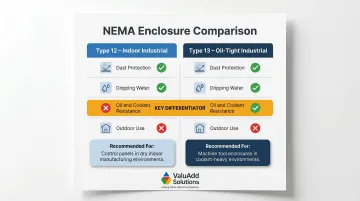
That oil and coolant resistance is the single defining difference between the two types:
| Feature | Type 12 | Type 13 |
|---|---|---|
| Dust Protection | ✓ | ✓ |
| Dripping Water | ✓ | ✓ |
| Oil & Coolant | ✗ | ✓ |
| Best Use | Dry manufacturing | Metalworking, CNC |
NEMA vs. IP Ratings: What's the Difference?
IP (Ingress Protection) ratings are an international standard from the IEC that use two digits to classify protection against solid particle intrusion and liquid ingress. While NEMA and IP ratings are often cross-referenced, NEC Section 110.28 explicitly states that "IP ratings are not a substitute for Enclosure Type ratings".
NEMA ratings cover factors that IP ratings don't, including:
- Corrosion resistance (mandatory testing for NEMA 4X)
- Oil and coolant exposure
- Ice formation on enclosure surfaces
- Installation context and environmental conditions
An IP66-rated enclosure does not automatically satisfy NEMA 4X standards — the two systems test for different things. For projects with international scope or global equipment sourcing, specify both ratings explicitly rather than treating one as a substitute for the other.
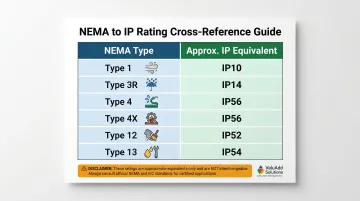
NEMA to IP Approximate Comparison
| NEMA Type | Approximate IP Equivalent |
|---|---|
| Type 1 | IP10 |
| Type 3R | IP14 |
| Type 4 | IP56 |
| Type 4X | IP56 |
| Type 12 | IP52 |
| Type 13 | IP54 |
Note: These are approximate comparisons only. NEMA ratings meet or exceed the associated IP ratings, but the conversion cannot be used in reverse.
How to Choose the Right NEMA Enclosure Type
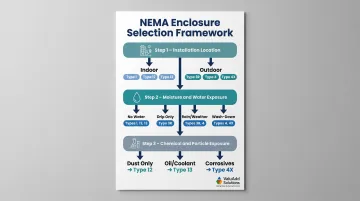
Start with Installation Location
This is your first filter. Indoor-only environments narrow the choice to Types 1, 12, or 13. Environments that are either indoor or outdoor open up Types 3R, 4, and 4X. Misidentifying the installation environment is one of the most common specification errors.
Assess Moisture and Water Exposure
Distinguish between:
- No water exposure: Type 1
- Drip and splash only: Type 12
- Outdoor rain and weather: Type 3R
- Active wash-down or hose-directed water: Types 4 and 4X
When in doubt about future wash-down procedures, defaulting to Type 4 or 4X is safer than Type 12 or 3R.
Evaluate Particle and Chemical Exposure
- Circulating dust/fibers, no oil: Type 12
- Oil and coolant environments: Type 13
- Corrosive chemicals, saltwater, or cleaning agents: Require the "X" designation (Type 4X)
The "X" designation is essential in water treatment, oil and gas, and food processing industries where exposure to corrosive substances is common.
Consider Total Cost of Ownership
Type 4X costs more upfront than Type 12 or 3R — but a single unplanned shutdown in a corrosive environment typically exceeds the price difference many times over. A useful rule of thumb:
- Compare the replacement cost of the protected equipment against the enclosure upgrade cost
- Factor in downtime risk, especially in continuous-process industries like water treatment or oil and gas
- Lean toward the higher rating whenever operating conditions may evolve
ValuAdd's engineering team can help match enclosure ratings to specific applications based on your installation environment and control system requirements.
Common Mistakes to Avoid When Selecting a NEMA Enclosure
Three specification errors account for a disproportionate share of enclosure failures in industrial settings. Avoiding them starts with understanding where the reasoning typically breaks down.
Selecting Based on Current Conditions Only
Don't choose the lowest-rated enclosure that technically meets today's minimum requirement. Future process changes, cleaning procedures, and seasonal environmental exposure all affect whether your enclosure remains adequate. Specifying Type 1 in a facility that later adds a wash-down protocol is a common and entirely avoidable failure.
Treating NEMA and IP Ratings as Interchangeable
Specifying IP66 does not guarantee NEMA 4X compliance. In regulated industries — water treatment, food production, oil and gas — NEMA compliance may be required by code or by the equipment manufacturer. IP ratings address ingress protection only; NEMA ratings carry additional construction and performance requirements that IP codes don't cover.
Overlooking the "X" Corrosion Designator Until Damage Occurs
Corrosion-related failures tend to go undetected until a critical component is already damaged. If your environment involves cleaning chemicals, saltwater, humidity, or acidic atmospheres, only an "X"-designated enclosure provides the corrosion resistance needed for long-term reliability.
Conclusion
NEMA enclosure ratings provide a standardized, reliable framework for protecting electrical equipment across a wide range of industrial environments. Knowing what Types 1, 3R, 4, 4X, 12, and 13 each cover makes it straightforward to match the right enclosure to any installation.
The right choice starts with the actual environment — the specific hazards, moisture exposure, and contaminants present on site. Specifying to those conditions, rather than defaulting to the most common type, is what prevents premature failures and costly replacements down the line.
Frequently Asked Questions
What are NEMA ratings for enclosures?
NEMA ratings are standardized classifications from the National Electrical Manufacturers Association that define the level of protection an electrical enclosure provides against environmental hazards such as dust, water, oil, corrosion, and ice. They are defined in ANSI/NEMA 250.
What is the difference between Type 4 and Type 12 enclosures?
Type 4 is rated for indoor and outdoor use with full watertight and dust-tight protection including hose-directed water, while Type 12 is indoor-only and protects against circulating dust and dripping liquids but is not rated for water spray or outdoor weather exposure.
Is IP66 equivalent to NEMA 4X?
IP66 and NEMA 4X share similar water and dust protection levels but are not interchangeable. NEMA 4X also requires corrosion resistance and accounts for ice formation and installation context — factors IP66 does not cover — so an IP66 rating alone does not confirm NEMA 4X compliance.
What is the difference between Type 1 and Type 2 enclosures?
Both are indoor-only enclosures, but Type 1 only protects against falling dirt and contact with live parts. Type 2 adds drip shields for protection against falling water and light splashing, making it the right choice for areas with condensation or minor moisture exposure.
Is NEMA 6 better than NEMA 4?
NEMA 6 is not a universal upgrade over NEMA 4. It handles temporary submersion at 6 feet for 30 minutes and hose-directed water, but does not add corrosion resistance the way 4X does. Choose NEMA 6 when submersion risk is the primary concern; choose 4X for corrosion or wash-down environments.
What is a Type 7 enclosure used for?
NEMA Type 7 enclosures are used in indoor Class I, Division 1 hazardous locations (Groups A, B, C, or D under NFPA 70), where flammable gases or vapors are present under normal operating conditions. They are explosion-proof designs built to contain an internal ignition without allowing it to propagate to the surrounding atmosphere.