Introduction
A plant engineer receives an urgent call from the local electrical inspector: the manual transfer switch installed last month—assembled from individually UL Listed breakers, enclosures, and wiring components—has failed the final inspection. The inspector demands a complete UL 1008 Listed assembly before issuing the certificate of occupancy. The project is now weeks behind schedule, and the facility's backup power system remains offline.
This scenario highlights the critical distinction many engineers and system integrators miss: individual component listings do not equal a certified transfer switch assembly. UL 1008—the UL standard governing transfer switch equipment—validates the complete assembly's performance under fault, overload, and switching conditions.
For engineers, system integrators, and facility managers specifying transfer switches for industrial manufacturing, healthcare facilities, or municipal water treatment plants, a gap in UL 1008 knowledge translates directly into failed inspections, delayed occupancy certificates, and offline backup power.
This article covers what UL 1008 certifies, the rigorous testing required, how to interpret short-circuit ratings, the four distinct certification types, and how UL 1008 connects to NEC compliance and Authority Having Jurisdiction (AHJ) approval.
Key Takeaways
- UL 1008 certifies complete transfer switch assemblies—both automatic (ATS) and manual (MTS)—not individual components
- Switches must survive Normal Operation, Overload, Temperature, Endurance, Dielectric, and Short-Circuit Withstand/Closing tests
- Withstand and Closing Ratings (WCR) must meet or exceed available fault current at the installation site
- Four ATS certification types cover distinct fault scenarios: Time-Based, Specific Breaker, Fuse-Protected, and Short-Time Rating
- AHJs increasingly reject field-assembled panels built from individually listed components
What Is UL 1008 and Why Does It Exist?
UL 1008 is the definitive safety standard for transfer switch equipment, published by Underwriters Laboratories to govern complete assemblies—not individual parts. Edition 9, released in July 2022, expanded the scope to include equipment rated up to 1000V and formally integrated Branch Circuit Emergency Lighting Transfer Switches (BCELTS).
Transfer switches serve a life-safety function: they must reliably switch between normal and emergency power sources when it matters most. Performance under severe fault conditions, sustained overloads, and repeated switching cycles cannot be assumed from component ratings alone.
A UL Listed breaker inside a UL Listed enclosure does not automatically produce a safe, reliable transfer switch. The interactions between components under stress must be validated together, as an integrated system.
Scope of equipment covered:
- Automatic Transfer Switches (ATS) — standard for generator and utility source switching
- Manual Transfer Switches (MTS) — operator-initiated source changeover
- Branch Circuit Emergency Lighting Transfer Switches (BCELTS) — added via 2017 NEC Article 700.25 for circuits ≤20A
- Bypass/isolation and closed-transition switches — used where zero-interruption transfer is required
Understanding which switch type falls under UL 1008 is the first step — the standard's testing requirements then determine exactly how each must perform.
UL 1008 Testing Requirements Explained
To earn UL 1008 certification, a transfer switch assembly must pass a rigorous series of performance and safety tests:
Core Performance Tests
| Test | What It Validates | Key Concern Addressed |
|---|---|---|
| Normal Operation | Correct switching under standard conditions | Basic function: open, close, transfer |
| Overload | Carries current above rated capacity for set duration | Inrush currents and temporary overloads |
| Temperature | All components stay within safe limits at 100% load | Poor connections, undersized conductors, ventilation |
| Endurance | Survives thousands of transfer cycles under full load | Mechanical and electrical durability over service life |
| Dielectric Voltage-Withstand | Insulation integrity above rated voltage | Voltage transients, moisture, and contaminants |
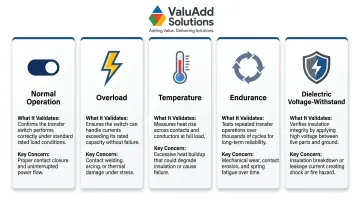
These five tests establish baseline performance. The more demanding tests — and the ones most relevant to specifiers in industrial and critical-power applications — address fault conditions.
Critical Short-Circuit Tests
Short-Circuit Withstand Test
The switch is held closed in the Source 1 position while fault current is applied. The test simulates a downstream fault with the switch already closed. After the fault clears, the switch must demonstrate:
- Ability to transfer electrically and manually to the alternate source
- No breakage of internal parts or switch base
- Cabinet door remains secure
- Cables stay connected without insulation damage
- No electrical continuity between normal and alternate terminals
- Passes dielectric re-test
Short-Circuit Closing Test
The most demanding scenario: the switch starts with contacts open and must close into an active fault. This simulates an emergency transfer into a fault condition on the alternate source. The switch must meet the same post-fault survivability criteria as the Withstand Test.
Short-Time Current Rating Test (Optional)
A newer test assessing whether the switch can sustain a fault for extended durations—typically 0.1 to 0.5 seconds (6 to 30 cycles)—and remain operational. After the short-time test, the switch must pass an additional temperature-rise test to confirm it can still carry rated current. This rating is critical for systems requiring selective coordination, where upstream breakers delay tripping to allow downstream devices to clear faults first.
What Passing These Tests Confirms
When a transfer switch carries UL 1008 certification, buyers and specifiers know the entire assembly—enclosure, switching mechanism, contacts, wiring, and terminals—has been validated under the most severe conditions the standard defines.
For system integrators and facility engineers, that distinction matters at spec time. A certified assembly arrives with documented fault-current ratings, tested insulation, and proven mechanical endurance — no additional third-party verification required before commissioning.
Understanding Short-Circuit Withstand and Closing Ratings (WCR)
Withstand and Closing Rating (WCR) defines the maximum symmetrical fault current at nominal voltage that a transfer switch can safely sustain until an upstream protective device clears the fault. The transfer switch's WCR must equal or exceed the available fault current at the installation point; a switch undersized for the available fault current presents a direct safety hazard.
UL 1008 Short-Circuit Rating Tiers
The standard establishes minimum fault current levels and time durations based on the switch's amperage rating:
| Switch Rating (Amperes) | Minimum Fault Current | Power Factor | Minimum Time Duration |
|---|---|---|---|
| ≤100A | 5,000A | 0.40–0.50 | 0.008 seconds (0.5 cycles) |
| 101–400A | 10,000A | 0.40–0.50 | 0.025 seconds (1.5 cycles) |
| 401–1000A | 20× rating (min 10,000A) | 0.25–0.30 | 0.050 seconds (3 cycles) |
| ≥1001A | 20× rating | ≤0.30 | 0.050 seconds (3 cycles) |
The higher the amperage rating, the more severe the test conditions. A 600A switch, for instance, must withstand at least 12,000A for 0.05 seconds.
Withstand vs. Closing: What's the Difference?
- Withstand Test: The switch is already closed when the fault occurs and must survive without damage while the upstream device clears it.
- Closing Test: The switch closes into a pre-existing fault condition — the more demanding of the two scenarios, since it replicates an emergency transfer onto a faulted source.
Why WCR Matters in Specification
A transfer switch with a 10,000A WCR installed where 18,000A of fault current is available will exceed its design limits under a fault event. The result can be contact welding, internal arcing, enclosure rupture, or complete failure — injuring personnel and damaging downstream equipment.
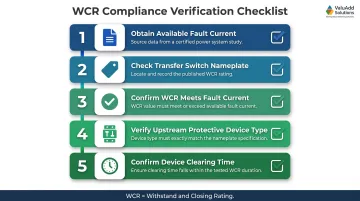
How to verify WCR compliance:
- Obtain the available fault current at the installation point from the facility's power system study
- Check the transfer switch nameplate for its rated WCR value
- Confirm the WCR equals or exceeds the available fault current
- Verify the upstream protective device type (breaker or fuse) matches the nameplate specification
- Ensure the protective device clearing time falls within the switch's tested duration
The Four Types of ATS Short-Circuit Certifications
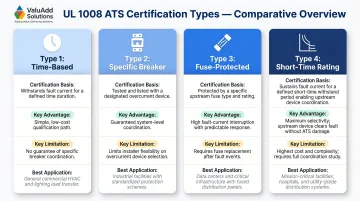
UL 1008 permits four distinct certification approaches, each offering different engineering trade-offs:
Type 1: Time-Based Rating
The switch is certified to withstand a specific fault current for a defined duration (marked in seconds, e.g., 0.050s). Any manufacturer's external circuit breaker can be used, provided it clears the fault within the specified time.
This approach offers maximum flexibility in breaker selection, but produces lower kA ratings than the other three types. It suits projects where breaker brand flexibility outweighs the need for maximum fault current capacity.
Type 2: Specific Manufacturer's Circuit Breaker
The switch is tested with a specific external breaker model. The breaker's published instantaneous clearing time must be ≤ the switch's tested duration.
Locking in a specific breaker model achieves higher withstand current ratings (WCR) than time-based certifications. The trade-off: contractors must use the exact tested breaker, with no substitutions. Use this type when maximizing WCR on high-fault-current installations justifies that restriction.
Type 3: Protected by Fuse
The switch is tested in series with specific classes of current-limiting fuses, which offer the fastest fault clearing available.
This approach delivers the highest possible short-circuit ratings — but it requires fuses rather than breakers, which rules it out for some applications. It's the right choice for installations with extremely high available fault currents where maximum protection takes priority.
Type 4: Short-Time Rating with External Breaker
The switch withstands faults for extended durations (0.1 to 0.5 seconds / 6 to 30 cycles) and passes a subsequent temperature-rise test. This certification enables selective coordination — allowing upstream breakers to delay tripping so downstream devices can clear faults first.
Type 4 is the most demanding certification: fewer switches carry it because of its extended withstand and temperature-rise test requirements. In return, it enables NEC-compliant selective coordination — critical for complex distribution systems in healthcare, data centers, or industrial facilities where fault isolation must occur at the point closest to the problem.
The table below summarizes the key distinctions at a glance:
| Type | Certification Basis | Key Advantage | Key Limitation | Best Application |
|---|---|---|---|---|
| 1 | Time-based (seconds) | Any breaker brand allowed | Lower kA ratings | Projects prioritizing breaker flexibility |
| 2 | Specific breaker model | Higher WCR than Type 1 | One breaker model only | High-fault-current installs |
| 3 | Current-limiting fuses | Highest short-circuit ratings | Fuses required, no breakers | Extreme fault-current environments |
| 4 | Short-time + temp rise | Enables selective coordination | Most stringent; fewest options | Healthcare, data centers, industrial |
UL 1008 vs. UL Listed Components: Why the Distinction Matters
A common misconception is that assembling a transfer switch from a UL 50 Listed enclosure, UL 489 Listed breakers, and other individually Listed components produces a UL 1008 Listed transfer switch. It does not. Individual component listings confirm only that each part meets its own product standard — they say nothing about how those components interact under fault, overload, or repeated switching conditions.
UL Recognized Components are evaluated for factory installation only, where their limitations are known and controlled. Field installation by contractors falls outside that scope. In practice, products bearing only the UL Recognized Component mark may be treated as unlisted assemblies during AHJ inspection — and rejected.
UL 1008 certification means the complete, factory-assembled unit has passed the full battery of tests — confirming the assembly performs as designed under the most severe conditions. Products like ValuAdd's Socomec SIRCOVER UL manual transfer switches and ATyS FT automatic transfer switches are built to meet this standard as complete, certified assemblies.
Practical Benefits for Specifiers
Specifying UL 1008 eliminates the burden of independently verifying that a self-assembled design meets all transfer switch requirements. This reduces:
- Design time (no need to validate component interactions)
- Compliance risk (no AHJ rejection due to unlisted assemblies)
- Liability exposure (manufacturer assumes responsibility for system-level performance)
How UL 1008 Connects to NEC and AHJ Compliance
UL 1008 is explicitly referenced throughout the National Electrical Code (NFPA 70) and NFPA 99:
NEC Article 700.25 – Branch Circuit Emergency Lighting Transfer Switches
Introduced in the 2017 NEC, this section permits emergency lighting loads on branch circuits (≤20A) to be transferred using a Listed Branch Circuit Emergency Lighting Transfer Switch (BCELTS). An informational note directs users to UL 1008 for these devices. Specifiers must require UL 1008 BCELTS rather than UL 924 Automatic Load Control Relays (ALCRs), which are not evaluated for transferring between two non-synchronous power sources.
NEC Article 517 & NFPA 99 – Health Care Facilities
These codes govern the Essential Electrical System (EES) in healthcare settings. NFPA 99 requires automatic transfer switches to restore power to critical systems within 10 seconds. Manual transfer switches listed under UL 1008 are evaluated against Article 517 and NFPA 99 requirements — giving specifiers a clear compliance path for non-automatic switching in healthcare applications.
NEC Article 702 – Optional Standby Systems
UL 1008 covers transfer switches for optional standby systems, confirming that source separation meets the same safety thresholds required of emergency systems — a distinction that matters during AHJ inspections at industrial and municipal facilities.
AHJ Inspection Considerations
Authorities Having Jurisdiction increasingly require manual transfer switches to carry the same UL 1008 listing as automatic switches, since both perform the same fundamental switching function. A UL 1008 Listed unit arrives pre-evaluated — which typically streamlines local inspection compared to a field-assembled panel and reduces the risk of costly project delays.
Relevant applications where code compliance intersects UL 1008 requirements:
- Healthcare facilities (hospitals, clinics, nursing homes)
- Industrial manufacturing (processing plants, assembly operations)
- Municipal water/wastewater treatment
- Data centers and telecommunications facilities
- Any facility with optional or legally required standby power systems
Frequently Asked Questions
What is the UL 1008 standard for transfer switches?
UL 1008 is the Underwriters Laboratories Standard for Safety specifically developed for transfer switch equipment. It covers both automatic and manual switches and validates the complete factory-assembled unit—not just individual components—through rigorous performance and fault-condition tests.
What is the difference between a UL 1008 Listed transfer switch and one built from UL Listed components?
UL 1008 certifies the complete assembled unit as a transfer switch system, whereas individual UL Listed components (enclosure, breakers, connectors) carry separate product-level listings that do not validate transfer switch performance as a whole. This distinction is critical for AHJ approval and system reliability.
Does UL 1008 apply to both manual and automatic transfer switches?
Yes, UL 1008 applies to both automatic (ATS) and non-automatic (manual/MTS) transfer switches. AHJs increasingly apply the same listing requirement to manual units because both types switch between power sources and serve the same fundamental safety function.
What are withstand and closing ratings (WCR) and why do they matter?
WCR defines the maximum fault current a transfer switch can safely handle until an upstream protective device clears it. The switch's WCR rating must meet or exceed the available fault current at the installation site to prevent catastrophic failure, contact welding, or enclosure rupture during fault conditions.
How does UL 1008 relate to the National Electrical Code (NEC)?
UL 1008 Listed transfer switches are evaluated against NEC Articles 517 (Health Care Facilities) and 702 (Optional Standby Systems), NFPA 99 for healthcare applications, and NEC Article 700.25 for branch circuit emergency lighting transfer switches.
What happens if a transfer switch at my facility is not UL 1008 Listed?
A non-UL 1008 Listed switch may fail AHJ inspection, may not meet NEC requirements, and carries unvalidated risk. Without independent certification, there's no assurance the assembly will perform safely under fault or overload conditions.