Introduction
When utility power fails at a manufacturing plant, water treatment facility, or data center, the reliability of emergency power transfer equipment becomes the difference between a controlled transition and a dangerous, costly outage. In these high-stakes moments, two technical standards govern the equipment that keeps critical systems running: UL 1008 and NFPA 110.
UL 1008 certifies the transfer switch device itself as a complete, tested assembly. NFPA 110 establishes system-level performance requirements for Emergency Power Supply Systems (EPSS). Together, they form the compliance backbone for emergency power systems in hospitals, industrial facilities, and continuous-process operations. Yet engineers and facility managers frequently run into the same confusion: which standard applies, how the two interact, and what each actually requires at the equipment level.
This guide breaks down what each standard requires, how UL 1008 testing validates transfer switch performance, and what NFPA 110 mandates at the system level. The goal: give engineers and facility managers a clear framework for specifying compliant, reliable transfer switch equipment.
Key Takeaways
- UL 1008 certifies transfer switches as complete assemblies—not just individual components—covering performance, short-circuit ratings, and safety under standardized testing
- NFPA 110 establishes system-level requirements including transfer times (Type 10/60/120), operating duration (Class), and testing intervals for the complete EPSS
- UL 1008 listing simplifies AHJ inspections and is increasingly required by code for healthcare, industrial, and legally required standby systems
- Non-compliant transfer switches can trigger failed inspections, voided insurance coverage, and liability exposure in critical outage events
- Compliant selection means matching UL 1008 short-circuit ratings to available fault current and NFPA 110 Type/Class to facility load requirements
What Is UL 1008? The Safety Standard for Transfer Switch Equipment
UL 1008 is the Standard for Safety — Transfer Switch Equipment, developed specifically by Underwriters Laboratories to certify complete transfer switch assemblies. The current edition is Edition 9, published July 13, 2022. This standard validates that the entire transfer switch—not just individual components housed in an enclosure—has been rigorously evaluated and tested as a complete functional unit.
Listed Assembly vs. Component-Built Units
A critical distinction determines code compliance: a UL 1008 Listed transfer switch differs fundamentally from a unit assembled from individually UL-listed components inside a UL 50 enclosure. NFPA 110 explicitly requires transfer switches to be "listed for emergency service as a completely factory-assembled and factory-tested apparatus." Only a full UL 1008 listing satisfies this requirement. Component assemblies—even those using certified parts—face rejection by the Authority Having Jurisdiction (AHJ).
NEC Code Alignment
UL 1008 Listed transfer switches are evaluated against multiple NEC articles:
- NEC Article 700 — Emergency Systems
- NEC Article 701 — Legally Required Standby Systems
- NEC Article 702 — Optional Standby Systems
- NEC Article 517 — Healthcare Facilities
- ANSI/NFPA 99 — Healthcare Facilities Code
The listing gives AHJs a standardized, auditable basis for approval — eliminating the case-by-case component evaluation that delays inspections.
Branch Circuit Emergency Lighting Transfer Switches (BCELTS)
NEC Article 700.2 formally defines a Branch Circuit Emergency Lighting Transfer Switch (BCELTS) as a device connected on the load side of a branch circuit overcurrent protective device that transfers only emergency lighting loads from normal to emergency supply.
Key code provisions governing BCELTS applications:
- NEC 700.25 permits emergency lighting loads on branch circuits rated 20 amperes or less to be transferred using a listed BCELTS
- UL 1008 is the explicitly referenced listing standard for BCELTS compliance
- Both provisions work together to enable compliant emergency lighting system design without requiring a full transfer switch assembly
NEC 700.3(F): Maintenance Switching Requirement
Introduced in the 2017 NEC, provision 700.3(F) mandates that if a single alternate emergency power source will be taken offline for maintenance, the system must include permanent switching means to connect a portable or temporary source. This connection must:
- Be available for the maintenance duration
- Feature mechanical or electrical interlocking to prevent inadvertent interconnection
- Include remote annunciation
A UL 1008 Listed manual transfer switch (such as a docking station or manual transfer switch) is the code-compliant solution for meeting this provision without modifying permanent wiring.
UL 1008 Testing Requirements and ATS Short-Circuit Ratings
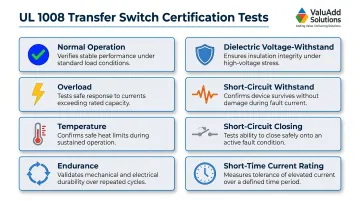
To achieve UL 1008 certification, transfer switches must pass eight major tests covering normal, overload, and extreme fault conditions.
The Eight Major UL 1008 Tests
| Test | Purpose |
|---|---|
| Normal Operation Test | Verifies functionality under standard conditions |
| Overload Test | Confirms ability to carry overload currents without damage |
| Temperature Test | Validates safe operating temperature at 100% load |
| Endurance Test | Tests durability through defined operating cycles |
| Dielectric Voltage-Withstand Test | Ensures insulation integrity at twice rated voltage (minimum 900V) |
| Short-Circuit Withstand Test | Confirms the switch survives fault currents while closed |
| Short-Circuit Closing Test | Validates safe operation when closing into a fault |
| Short-Time Current Rating Test | Optional test for longer fault durations (0.30s or 0.50s) |
Critical Fault Tests for Industrial Applications
For industrial installations, the Short-Circuit Withstand Test and Short-Circuit Closing Test carry the most weight. These two tests address the fault scenarios most likely to cause catastrophic ATS failure in the field:
- Confirms the ATS survives a fault while closed in Source 1 position (Withstand Test)
- Confirms the ATS closes safely into a fault from Source 2 and remains operable afterward (Closing Test)
Both tests require that the switch:
- Remains manually and electrically transferable
- Shows no continuity between normal and alternate source terminals
- Passes post-test dielectric voltage-withstand testing
- Exhibits no damage to alternate-side contacts
Four ATS Short-Circuit Certification Types
| Rating Type | Description | Application |
|---|---|---|
| Time-Based (Any-Breaker) Rating | Certified to fault level for defined time (e.g., 0.05s) with any upstream breaker | Maximum flexibility when upstream breaker is unknown during design |
| Specific Breaker Rating | Tested with named manufacturer's breaker | Typically yields higher ratings but restricts breaker selection |
| Fuse-Protected Rating | Uses upstream fuses for fastest clearing | Achieves highest short-circuit ratings |
| Short-Time Rating | Tested at 0.30s or 0.50s for selective coordination | Required for complex power systems with coordination studies |
UL 1008 Standard Short-Circuit Rating Thresholds
| Switch Rating | Minimum Available Short-Circuit Current | Minimum Time Duration |
|---|---|---|
| 100A or less | 5,000 A | 0.008 seconds |
| 101–400A | 10,000 A | 0.025 seconds |
| 401–1,000A | 20× rating (minimum 10,000 A) | 0.050 seconds |
| 1,001A and greater | 20× rating | 0.050 seconds |
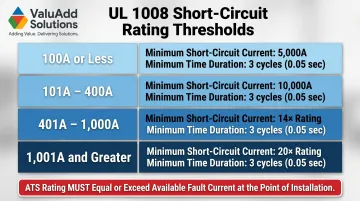
The ATS short-circuit current rating must equal or exceed the available fault current at the installation point. Skipping this verification is one of the most common specification errors — and one that leads to equipment damage, failed inspections, or dangerous fault conditions on site.
NFPA 110: Transfer Switch Requirements for Emergency Power Systems
NFPA 110, Standard for Emergency and Standby Power Systems (current edition: 2025), establishes minimum performance requirements for the complete Emergency Power Supply System—generator, transfer switch, distribution, and fuel supply. Where UL 1008 certifies the transfer switch as a device, NFPA 110 sets the rules for how the entire system performs under real emergency conditions.
NFPA 110 Types: Transfer Time Requirements
| Type | Maximum Transfer Time | Typical Application |
|---|---|---|
| Type U | Uninterruptible (UPS) | Critical computer systems |
| Type 10 | 10 seconds | Life safety, hospitals, emergency lighting |
| Type 60 | 60 seconds | Less critical standby systems |
| Type 120 | 120 seconds | Equipment protection |
| Type M | Manual (no time limit) | Portable generators |
Type 10 is required for life safety applications such as hospitals, where Joint Commission and CMS requirements mandate strict emergency power transfer times.
NFPA 110 Classes: Operating Duration Requirements
| Class | Minimum Operating Time | Fuel Storage Requirement |
|---|---|---|
| Class 0.083 | 5 minutes | Minimal |
| Class 0.25 | 15 minutes | Short-term |
| Class 2 | 2 hours | Moderate |
| Class 6 | 6 hours | Extended |
| Class 48 | 48 hours | Long-term |
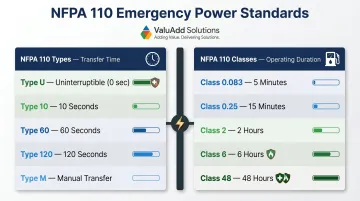
The Class designation drives generator sizing and fuel storage but also informs transfer switch specification, as the switch must support continuous operation for the required duration.
Transfer Switch-Specific NFPA 110 Requirements
NFPA 110 Chapter 6 mandates that transfer switches used in EPSS must:
- Carry emergency service listing — UL 1008 certification satisfies this requirement
- Prevent inadvertent paralleling of power sources through mechanical interlocking
- Include monitoring and annunciation capabilities for system status
- Support defined testing intervals — monthly operation and annual full-load testing at minimum
NFPA 110 Testing Intervals
- Monthly exercising — Transfer switches must be operated monthly; generators require 30-minute runs at minimum 30% nameplate kW
- Annual full-load testing — 1.5-hour continuous load bank test (30 minutes at 50% kW, 1 hour at 75% kW)
- Triennial testing — Level 1 EPSS requires 4-hour test every 36 months
Legal Status of NFPA 110
NFPA 110 is a consensus standard, not federal law. Meeting those testing intervals matters because the standard becomes legally enforceable when:
- Adopted by state or local jurisdictions
- Referenced by mandatory codes (The Joint Commission for hospitals, local building codes)
- Required by federal regulations (CMS Conditions of Participation for hospitals)
For facilities in regulated sectors — hospitals, water treatment plants, industrial campuses — non-compliance with an adopted version of NFPA 110 carries the same legal weight as any other code violation.
How UL 1008 and NFPA 110 Compliance Work Together in Practice
The two standards create a layered compliance model:
- NFPA 110 defines what the emergency power system must do—performance outcomes, transfer times, test intervals
- UL 1008 confirms that the specific transfer switch device has been rigorously tested and certified as a safe, reliable assembly
Understanding how each standard functions separately makes it easier to see where they reinforce each other during specification and inspection.
UL 1008 Simplifies NFPA 110 Compliance
A UL 1008 Listed ATS has already been evaluated against NEC Articles 517, 700, 701, and 702 — so engineers and facility managers don't need to independently verify that individual components meet transfer switch performance criteria. The listing delivers standardized proof of compliance, and AHJs increasingly require it over component-by-component assemblies.
Critical Facilities Requiring Dual Compliance
Dual compliance with both UL 1008 and NFPA 110 is most critical for:
- Hospitals and healthcare facilities — Joint Commission and CMS requirements
- Data centers — Mission-critical uptime requirements
- Municipal water and wastewater treatment plants — Public safety systems
- Industrial manufacturing facilities — Legally required standby loads
- Oil and gas processing operations — Process continuity and safety systems
ValuAdd supports specification in these environments as an industrial manufacturer representative — helping engineers identify UL Listed transfer switch components that satisfy both UL 1008 device requirements and NFPA 110 system-level obligations.
Selecting a Compliant Transfer Switch: Key Criteria for Industrial Applications
Primary Selection Criteria
1. Automatic vs. Manual
- ATSs for legally required standby and emergency systems
- Manual transfer switches for maintenance bypass or optional standby
2. Amperage and Voltage Rating
- Match to load requirements
- Verify continuous operating capacity
3. Short-Circuit Current Rating
- Must equal or exceed available fault current at installation point
- Verify specific breaker compatibility or specify time-based rating for flexibility
4. NFPA 110 Type Rating
- Type 10 for life safety (hospitals, emergency lighting)
- Type 60/120 for less critical standby systems
5. UL 1008 Listing Confirmation
- Verify complete assembly carries certification, not just components
Industrial Environment Demands
Harsh Environment Considerations:
- Dust, vibration, moisture exposure — Specify appropriate NEMA enclosure ratings
- NEMA 12 for indoor dust/drip protection
- NEMA 4X for washdown, corrosion, outdoor exposure
- High available fault currents — May require short-time or fuse-protected ratings
- Motor loads, VFDs, soft starters — Account for inrush characteristics during transfer
- Consider open transition (delayed) to allow motor voltage decay
- Or closed transition for seamless transfer without interruption
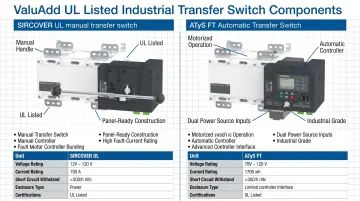
ValuAdd's UL Listed industrial components include the SIRCOVER UL manual transfer switch series (100A–1200A, UL 1008 certified) and the ATyS FT automatic transfer switch (up to 100 kA short-circuit rating). System integrators and facility engineers can work directly with ValuAdd's technical team to match equipment ratings to site-specific fault current levels and enclosure requirements.
Documented Compliance Records
Selecting compliant equipment is only half the equation — you also need documentation to prove it. For NFPA 110 inspections and AHJ reviews, maintain:
- UL 1008 listing documentation
- Short-circuit rating label data
- NFPA 110 system classification records
- Transfer switch test and maintenance logs
AHJs routinely flag missing test logs during inspections — even when the equipment itself is fully compliant. Dated service records and signed testing schedules close that gap before an inspector ever arrives on site.
Frequently Asked Questions
What is UL 1008 standard for transfer switch equipment?
UL 1008 is the Underwriters Laboratories safety standard for transfer switch equipment. It certifies the complete assembled unit—not just individual components—against rigorous performance, safety, and short-circuit ratings under normal, overload, and fault conditions.
What is the difference between UL 1008 and UL 924?
UL 1008 covers transfer switches that physically switch the emergency lighting or power load between two power sources (normal and emergency). UL 924 covers Automatic Load Control Relays (ALCRs) that bypass dimming controls and turn lights on from a single "normally on" emergency source—UL 924 devices cannot transfer between two power sources.
What are the requirements for NFPA 110 transfer switches?
NFPA 110 requires transfer switches to be listed for emergency service, prevent inadvertent source paralleling, support monitoring and annunciation, and undergo testing at required intervals. Transfer time (Type 10, 60, or 120) and minimum operational duration (Class) must also meet the standard based on facility type.
Is NFPA 110 required by law?
NFPA 110 is a consensus standard, not federal law. It becomes legally enforceable when adopted by state or local jurisdictions, or when referenced by mandatory codes such as The Joint Commission standards for hospitals, CMS Conditions of Participation, or local building codes.
What does NFPA 110 mean?
NFPA 110 is the National Fire Protection Association's Standard for Emergency and Standby Power Systems. It sets minimum requirements for performance, installation, testing, and maintenance of the complete Emergency Power Supply System (EPSS)—from generators and transfer switches to fuel supply systems.
What are the three types of emergency power?
Under NFPA 110, emergency power systems are classified by transfer time: Type 10 (transfer within 10 seconds, required for life safety systems such as hospitals), Type 60 (within 60 seconds), and Type 120 (within 120 seconds). The Type designation determines how quickly the transfer switch must complete the source changeover.