The problem is that VFD failure modes are largely invisible. Unlike a worn gear or a leaking seal, degrading capacitors and thermal stress accumulate silently until a fault code appears — or the drive shuts down entirely.
ARC Advisory Group estimates that downtime costs process industries approximately $1 trillion per year globally. VFDs sit directly in that exposure window. This guide covers the root causes behind the most common VFD faults, the warning signs to catch early, the three maintenance types worth understanding, and a practical scheduling framework you can implement immediately.
Key Takeaways
- Overheating, capacitor aging, IGBT stress, contamination, and loose connections cause most VFD failures — and structured maintenance prevents all of them
- DOE data shows a 20% speed reduction on variable-torque equipment can cut input power by ~50% — a gain that disappears when a drive runs degraded or in bypass
- Fault codes, erratic motor behavior, unusual heat, and abnormal sounds are early indicators that warrant investigation, not just a reset
- A layered maintenance schedule keeps drives within spec and extends service life well beyond 10 years
- The right maintenance approach depends on drive criticality, operating environment, and the cost consequences of unplanned downtime
Why VFD Maintenance Matters
VFDs are electronic systems, not mechanical ones. There's no audible grinding before a capacitor fails, no visible wear before a cooling fan stops moving air. By the time a fault is obvious, secondary damage is already done.
The Energy Case
For pumps, fans, and other variable-torque loads, reducing speed by just 20% cuts input power by roughly 50% — a relationship governed by the affinity laws. That energy advantage disappears when a drive operates with degraded cooling, a drifting DC bus, or repeated fault resets that force bypass operation.
IEA-4E's 2025 EMSA report puts the scale in context: electric motor systems consumed 53% of global electricity in 2023, accounting for 72% of industrial electricity use. That makes VFD maintenance an energy management task, not just a reliability one.
The Cost Case
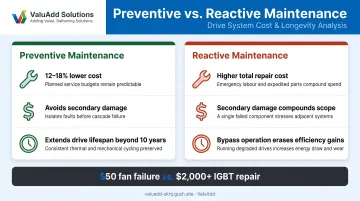
Planned maintenance is cheaper than reactive repair. DOE/PNNL's O&M Best Practices guide benchmarks preventive maintenance at 12–18% lower cost than reactive approaches across industrial facilities. For VFDs specifically, the gap widens when secondary damage is factored in — a failed cooling fan that destroys an IGBT module turns a $50 part into a $2,000+ repair.
For facilities running continuous operations, the consequences compound quickly:
- A few hours of unplanned downtime on a critical pump or compressor drive can exceed an entire year's maintenance budget
- Bypass operation during drive faults burns energy at fixed-speed rates, erasing months of efficiency gains
- Repeated thermal cycling from poor cooling accelerates capacitor degradation, shortening drive lifespan
Most Common VFD Faults and Their Root Causes
VFD troubleshooting has one non-negotiable rule: fix the cause, not the symptom. Replacing a failed IGBT without correcting the thermal condition that destroyed it produces the same failure within months.
Cooling System and Overheating Failures
Overheating is the most common and most preventable VFD failure mode. Clogged heat sink vents, failed cooling fans, and inadequate enclosure ventilation all push the drive past its thermal limits. The damage spreads — cascading across capacitors, IGBTs, and control boards simultaneously.
ABB's ACS880 maintenance schedule includes heat sink cleaning, inlet/outlet mesh inspection, and cooling fan replacement as core annual tasks. Rockwell's preventive maintenance checklist for PowerFlex drives covers the same ground. Both OEMs treat thermal management as the foundation of drive reliability.
Capacitor Degradation
Electrolytic capacitors on the DC bus have a finite service life, and heat accelerates their degradation. Symptoms include power instability, irregular output voltage, and increased ripple current — often subtle until the capacitor fails outright.
Two important facts for maintenance programs:
- ABB requires DC-link capacitor reforming if a drive has been non-operational for one year or more
- Rockwell specifies staged reforming procedures based on storage duration: no reforming needed under 2 years, rated voltage for 30 minutes at 2–3 years, and staged DC reforming beyond 3 years
Tag stored spare drives and idle units with their last-energized date — reforming procedures apply before installation regardless of the drive's outward condition.
IGBT and Power Semiconductor Failures
IGBTs fail from electrical stress (overvoltage, short circuit), thermal stress, and as a downstream consequence of capacitor failure. When a diode or IGBT is found shorted or open during testing, component replacement is the easy part. Finding out why it failed is the critical step.
Rockwell's PowerFlex 755T platform simplifies this with native predictive maintenance tracking for IGBTs, fans, and bus capacitors — drawing on actual usage data rather than time-based estimates alone.
Environmental Contamination
Dust, moisture, and corrosive agents degrade insulation, corrode terminals, and cause intermittent faults that are often misdiagnosed as board failures. The fix isn't just cleaning — it's matching enclosure protection to the actual environment.
NEMA Type 4X enclosures cover indoor/outdoor use with protection against windblown dust, rain, hose-directed water, and corrosion. IP66 adds dust-tight construction with resistance to high-pressure water jets. ValuAdd's SW Series Washdown Drives carry UL Type 4X (IP66) ratings for food processing, chemical processing, and high-pressure washdown environments where standard enclosures routinely fail.
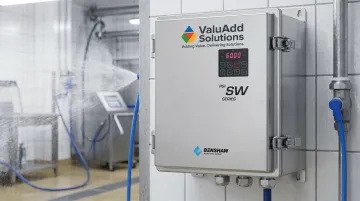
One important distinction: NEMA Type 4X explicitly includes corrosion resistance, while IP ratings address ingress only. For coastal, chemical, or washdown environments, specify both the ingress protection level and corrosion resistance requirements.
Loose Connections and Wiring Issues
Vibration loosens terminals over time. Loose connections at input/output terminals and control wiring cause arcing, localized overheating, and intermittent fault codes that can look exactly like a board-level failure. Many drives returned for suspected control board issues turn out to have a single loose terminal.
Two actions prevent the majority of connection-related misdiagnoses:
- Verify terminal torque values at every scheduled maintenance event using OEM torque specs
- Inspect control wiring separately from power terminals — intermittent signal faults often originate at low-current connections, not the power side
Warning Signs Your VFD Needs Attention
Catching these indicators early enables targeted repair rather than full replacement.
Performance and Output Irregularities
- Motor not reaching commanded speed or running erratically
- Inconsistent acceleration or deceleration profiles
- Frequent trips under normal load conditions
- Output current readings deviating from established baseline
Any of these warrant immediate investigation of the drive's fault log, thermal status, and connection integrity before the next fault event.
Fault Codes and Unusual Operating Behavior
Start with the drive's built-in fault log — it's your primary diagnostic tool. Rockwell PowerFlex 750 drives log standard fault categories including:
- UnderVoltage and OverVoltage
- HW OverCurrent and Ground Fault
PowerFlex 7000 medium-voltage drives add Line OverCurrent, Line OverVoltage, and inverter heatsink overtemperature to that list.
A single isolated trip may be a transient. A fault code that appears three times in a month is a deterioration signal — treat it as one, not a nuisance to reset.
Physical and Environmental Warning Signs
Conduct a visual and sensory check at each scheduled inspection:
- Burnt smell or discoloration near terminals or on the drive chassis
- Swollen or leaking capacitors (visible bulging on the top of the can)
- Debris-blocked vents or heat sinks
- Condensation inside the enclosure
- Unusual fan noise — grinding, intermittent cycling, or silence when the drive is running at load
- Buzzing or humming from internal components at frequencies inconsistent with normal operation
If any of these turn up during a shift check, schedule a formal inspection before operations continue.
Types of VFD Maintenance
No single approach suits every application. The right mix depends on drive criticality, operating hours, and the financial consequences of downtime.
Preventive (Routine) Maintenance
Preventive maintenance is the baseline for every VFD installation — performed on a schedule, regardless of whether the drive shows symptoms. Core tasks include:
- Inspecting and replacing cooling fans
- Clearing heat sink vents and air filters
- Checking terminal connections for tightness and corrosion
- Reviewing fault logs for trend patterns
- Verifying parameter settings against documented baseline
This approach is low-cost per event and prevents the compounding failures that occur when minor degradation is ignored. For drives in continuous operation — water treatment, manufacturing lines, oil and gas — preventive maintenance is non-negotiable.
When a drive does fail despite preventive efforts, a structured corrective process limits secondary damage and keeps repair scope manageable.
Corrective (Reactive) Maintenance
Corrective maintenance is triggered by a fault, unexpected shutdown, or performance failure. The diagnostic sequence:
- Read and document all active and historical fault codes
- Test the diode bridge, IGBT modules, and capacitor condition
- Identify root cause before replacing any component
- Repair or replace targeted parts with verified cause addressed
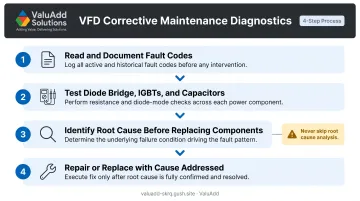
The risk with reactive-only maintenance is secondary damage. A drive that operated through a thermal event before shutting down may have compromised capacitors, IGBTs, and control board components simultaneously. Repair scope — and cost — expands accordingly.
Predictive / Condition-Based Maintenance
Predictive maintenance monitors key performance indicators to catch deterioration before it causes a fault:
- DC bus voltage stability trends
- Thermal imaging of heat sinks, terminals, and cabinet interiors
- Fan RPM and vibration monitoring
- Drive-native component life counters where available
This approach delivers the strongest ROI on high-horsepower and medium-voltage drives. ValuAdd's medium-voltage VFDs — including the MVH2 Series (up to 1,500 HP at 4,160V) and the M2L Series (300–12,000 HP, up to 7.2kV) — include Benshaw Connect remote monitoring with operational data trends, event logs, and motor parameters accessible without on-site visits. For large drives where on-site diagnostics are time-consuming and costly, that continuous data access makes condition-based maintenance operationally realistic.
For a concrete scale reference: ARC Advisory Group documented a predictive maintenance implementation that avoided 17+ hours of unplanned downtime, translating to approximately $300,000 in avoided losses at a single facility.
VFD Maintenance Schedule
Maintenance frequency should reflect the actual operating environment, not a generic calendar. Drives in dusty, humid, or corrosive environments running 24/7 need more frequent attention than those in climate-controlled facilities at partial load.
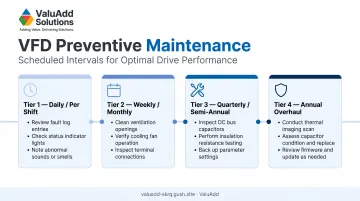
Maintenance Frequency Table
| Interval | Tasks |
|---|---|
| Daily / Per Shift | Review fault logs and alarms; confirm status indicators; check for unusual sounds or smells |
| Weekly / Monthly | Clean heat sink vents and air filters; verify cooling fan operation; check for loose terminal connections; review operating temperature |
| Quarterly / Semi-Annual | Inspect capacitors for visual wear; test motor cable insulation resistance; back up parameter settings; check output voltage balance across phases |
| Annual Overhaul | Thermal imaging of all power and control connections; capacitor condition assessment via OEM diagnostics; cooling fan replacement per model schedule; firmware review; full functional test under load |
OEM fan replacement intervals differ significantly:
- ABB recommends ACS880 main cooling fan replacement at 9 years
- Rockwell recommends PowerFlex 750 fan replacement at 5 years
Don't use a universal fan interval. Pull the specific OEM schedule for the installed drive model.
Environment-based adjustments:
- Heavy-duty environments (oil and gas, chemical processing, 24/7 operation): compress quarterly tasks to monthly
- Climate-controlled facilities with light intermittent loads: annual intervals may be sufficient with consistent daily checks
- New installations: Rockwell recommends an initial inspection at 3–4 months after commissioning, before the first annual cycle
One interval that's easy to overlook: stored spares. Any drive or spare unit non-operational for one year or more requires capacitor reforming before installation. Follow the OEM procedure specific to the storage duration involved.
Conclusion
VFD maintenance is not a discretionary activity for facilities that depend on continuous motor control. It is the most direct way to protect capital investment, minimize unplanned downtime, and extend drive service life well beyond the 10-year baseline that well-maintained drives routinely achieve.
A layered strategy covering routine preventive tasks, condition monitoring for critical drives, and documented corrective procedures consistently outperforms reactive repair — at lower total cost. Keeping drives running is the point; fixing them means the strategy already failed.
Starting with drives built for serviceability in demanding environments creates a stronger foundation. ValuAdd's IEEE 519-compliant, NEMA Type 4X-rated VFD solutions cover general industrial through large-horsepower applications:
- H2 Series for general industrial motor control
- MVH2 and M2L drives for medium-voltage, high-horsepower installations
- Modular power-cell designs and front-access enclosures that simplify maintenance
- Remote monitoring capabilities that cut unplanned downtime exposure
Frequently Asked Questions
Can a VFD be repaired?
Most VFDs can be repaired. Common repairs include capacitor replacement, IGBT module replacement, cooling fan replacement, and control board servicing. Repair feasibility depends on component availability, drive age, and whether repair cost is economical relative to replacement cost.
What are the most common faults in VFDs?
The most frequently cited fault categories are overtemperature (cooling system failures), DC bus issues (capacitor degradation), overcurrent (IGBT stress or wiring problems), and environmental faults from contamination or moisture ingress. Fault log history is the best starting point for diagnosis.
How much does it cost to replace a VFD?
Replacement cost varies widely based on horsepower, voltage class, enclosure rating, and required options. For large or medium-voltage drives, repair is often substantially more economical than replacement. Get a quote using the exact catalog number, enclosure rating, and full option set.
What is the typical lifespan of a VFD?
Rockwell states that overall component design life normally exceeds 10 years, with some drives lasting 20 years or more under normal operating conditions. Lifespan depends heavily on thermal management, operating environment, and preventive maintenance — electrolytic capacitors typically limit service life if not replaced proactively.
How often should a VFD be serviced?
Annual professional servicing is the minimum for most drives. Drives operating in harsh or high-utilization environments warrant monthly visual checks and quarterly inspections. Follow the OEM maintenance schedule for the specific model installed.
When should you repair a VFD instead of replacing it?
Repair makes sense when the failure is limited to replaceable components (capacitors, fans, IGBTs), parts are available, and repair cost is well below replacement cost. Replace the drive when it is obsolete, no longer manufacturer-supported, or showing repeated failures that point to systemic degradation.