
Introduction
A soft starter fault during motor startup doesn't just trip a breaker — it can halt an entire production line. In water treatment, oil and gas, and manufacturing, these devices are load-bearing components where unplanned failures carry real operational cost. Unplanned downtime costs Fortune Global 500 companies approximately $1.4 trillion annually, and industrial facilities average 47 hours of motor system downtime per year.
Soft starters develop faults over time due to component wear, environmental exposure, incorrect parameter settings, or maintenance gaps. The error codes displayed on the keypad panel are often the first—and only—warning before a full shutdown. Knowing what those codes mean — and how to act on them — separates a 15-minute parameter fix from a multi-day production outage.
Key Takeaways
- Most soft starter faults stem from overtemperature, phase loss, overcurrent, or SCR/bypass relay failure
- Always read the error code and review the stored fault log before physical inspection
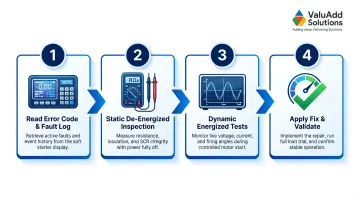
- Diagnose in sequence: read the fault code, run static checks, perform dynamic tests, then apply a targeted fix
- Replace when thyristors are damaged, faults recur after repair, or the unit is undersized
What Is a Soft Starter?
A soft starter is a motor control device that uses thyristors (Silicon Controlled Rectifiers or SCRs) to gradually ramp up voltage to an AC motor during startup. By controlling the SCR firing angle, the device limits inrush current from the typical 6-8x Full Load Amperage (FLA) seen in direct-on-line starts down to a controlled 3-5x FLA. This reduces both electrical system stress and mechanical torque shock.
Unlike a simple contactor that applies full voltage instantly, or a variable frequency drive (VFD) that varies both voltage and frequency throughout operation, a soft starter focuses exclusively on the startup and stop phases.
Once the motor reaches full speed, most soft starters engage a bypass relay to allow full voltage operation with minimal heat generation and near-zero harmonics.
Where Soft Starters Are Used
That controlled startup makes soft starters the right choice anywhere abrupt full-voltage starts cause damage or accelerated wear:
- Centrifugal pumps eliminate water hammer and pressure surges through torque-controlled stop ramps
- Conveyor systems avoid sudden jerks that damage products or stress gearboxes
- Fans and blowers reduce belt slip and bearing wear by applying voltage gradually
Soft starters are electronic devices subject to degradation through thermal cycling, environmental contamination, and usage patterns. Correct sizing, configuration, and periodic inspection are essential to long-term reliability — and understanding these basics sets the foundation for diagnosing faults when they do occur.
Common Soft Starter Faults and Error Codes
Most soft starter failures are predictable and display recognizable fault codes. The four fault types below cover the majority of field failures—each with a distinct code pattern, root cause, and clear corrective path.
Overtemperature / Thermal Overload Fault
Symptoms:
- Unit shuts down unexpectedly during operation
- Overtemperature or thermal overload fault code displayed (e.g., ABB F04xx, SF50)
- Enclosure or heatsink warm to the touch
- Fault often occurs after repeated rapid starts without cooldown
Likely Causes:
- Blocked ventilation ducts or dust-clogged cooling fans
- Insufficient installation clearance inside the enclosure
- Ambient temperature exceeding rated operating limits (typically 0°C to +50°C)
- Too many motor starts in a short window (exceeding duty cycle)
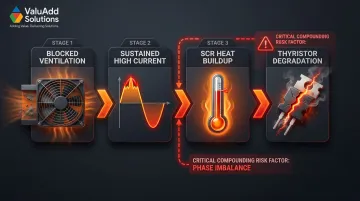
Sustained high current elevates heat in the SCR stack, gradually eroding thyristor reverse blocking capability until permanent degradation occurs. Phase imbalance compounds this risk—uneven current distribution concentrates thermal load on a single thyristor pair.
Phase Loss or Phase Imbalance Fault
Symptoms:
- Unit trips immediately on startup or during acceleration
- Phase loss or voltage unbalance fault code displayed (e.g., ABB F03xx, EF1x)
- Motor hums without turning or runs with excessive vibration
- Heat buildup in motor windings
Likely Causes:
- Loose, corroded, or open input wiring connection at terminals R, S, or T
- Blown fuse on one supply phase
- Incorrect phase sequence at input terminals
- Upstream supply network instability
NEMA Standard MG1 dictates that motors should not operate with voltage unbalance exceeding 1% without derating. Operation above 5% voltage unbalance is not recommended, as a small voltage unbalance results in 6-10x greater phase current unbalance. NEMA Standard MG1 dictates that motors should not operate with voltage unbalance exceeding 1% without derating. Operation above 5% voltage unbalance is not recommended, as a small voltage unbalance results in 6–10x greater phase current unbalance. If supply quality is confirmed, the next likely culprit is overcurrent—often driven by parameter misconfiguration or mechanical load issues.
Overcurrent / Motor Overload Fault
Symptoms:
- Unit trips during ramp-up phase or under heavy load
- Overcurrent or overload fault code displayed (e.g., ABB F02xx, EF6x)
- May coincide with visible mechanical resistance or jammed load
- Motor draws current significantly above nameplate rating
Likely Causes:
- Motor rated current parameter set too low relative to motor nameplate
- Ramp time configured too short for the load's rotational inertia
- Soft starter undersized for the application
- Mechanical overload on driven equipment (stuck pump impeller, seized bearing)
Before replacing hardware, verify the motor rated current parameter matches the nameplate exactly. A mismatched setting is the most common cause of nuisance tripping in otherwise correctly sized installations.
SCR / Bypass Relay Fault
Symptoms:
- Unit fails to complete startup ramp
- Current imbalance or bypass fault code displayed (e.g., ABB F09xx, SF4x)
- Abnormal heat generation from power section
- Burning odor near the unit in severe cases
Likely Causes:
- Damaged or shorted thyristor (SCR) confirmed via continuity test
- Bypass relay failed to engage at end of ramp sequence
- Wiring fault in main power circuit between soft starter and motor
- Thermal cycling degradation or transient voltage spikes
When an SCR shorts (<1 MΩ resistance in static test), its reverse blocking capability is permanently destroyed and it must be replaced—no repair is possible.
How to Troubleshoot a Soft Starter Step-by-Step
Each step below builds on the last — start with the error log, move through static checks, then energized tests, and finish with a targeted fix and validation cycle.
Safety First: Always isolate the power supply and apply lockout/tagout (LOTO) per OSHA 29 CFR 1910.147 before any physical inspection. Confirm all terminals are fully de-energized with a calibrated multimeter. Energized dynamic tests must only be performed by qualified electrical technicians.
Step 1: Read the Error Code and Review the Error Log
Access the fault information:
- View the active fault code on the keypad display
- Cross-reference it against the manufacturer's instruction manual fault code table
- Navigate to the stored error log — most soft starters retain the last 5-10 fault entries with timestamps (ValuAdd's RX3E and MVRXE models store up to 99 fault entries)
- Determine whether the current fault is isolated or part of a recurring pattern
Document contextual details:
- When did the fault occur? (Startup, during ramp, under full load, continuous operation)
- How frequently has it appeared?
- Were there recent changes to the motor, load, ambient environment, or parameter settings?
This context cuts diagnostic time. A fault that appears only during high ambient temperature periods points to thermal issues, while faults occurring immediately at startup suggest wiring or parameter problems.
Step 2: Perform Static (De-Energized) Inspections
Visual inspection:
- Inspect enclosure interior for dust buildup, moisture, corrosion, or burn marks
- Check cooling fans are clean, rotating in correct direction, and unobstructed
- Look for signs of arcing on component terminals
- Clean ventilation ducts if dust or debris is present
Component testing:
- Test thyristors using a multimeter in continuity mode across terminal pairs R+U, S+V, and T+W
- A continuous reading (audible beep) indicates a shorted SCR requiring replacement
- Use a 500V megger across main terminals; readings below 1 MΩ confirm SCR damage
- Measure resistance across thyristor control wire pairs for balance across all three phases
- Inspect and re-torque all input and output wiring connections
- Verify motor rated current parameter matches motor nameplate data exactly
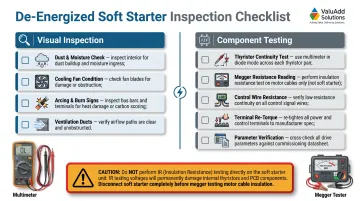
Critical Warning: Never perform insulation resistance (IR) testing on the soft starter itself — the high voltages used for motor IR testing will destroy SCRs and control boards. Always disconnect the soft starter from the motor before meggering.
Step 3: Perform Dynamic (Energized) Tests
Pre-start verification:
- With power restored and unit in STOP mode, use a multimeter to verify input phase voltages at R, S, and T are balanced
- Input voltages should be within ±10% of rated supply voltage and within 1% of each other
- Confirm keypad displays correctly and shows READY state
- If keypad is blank, check whether control board LED indicator activates on power-up
Operational monitoring:
- Start the soft starter under a connected load
- Monitor output current and voltage readings displayed on keypad
- Verify readings are balanced across output terminals U, V, and W
- Note any current asymmetry greater than 40% — this points to unbalanced load, phase loss, or SCR gating failure
- Compare all values against motor nameplate data
- Log all readings for analysis
Step 4: Apply the Targeted Fix and Validate
Resolve the root cause directly:
- Thermal faults: Clean ventilation paths, ensure proper clearances, verify cooling fan operation, reduce start frequency
- Phase issues: Re-terminate or replace damaged conductors, replace blown fuses, correct phase sequence
- Overcurrent trips: Adjust motor rated current parameter to match nameplate, extend ramp time for load inertia, verify no mechanical overload
- Component faults: Replace damaged SCR or bypass relay, repair wiring faults
- Corrupted settings: Perform factory parameter restore if settings are suspected to be corrupted
Validation and monitoring:
- Run the soft starter under normal operating conditions followed by peak load conditions
- Monitor output current, voltage, and temperature over a defined observation period
- Plan for at least 24-48 hours of operational monitoring
- Confirm no new fault codes appear
- Verify all values remain within expected range for the application
When Should You Fix vs. Replace a Soft Starter?
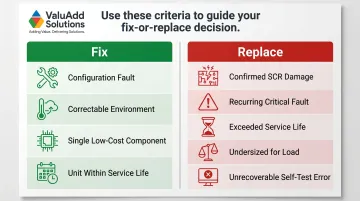
The fix-or-replace decision balances the direct cost of repair against the risk of repeat failure, unit age, and application criticality. Use these criteria as a quick reference.
Fix when:
- Fault is configuration-related (incorrect motor rated current, ramp settings, wiring errors)
- Caused by a correctable environmental condition (blocked ventilation, contamination)
- Involves a single low-cost replaceable component (fuse, relay, cooling fan)
- Unit is relatively new and within the manufacturer's recommended service life
Replace when:
- SCR or thyristor damage is confirmed (<1 MΩ resistance in static test); sourcing and replacing these components reliably requires specialist tools and expertise
- The same critical fault code recurs after multiple repair attempts
- Unit has exceeded service life or inspection intervals
- Application load has grown beyond the unit's original current rating (undersized)
- Device displays an unrecoverable self-test error indicating internal electronics or ROM failure
When replacement is the right call, ValuAdd can help identify the correct soft starter for your application — including advanced medium voltage options for demanding industrial environments.
Preventive Measures to Avoid Future Soft Starter Faults
Running equipment to failure costs up to 10 times more than preventive programs, and preventive maintenance costs 12-18% less than reactive maintenance. Every $1 spent on preventive maintenance returns approximately $5.45 (545% ROI) by avoiding emergency labor rates and downtime. Three practice areas cover the majority of preventable soft starter failures: routine inspections, parameter discipline, and team preparedness.
Scheduled Annual Inspections
- Check for dust and moisture accumulation in enclosure
- Verify connection torque on all power and control terminals
- Inspect for signs of arcing, corrosion, or component discoloration
- Confirm cooling fan operation and proper rotation direction
- Verify enclosure ventilation clearances meet manufacturer specs
- Review stored fault log to catch emerging issues before they become failures
Parameter Management
- After any motor replacement or load change, update motor rated current and ramp times immediately
- Document all parameter changes with dates in a maintenance log
- Maintain a running log of past fault codes and resolutions to accelerate future troubleshooting
- Verify settings haven't drifted or been changed without documentation
Training and Procedures
- Train maintenance personnel to read error codes and access fault logs
- Establish clear escalation procedures distinguishing between in-house and specialist support
- Avoid component-level repairs without proper tools or expertise, as they extend downtime and risk introducing new faults
- Know when to call for technical support rather than experimenting
Frequently Asked Questions
What are some common causes of soft starter failure?
The primary causes are overheating due to poor ventilation or excessive cycling, phase loss or supply imbalance, overcurrent from incorrect parameter settings or mechanical overload, and SCR or component aging. Most failures are preventable through correct sizing, proper setup, and routine maintenance.
Is a soft start just a capacitor?
No. Soft starters use thyristors (SCRs) to progressively control voltage during motor startup — not capacitors. Capacitors appear elsewhere in motor circuits (run capacitors, power factor correction banks), but they don't affect startup voltage control.
How do I reset a soft starter after a fault?
Reset via the keypad menu or a power cycle — but identify and correct the underlying fault first. Resetting without fixing the root cause will trigger the same fault code immediately.
What does a phase loss fault mean on a soft starter?
A phase loss fault indicates one or more input supply phases are missing or severely unbalanced, which can cause motor damage if unresolved. First steps: check input wiring connections at R, S, and T terminals, inspect upstream fuses on each phase, and verify the supply network for instability or incorrect phase sequence.
How often should a soft starter be serviced or inspected?
Annual inspections are the minimum under standard industrial conditions — increase frequency in high-dust, high-humidity, or high-temperature environments. Each inspection should cover ventilation, connection integrity, parameter settings, and a fault log audit.
What is the difference between a soft starter and a VFD?
A soft starter controls voltage only during motor startup and stop ramps to limit inrush current, then allows full-voltage operation (often via bypass). A VFD (variable frequency drive) varies both voltage and frequency throughout operation to continuously control motor speed. Soft starters are the more cost-effective choice for fixed-speed applications requiring smooth starts and stops.