Introduction
Disconnect switches serve as critical safety boundaries in electrical distribution systems, enabling safe equipment isolation and emergency shutoff across commercial and industrial applications. Pricing spans a surprisingly wide range—from light-duty commercial units under $100 to heavy-duty industrial configurations exceeding $3,000.
Cost confusion is common. Many buyers underbudget by comparing light commercial switch prices to industrial requirements, while others overspend on ratings their application doesn't need. The price difference reflects measurable differences in performance, environmental protection, and safety certification—not just brand markup.
This guide covers what you need to make a confident purchasing decision:
- Price ranges by switch type and amperage
- Key factors that drive cost up or down
- What a full ownership budget actually looks like
- How to match the right switch to your application
TLDR
- Residential disconnect switches cost $20–$150; light industrial units run $150–$600; heavy-duty industrial switches range from $600–$3,000+
- Voltage rating, amperage, NEMA enclosure type, and fused/non-fused configuration are the biggest price drivers
- Critical industrial environments require certified, rated units — budget switches are only appropriate for low-duty, non-critical applications
- Installation labor, compliance requirements, and ongoing maintenance add meaningful cost beyond the purchase price
How Much Does a Disconnect Switch Cost?
Disconnect switch pricing has no single standard. Costs vary dramatically by type, rating, and intended environment. Selecting a switch for the wrong application leads to early failure or costly replacement.
Two common mistakes drive cost estimation errors: purchasing a residential-grade switch for an industrial setting (under-specifying), or paying for heavy-duty ratings in a light-duty application (over-specifying).
Entry-Level: $20–$150
This tier covers non-fusible, single- or double-pole switches rated at 30–60A, typically housed in NEMA 1 or NEMA 3R enclosures. These units suit residential HVAC disconnects, small appliance isolation, and light commercial use.
What's excluded at this price:
- No load-break capability
- Limited short-circuit protection
- Not rated for harsh or corrosive environments
- Basic steel or plastic construction
Mid-Range: $150–$600
Mid-range switches include fusible or non-fusible safety switches rated 100–200A, available in NEMA 3R or NEMA 4 enclosures with 3-pole configurations. They're suitable for light industrial machinery, commercial rooftop equipment, and panel-level isolation.
UL listing is standard at this range, but verify compliance with local codes before purchase. Fused options provide additional short-circuit protection at marginal added cost—typically $50–$100 more than non-fused equivalents.
According to distributor pricing data, a 100A fusible Siemens HF363NR in NEMA 3R enclosure retails for approximately $421.
What's typically included at this price:
- UL-listed safety switches (fusible or non-fusible)
- NEMA 3R or NEMA 4 enclosure options
- 3-pole configurations for three-phase loads
- Load-break capability on select models
High-End / Industrial Grade: $600–$3,000+
Heavy-duty load-break switches rated 400A–1,200A or medium-voltage configurations fall into this tier. Expect NEMA 4X or Type 12 enclosures, 3-pole configurations, and features like load-break ratings, corrosion-resistant construction, and compliance certifications for demanding environments such as oil and gas, water treatment, and manufacturing.
For applications isolating motors tied to variable frequency drives or high-inrush equipment, load-break certification is required. Switches like the SIRCO UL 98 C address this with a double-breaking-per-pole design that improves arc interruption performance under load.
Premium pricing includes:
- Integrated auxiliary contacts
- Padlocking provisions
- Cable entry options
- Visible position indicators
- Enhanced short-circuit withstand ratings
Distributor pricing shows a 30A NEMA 4X stainless steel Eaton disconnect at $3,030, while a 200A NEMA 4X fusible Siemens unit reaches $4,960.
Key Factors That Affect the Cost of a Disconnect Switch
Price is shaped by a combination of electrical specifications, environmental requirements, and compliance standards. Changing any one variable can shift cost substantially.
Voltage and Amperage Rating
Higher voltage (600V vs. 240V) and higher amperage ratings require more robust contacts, insulation, and housing. For continuous loads, the National Electrical Code (NEC) requires an ampacity not less than 125% of the continuous load, effectively limiting continuous current to 80% of the switch's rating.
Oversizing or undersizing the rating creates reliability and safety problems. A 100A switch handling continuous 95A load will experience premature contact wear; conversely, specifying a 200A switch for a 50A load wastes capital.
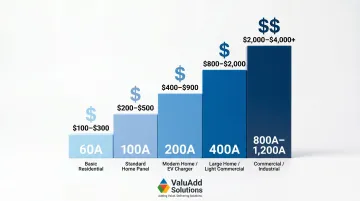
Typical cost scaling:
- 60A switches: $100–$300
- 100A switches: $200–$500
- 200A switches: $400–$900
- 400A switches: $800–$2,000
- 800A–1,200A switches: $2,000–$4,000+
Fused vs. Non-Fused Configuration
Fused disconnect switches include an integrated overcurrent protection element, adding cost but eliminating the need for a separate fuse block. Non-fused switches are cheaper but require external protection.
In industrial settings with high fault currents, fused configurations typically save money system-wide by preventing cascade failures. Current-limiting fuses greatly minimize the total destructive heat energy (I²t) delivered during a fault, protecting downstream equipment.
Cost premium: Expect fused switches to cost 15–25% more than equivalent non-fused units at the same amperage and enclosure rating.
NEMA Enclosure Rating
NEMA 1 (indoor, general purpose) is the baseline. Each step up adds cost:
- NEMA 1: Indoor, general purpose—baseline price
- NEMA 3R: Outdoor, rain-resistant—adds 10–20%
- NEMA 4: Watertight—adds 30–50%
- NEMA 4X: Corrosion-resistant, watertight—adds 100–200%
- NEMA 12: Industrial, dust/oil-tight—adds 40–70%
For chemical plants, food processing, or coastal installations, NEMA 4X is typically mandated, not optional. Stainless steel NEMA 4X enclosures last 2–3 times longer than painted steel in corrosive environments—making the higher upfront cost the more economical choice over a 10–15 year service life.
Load-Break vs. Non-Load-Break Capability
A load-break disconnect can safely interrupt current under load. Non-load-break types must only be operated with the circuit de-energized.
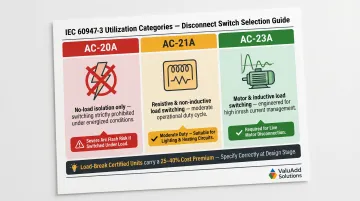
IEC 60947-3 classifies switching devices by utilization category, each defining what the switch can interrupt safely:
- AC-20A: No-load isolation only — no current interruption permitted
- AC-21A: Baseline load-break for resistive loads
- AC-23A: Most demanding duty — motors and highly inductive loads with high locked-rotor inrush
Operating a non-load-break switch under load creates severe arc flash risk, contact welding, and potential equipment damage. Load-break certification typically adds 25–40% to switch cost but is non-negotiable for live-switching applications.
Number of Poles and Phase Configuration
Pole count follows directly from your load type. Single-phase (2-pole) switches cost less than 3-pole three-phase versions, with the price difference typically ranging from 20–35% depending on amperage.
When to use each:
- Single-pole/2-pole: Single-phase loads, small motors, residential applications
- 3-pole: Three-phase industrial motors, panel feeders, equipment requiring simultaneous disconnection of all phases
NEC Section 430.103 mandates that the disconnecting means must open all ungrounded supply conductors, making 3-pole switches a requirement for three-phase motor applications.
Full Cost Breakdown of a Disconnect Switch
The unit purchase price is just the starting point. Total cost of ownership includes installation, compliance, and ongoing maintenance.
Initial Purchase (One-Time)
Unit cost varies by type and amperage rating. Source from suppliers whose products carry UL listings and relevant certifications — non-compliant units that fail inspection create re-work costs that quickly exceed any upfront savings.
ValuAdd distributes disconnect switches certified to UL 98C and other applicable standards, so the compliance documentation is already in place when your inspector arrives.
Installation and Setup (One-Time)
Industrial installations with conduit routing, panel integration, and commissioning typically run $500–$2,000+ depending on complexity. Light commercial work sits at the lower end of that range; large-scale industrial projects with multiple disconnects can exceed it.
According to the Bureau of Labor Statistics, the median annual wage for electricians was $62,350 in May 2024, translating to roughly $30–$40 per hour base rate. Actual project billing rates run $75–$150 per hour including overhead.
Installation cost drivers:
- Electrical system complexity
- Conduit and wiring runs
- Panel modifications
- Commissioning and testing
- Local labor rates
- Accessibility of installation location
Maintenance and Inspections (Recurring)
Periodic inspection of contacts, fuse elements, and enclosure integrity is required. UL 98 fusible disconnects are tested for 6,000 electrical operations and 16,000 to 20,000 mechanical operations, establishing baseline durability expectations.
Higher-quality switches reduce maintenance frequency but require trained personnel for service. Budget $150–$500 annually for industrial installations with regular use.
Upgrades and Replacements (Periodic)
When load requirements grow, upgrading to a higher-rated disconnect becomes necessary. Specifying a switch with 25–30% headroom above current draw at the time of purchase is the most practical way to avoid that cost ahead of schedule.
Hartford Steam Boiler data shows that loose connections (30.3%), moisture (17.4%), and defective insulation (9.9%) are the top causes of electrical distribution failures—preventable with proper specification and maintenance.
Low-Cost vs. High-Cost Disconnect Switches—What's the Difference?
Low-Cost vs. High-Cost Disconnect Switches—What's the Difference?
The price gap between basic and industrial-grade switches reflects measurable differences in performance, safety, and service life—not just brand markup.
Performance and Safety
Low-cost switches have lower interrupting ratings and may not safely handle fault currents in industrial environments. Higher-cost switches are tested and rated for specific fault conditions, load-break operation, and repeated cycling. The table below illustrates how that rating gap translates into real application risk:
| Rating | Application | Risk Level |
|---|---|---|
| AC-20A | No-load isolation only | Severe arc flash risk if used for load switching |
| AC-23A | Motor switching with high inrush | Rated for safe load-break operation |
Durability and Environment Resistance
Budget switches use standard steel or plastic enclosures unsuitable for wet, corrosive, or high-temperature environments. Premium switches use stainless steel, fiberglass, or coated enclosures with IP/NEMA ratings.
Stainless steel NEMA 4X enclosures typically last 15–30 years, with Grade 316 performing best in marine and food processing environments. Fiberglass (GRP) enclosures commonly exceed 20 years and offer complete immunity to galvanic corrosion.
Long-Term Value
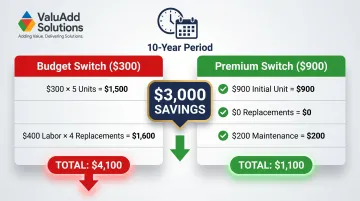
A $300 switch that fails after 2 years in a corrosive environment costs more over a 10-year period than a $900 NEMA 4X unit with a 15-year service life.
10-year TCO comparison:
- Budget option: $300 initial + ($300 replacement × 4) + ($400 labor × 4) = $4,100
- Premium option: $900 initial + $0 replacement + $200 maintenance = $1,100
That $600 upfront difference becomes a $3,000 savings—before accounting for unplanned downtime costs if a budget switch fails mid-operation.
How to Estimate the Right Budget for a Disconnect Switch
Accurate budgeting requires knowing your application requirements before you look at price tags. Skipping the technical groundwork is what leads to undersized switches, failed inspections, and costly replacements.
Identify Your Electrical Requirements First
Determine load amperage, voltage, phase configuration, and whether the switch will be operated under load. These technical specs set the non-negotiable minimum. Skipping this step is the most common cause of costly replacements.
Questions to answer:
- What is the continuous load in amperes?
- What is the system voltage (120V, 240V, 480V, 600V)?
- Single-phase or three-phase?
- Will the switch be operated under load or only for isolation?
- What is the available fault current at the installation point?
Match Environment to Enclosure Rating
Assess installation location (indoor/outdoor, exposure to moisture, dust, chemicals, or corrosive agents) and select the appropriate NEMA or IP rating.
Selection guide:
- NEMA 1: Clean indoor environments with no exposure to moisture
- NEMA 3R: Outdoor installations with rain/snow exposure
- NEMA 4: Watertight indoor/outdoor applications (hose-directed water)
- NEMA 4X: Corrosive environments, chemical plants, food processing, coastal installations
- NEMA 12: Industrial environments with circulating dust, lint, fibers
Choosing a lower rating to save $50–$100 upfront can result in $1,000+ in premature replacement.
Account for Compliance and Certification Requirements
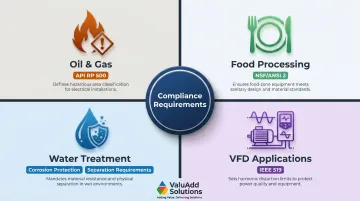
Many industrial sectors (oil and gas, water treatment, food processing) have specific code requirements. Verify UL listing and relevant compliance before purchasing.
Common requirements by sector:
- Oil & Gas: API RP 500 classification for hazardous locations
- Food Processing: NSF/ANSI 2 standards for food handling equipment
- Water Treatment: Corrosion protection and separation from habitation areas
- VFD Applications: IEEE 519 compliance for harmonic distortion limits
When in doubt, confirm certification requirements with your AHJ (Authority Having Jurisdiction) before purchasing — a switch that fails inspection will need to be replaced entirely.
Common Budgeting Mistakes to Avoid
- Prioritizing upfront price over total cost — installation and maintenance often exceed the switch price itself
- Over-specifying for simple applications, burning capital on features the load never demands
- Buying uncertified equipment to save money, then failing inspection and replacing it anyway
- Ignoring load growth projections — a switch undersized for future demand will require replacement within 3–5 years
Frequently Asked Questions
Frequently Asked Questions
How much does it cost to install or replace a disconnect switch?
Industrial disconnect switch installation typically runs $500–$2,000+ in labor. Final cost depends on electrical system complexity, conduit routing, panel integration requirements, and local labor rates.
What is a disconnect switch used for?
A disconnect switch safely isolates electrical equipment or circuits from the power supply, enabling maintenance, emergency shutoff, or equipment replacement without shutting down an entire system. It provides a visible break in the circuit for worker safety.
What do electricians call disconnect switches?
The terminology varies by application: safety switches, fusible disconnects, non-fusible disconnects, load break switches, and service entrance switches are all common names. Industrial contexts most often use fusible or non-fusible disconnect, while "service entrance switch" typically applies to utility connection points.
What is the difference between a fused and non-fused disconnect switch?
Fused disconnects include integrated overcurrent protection (fuses), while non-fused disconnects require a separate overcurrent device. Fused options cost 15–25% more upfront but simplify system design and provide added fault protection.
What NEMA rating do I need for my disconnect switch?
Match the enclosure rating to your environment:
- NEMA 1 — Clean, dry indoor locations
- NEMA 3R — General outdoor exposure (rain, sleet)
- NEMA 4 — Watertight indoor or outdoor use
- NEMA 4X — Corrosive environments or washdown areas
Industrial and chemical applications typically require NEMA 4 or 4X as a minimum.
How long does a disconnect switch last?
Quality industrial-grade disconnect switches typically last 15–25 years with proper maintenance. Budget units in demanding environments may fail within 2–5 years — specifying correctly from the start costs less than early replacement.