Introduction
ATS pricing ranges from under $500 for small residential-grade units to well over $50,000 for high-amperage industrial systems — and most facilities budget incorrectly because they focus on unit cost alone. An Automatic Transfer Switch automatically detects utility power loss and transfers the load to backup generator power, keeping critical operations running without manual intervention.
For manufacturing plants, water treatment facilities, and industrial sites, selecting the wrong unit or underestimating total installed cost can mean costly downtime or failed inspections.
ATS pricing varies based on amperage rating, switch type, enclosure class, installation complexity, and code compliance requirements. This guide breaks down pricing by amperage tier and identifies the key cost drivers so you can budget accurately.
Key Takeaways
- ATS unit costs typically range from under $1,500 for small residential and light commercial units to $21,000+ for high-amperage industrial systems
- Amperage rating is the single largest driver of ATS price, with each capacity tier reflecting stronger components and stricter engineering standards
- Beyond unit price, installation labor, enclosure upgrades, permitting, and ongoing maintenance add to total cost of ownership
- Focusing only on upfront unit cost leads to underspecifying or overspecifying — match the ATS to actual load requirements and compliance standards
ATS Pricing by Amperage: How Much Does an Automatic Transfer Switch Cost?
ATS pricing does not follow a single flat rate. Misunderstanding the cost structure leads to underbudgeting for industrial applications, choosing an undersized switch for the load, or paying a premium for features the application does not need. The following breakdown covers three amperage tiers — from entry-level service-entrance units to heavy industrial switches rated for mission-critical loads.
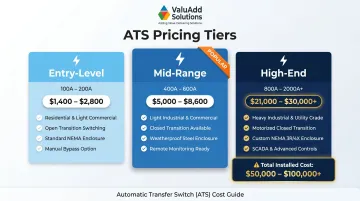
Entry-Level ATS (100A–200A)
Entry-level ATS units typically cost $1,400 to $2,800. For example, the Kohler RDT 200A service-entrance rated unit costs $1,429, while the ASCO 185 Series 100A unit costs $2,783.
Included standard:
- Standard open-transition switching (brief power interruption during transfer)
- Basic NEMA 1 or NEMA 3R enclosure
- Manual or automatic operation with simple voltage-sensing controls
- Time-delay adjustments to prevent false transfers
Typically excluded:
- NEMA 4X corrosion-resistant housing
- Advanced programmable controllers
- Load-shedding capabilities
- Closed-transition (seamless) transfer
Best-fit use cases:
- Single-phase or small three-phase applications
- Portable or standby generators up to 50kW
- Small commercial facilities with limited critical circuits
- Light industrial backup power needs
Mid-Range ATS (400A–600A)
Mid-range ATS units typically cost $5,000 to $8,600. The Cummins OTEC400 (400A) costs $5,044, while the Cummins OTEC600 (600A) reaches $8,582.
What's included:
- Commercial-grade construction with higher interrupt ratings
- Three-phase system compatibility
- Enhanced time-delay and voltage-sensing capabilities
- NEMA 1 or NEMA 3R enclosures standard
Typically excluded (or available as upgrades):
- Programmable logic controllers (basic models)
- NEMA 4X/12 industrial enclosures (available as upgrades)
- Remote monitoring or communication interfaces
- Bypass-isolation switching mechanisms
Best-fit use cases:
- Commercial buildings and office complexes
- Light industrial facilities and warehouses
- Water treatment pump stations
- Mid-size manufacturing operations
High-End ATS (800A–2000A+)
At this tier, unit pricing jumps sharply to reflect industrial-duty construction and sophisticated control requirements. High-amperage ATS units run $21,000 to $30,000+ for the switch alone — the Kohler 800A unit with MPAC 1500 controller costs $21,489. Medium-voltage units (above 600V) require custom request-for-quote pricing.
What's included:
- Heavy-duty switching mechanisms rated for tens of thousands of operations
- Closed-transition or soft-load transfer capability
- Sophisticated programmable control panels
- IEEE 519 compliance for harmonic-rich environments
- NEMA Type 4X or 12 enclosures for industrial conditions
Requires custom engineering (not standard):
- Medium-voltage configurations above 600V
- Bypass-isolation mechanisms
- Advanced remote monitoring and BACnet/Modbus integration
- Custom panel integration and system coordination
Best-fit use cases:
- Heavy industrial plants and processing facilities
- Oil and gas operations
- Data centers and mission-critical facilities
- Hospitals and healthcare institutions
- Municipal infrastructure and water treatment
Important note: Total installed cost (unit + labor + integration + commissioning) can far exceed the switch unit price alone, typically reaching $50,000 to $100,000+ for complete industrial installations.
Key Factors That Affect ATS Cost
ATS pricing is shaped by technical specifications, site conditions, and compliance requirements. The variables below account for most of the cost variance between a $1,500 residential unit and a $40,000+ industrial installation.
Switch Type and Transition Mode
Open-transition ATS (most common, lower cost):
- Brief power interruption during transfer (typically 50-100 milliseconds)
- "Break-before-make" switching prevents source paralleling
- Suitable for resistive loads and most motor applications
- Standard baseline pricing
Closed-transition ATS (higher cost):
- Seamless transfer with no power gap (momentarily parallels sources under 100ms)
- Requires in-phase synchronization monitoring
- Required for sensitive industrial loads and VFD-heavy facilities
- Adds a notable cost premium over open-transition units
Bypass-isolation ATS (highest cost tier):
- Combines standard ATS with manual bypass switch
- Allows maintenance without de-energizing the load
- Essential for healthcare and mission-critical data centers
- Commands highest price due to additional switching mechanisms
Amperage Rating and Voltage Class
Each step up in amperage demands stronger contacts, higher interrupt ratings, and more robust thermal management — all of which directly increase unit cost. For example, moving from 400A to 600A can add $3,500+ to the unit price.
Medium-voltage ATS (above 600V) commands a steep premium over low-voltage equivalents:
- Specialized insulation requirements
- Enhanced safety interlocks
- Custom engineering and factory testing
- Typically offered as quote-only by manufacturers like ABB and ASCO
The UL 1008 Withstand and Closing Rating (WCR) must match or exceed the available fault current at the installation point, which influences both amperage selection and cost.
That fault current rating also dictates the physical enclosure required — a factor that adds its own cost layer.
Enclosure Rating and Build Standards
Enclosure class significantly affects price:
NEMA Type 1 (indoor, general purpose):
- Baseline cost
- Protection against dust and incidental contact
- Suitable only for clean, indoor environments
NEMA Type 3R (outdoor, weatherproof):
- Moderate cost increase
- Protection against rain, sleet, snow, and ice formation
- Common for outdoor generator connections
NEMA Type 4X/12 (industrial, corrosion-resistant):
- Significant cost premium
- Stainless steel construction (4X) or sealed steel (12)
- Protection against washdowns, corrosive environments, and harsh conditions
- Anti-condensation heaters often recommended for outdoor/cold installations
UL Listing and certifications are baseline quality markers:
- UL 1008 certification is legally required by NEC Article 700.5 for emergency systems
- CE/FCC certifications add cost but enable international deployment
- IP65/IP66/IP68 ratings align with NEMA standards and influence pricing
Control Features and Integration Complexity
Basic ATS units include:
- Simple voltage-sensing and time-delay controls
- Manual or automatic operation
- Basic LED status indicators
Advanced units feature:
- Programmable logic controllers (PLCs)
- Remote monitoring and diagnostics
- Load-shedding capabilities
- Communication interfaces (Modbus, BACnet)
- Event logging and alarm functions
Each added capability increases cost. One often-overlooked cost driver: IEEE 519 harmonic compliance requirements in VFD-heavy facilities frequently require a 4-pole switched neutral design — which eliminates nuisance ground trips from zero-sequence harmonic currents but adds to unit cost.
Installation and Site Requirements
Installation cost is influenced by:
- Distance between generator and main panel
- Existing conduit infrastructure
- Local permitting fees and inspection requirements
- Whether a panel upgrade is needed
- Complexity of system integration
Electrician labor rates vary by region and project type. While the national median wage for electricians in May 2024 was $29.98/hour, industrial and commercial rates typically run $75–$150/hour depending on location and specialization. For industrial ATS installations requiring system integrator coordination, labor alone commonly adds $5,000–$20,000+ to the total project cost.
ATS Cost Breakdown: Beyond the Unit Price
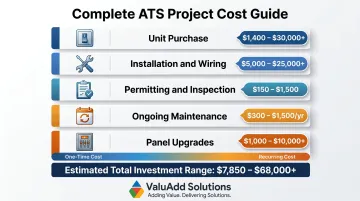
Total ATS project cost comprises several distinct line items beyond the switch itself. Buyers who budget only for the unit price are routinely surprised by the final invoice.
Complete Cost Structure
1. Unit Purchase (one-time):
- The transfer switch itself
- $1,400–$30,000+ depending on amperage and features
2. Installation and Wiring (one-time):
- Electrician labor at $30–$80 per hour depending on region
- Conduit, conductors, and mounting hardware
- Breaker tie-ins and panel integration
- Commercial and industrial installations typically add $5,000–$25,000+ for large-amperage systems
3. Permitting and Inspection (one-time):
- Fees vary widely by jurisdiction
- NYC Department of Buildings calculates fees based on estimated job cost
- Los Angeles LADBS uses specific electrical permit fee schedules
- Typically $150–$1,500 depending on project scope
4. Ongoing Maintenance (recurring):
- Annual testing and inspection
- Mechanical operation checks
- Contact resistance measurements
- Firmware updates for smart units
- $300–$1,500 annually for industrial units
5. Panel Upgrades or Subpanel Additions (periodic):
- Required when existing infrastructure cannot support new ATS load
- $1,000–$10,000+ depending on existing system capacity
For large-amperage systems (800A+), installation and maintenance costs can collectively match or exceed the unit purchase price over a 10-year operational horizon.
Budget vs. Premium ATS: What's the Real Difference?
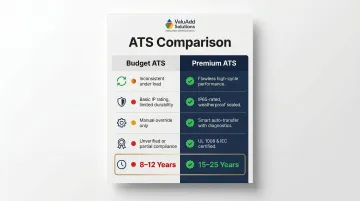
Price differences between budget and premium ATS units reflect real gaps in build quality, reliability under stress, and long-term total cost of ownership. Five factors account for most of that gap.
Where Budget and Premium ATS Units Diverge
Switching Reliability:
- Budget units may have higher failure rates under repeated cycling
- Premium units use hardened contacts rated for tens of thousands of operations
- Higher-grade contact materials reduce arcing and erosion
Enclosure and Environmental Protection:
- Budget units often carry basic NEMA 1 ratings
- Premium units are rated NEMA 4X/12 or IP66/IP68 for industrial environments
- Stainless steel construction and gasket sealing prevent corrosion
Control Sophistication:
- Budget units offer simple time-delay logic
- Premium units include programmable controls, diagnostics, and remote monitoring
- Advanced units log events and provide predictive maintenance alerts
Certifications and Compliance:
- Budget units may lack UL Listing or IEEE 519 compliance
- Premium units carry full certification stacks required for industrial, municipal, and regulated applications
- Documented test reports and compliance certificates reduce installation delays
Long-Term Value:
- Lower upfront cost on a budget unit can result in higher maintenance frequency
- Shorter service life means earlier replacement
- Downtime costs from transfer failures quickly outweigh any upfront savings
- Premium units typically deliver 15-25 year service life vs. 8-12 years for budget models
How to Estimate the Right ATS Budget for Your Facility
The right ATS budget starts with a clear load assessment, not a price search. Undersizing risks equipment failure during transfer; oversizing wastes capital. Matching ATS specifications — amperage, voltage class, enclosure, transition mode, certifications — to the actual demands of the application before quoting is how you avoid both underbuilding and overspending.
Key Inputs for Accurate Budgeting
1. Total Connected Load and Peak Demand
- Calculate in amps and kVA
- Include a 125% safety margin on continuous load per NEC requirements
- Account for motor starting inrush currents
2. Voltage Class and Phase Configuration
- Single-phase vs. three-phase
- Low voltage (600V and below) vs. medium voltage
- 120/240V, 120/208V, 277/480V, or higher
3. Environmental Conditions at the Installation Site
- Indoor, climate-controlled
- Outdoor with weather exposure
- Corrosive or washdown environments
- Hazardous locations requiring special ratings
4. Required Certifications and Compliance Standards
- UL 1008 (mandatory for NEC compliance)
- NEMA Type 4X or 12 for industrial environments
- IEEE 519 compliance for harmonic-sensitive facilities
- CE marking for international installations
5. Desired Transition Mode
- Open transition for most applications
- Closed transition for sensitive loads
- Bypass-isolation for maintenance flexibility
6. Long-Term Operating and Maintenance Costs
- Annual testing and inspection budget
- Expected service life and replacement cycle
- Cost of downtime if a transfer fails
When requesting quotes, ask suppliers for UL listing certificates and test reports alongside pricing. Specification errors caught before purchase cost far less than field modifications after installation.
What Most Buyers Miss About ATS Pricing
Focusing exclusively on unit price leads buyers to ignore total cost of ownership. An ATS priced 20% lower but rated for fewer switching cycles, lacking environmental protection, or requiring annual servicing will cost more over a 10-year operational horizon.
Three specification errors account for most of those hidden costs.
Three Common Specification Mistakes
1. Generator kW vs. Facility Amps:
- Generator output (kW) and facility load (amps) are not the same calculation
- ATS amperage must match the facility load at the specified voltage
- Proper load calculation requires licensed electrical engineer input
2. Enclosure Specification:
- Retrofitting a NEMA 4X enclosure post-purchase adds cost and delay
- Field modifications may void UL Listing
- Specify the correct enclosure upfront based on actual installation environment
3. VFD and Harmonic Integration:
- IEEE 519-compliant ATS units with 4-pole switched neutrals prevent nuisance tripping
- VFD-heavy facilities require coordination with system integrators
- Harmonic analysis and neutral strategy must be addressed during specification
Conclusion
ATS pricing ranges from approximately $1,400 for entry-level residential units to $30,000+ for high-amperage industrial systems. Amperage rating, transition type, enclosure class, certifications, and installation complexity all contribute to the final cost.
The right ATS is the one that reliably performs under a facility's specific load, environmental, and compliance conditions — not simply the cheapest unit that matches nameplate amperage. A properly specified, fully certified switch reduces long-term downtime risk and total cost of ownership.
Annual maintenance including contact resistance checks and operational testing is mandatory under NFPA 110 and keeps transfer times within spec while extending switch service life.
Frequently Asked Questions
How much does an ATS cost?
ATS costs range from approximately $1,400 for entry-level 200A residential units to $30,000+ for industrial high-amperage systems (800A+). Amperage rating, transition type (open vs. closed), and enclosure class (NEMA 1 vs. NEMA 4X) are the primary pricing variables. Medium-voltage units above 600V are custom-engineered and quote-only.
How much will an electrician charge to install a transfer switch?
Licensed electrician labor rates range from $30 to $80 per hour depending on region. Residential and light commercial installations typically add $600 to $2,500 in labor costs. Industrial ATS installations are more complex, often adding $5,000 to $25,000+ in labor and commissioning costs for large-amperage systems.
What amperage ATS do I need for my facility?
Required amperage is determined by your facility's total connected load plus a safety margin (typically 125% of continuous load per NEC). This calculation must account for voltage class, phase configuration, and motor starting inrush currents. Consult a licensed electrical engineer or qualified ATS supplier to perform proper load calculations before specifying a unit.
What is the difference between open transition and closed transition ATS?
Open transition involves a brief power interruption (typically 50–100ms) during transfer and suits most standard applications. Closed transition momentarily parallels both sources for seamless transfer with zero interruption — required for sensitive industrial or medical loads, and significantly more expensive due to synchronization and control complexity.
What certifications should an industrial ATS have?
Key certifications include UL 1008 Listing (required by NEC Article 700.5), NEMA Type 4X or 12 compliance for industrial environments, CE/FCC for internationally deployed equipment, and IEEE 519 compliance for VFD-heavy or harmonic-sensitive facilities. Request documented test reports and compliance certificates during the specification phase.
How often does an automatic transfer switch need maintenance?
Most industrial ATS units require annual maintenance including visual inspection, mechanical operation test, contact resistance check, voltage and timing verification, and cleaning. NFPA 110 mandates monthly operational testing (electrically transferring from primary to alternate and back). Deferred maintenance increases failure risk and puts facilities out of compliance with NFPA 110.