Introduction
Budgeting for a soft starter is harder than it looks. Two units with identical HP ratings can differ by thousands of dollars depending on voltage class, enclosure type, and onboard protection features — and choosing the wrong one means either overpaying or returning to the drawing board mid-project.
Soft starters limit in-rush current and provide controlled acceleration for three-phase AC induction motors. They're standard in manufacturing, oil and gas, and water treatment — anywhere mechanical stress at startup shortens equipment life.
The price spread is wider than most buyers expect. A 100 HP unit with basic features and an open chassis might run $1,200. That same HP rating with built-in bypass, advanced diagnostics, and a NEMA 4X enclosure can push past $5,000.
This guide breaks down soft starter pricing by HP tier, identifies the spec decisions that move the needle most on cost, and gives engineers and facility managers a reliable baseline for accurate budgeting.
Key Takeaways
- Soft starter prices range from $150 for small low-voltage units (5–30 HP) to over $30,000 for large medium-voltage systems (600 HP+)
- HP rating and voltage class are the biggest cost drivers, but enclosure type and protection features significantly impact price
- Unit cost represents only 50–70% of total installed cost; bypass contactors, wiring, and labor add significantly to the final number
- Small facilities can use budget-tier options; critical or high-HP applications justify premium investment
How Much Does a Soft Starter Cost? Pricing by HP Rating
Soft starter pricing spans a wide range depending on HP rating, voltage class, and included features. Misunderstanding this leads to underbudgeting, wrong-sizing, or unexpected add-on costs after purchase.
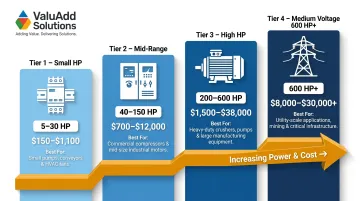
Small HP Tier (5–30 HP)
Typical Price Range: $150–$1,100
Small low-voltage soft starters are typically compact, DIN-rail or panel-mount units with basic overload protection. The Siemens 3RW30 Series ranges from $266 for a 5 HP unit to $710 for a 30 HP unit. ABB's PSR Series prices similarly: the PSR25 (25 A) lists at $568, while the PSR45 (45 A) lists at $1,103.
Best for:
- Light industrial loads
- Small pumps and conveyor systems
- HVAC fans
- Applications where in-rush reduction is the primary need
- Installations that don't require advanced control or communication
These units typically feature IP20/open chassis designs and integrated bypass contactors, suited for climate-controlled indoor installations.
Mid-Range HP Tier (40–150 HP)
Typical Price Range: $700–$12,000
Mid-range soft starters add built-in bypass, adjustable current ramp, and basic diagnostic capabilities. The Siemens 3RW4444 (215/372 A, 150/300 HP) with IP00 enclosure lists at $10,575. Eaton's S811+ Series for 150–200 HP applications ranges from $11,880 to $12,133.
Best for:
- Commercial pumps and compressors
- Industrial mixers
- Applications requiring motor protection and smoother starts
- Systems where full variable-speed control isn't needed
This tier represents the sweet spot for many industrial applications—enough protection and control for reliable operation without the premium cost of high-end features.
High HP Tier (200–600 HP)
Typical Price Range: $1,500–$38,000
High-HP low-voltage soft starters often include advanced protection relays, modular designs, and communication protocol options (Modbus, Profibus). Prices scale steeply with amperage: the Siemens 3RW5558 (1280 A) lists at $38,840. Packaged units with NEMA enclosures command significant premiums—ABB's PSTX X400 (400 HP @ 480 V, 590 A) in a NEMA 4 panel lists at $30,430.
Best for:
- Large pumps and crushers
- Centrifuges in manufacturing plants
- Heavy industrial loads requiring precise control
- Applications where communication integration is critical
The jump from mid-range to high-HP pricing reflects not just larger SCR components but also integrated thermal modeling, built-in diagnostic logging, and rugged enclosures. Once motor HP exceeds low-voltage system limits, the design shifts entirely—entering medium voltage territory.
Medium Voltage / 600 HP+ Tier
Typical Price Range: $8,000–$30,000+ (quote-based)
Medium voltage soft starters (2.3 kV–13.8 kV) require specialized design, solid-state SCR assemblies rated for high voltage, and often NEMA Type 4X or 12 enclosures. These are strictly quote-driven, engineered assemblies. They ship as metal-enclosed lineups featuring drawout SCR trucks, fully rated vacuum bypass contactors, control power transformers, and motor protection relays.
ValuAdd's MVE-P Series and CFMVRMX Series are engineered specifically for these critical-duty applications. The MVE-P Series supports mains voltage from 2.3 kV to 15 kV and current ratings up to 1200 A, featuring modular design for maintenance and fiber-optic isolation for operator safety.
Best for:
- Oil and gas pump stations
- Municipal water treatment facilities
- Large industrial facilities where motor HP exceeds low-voltage system capacity
- Applications where uptime is mission-critical
Key Factors That Affect Soft Starter Pricing
Price varies based on technical specifications, build standards, and application-specific requirements. Understanding each helps avoid over- or under-spending.
HP Rating and Voltage Class
HP and voltage class are the primary cost drivers. Low-voltage units (up to 600 V or 690 V) are far less expensive than medium-voltage units. Even within low-voltage, each step up in HP adds cost due to larger SCR components and thermal management needs. The voltage boundary at 1,000 V AC (per IEC 60038 and EU Directive 2014/35/EU) marks a significant cost inflection point, where specialized designs and safety standards dramatically increase pricing.
Protection Features and Built-In Functions
Added features increase cost significantly:
- Built-in bypass contactors (vs. external): Can add $100–$500+ depending on HP
- Motor thermistor inputs: Enable direct thermal monitoring
- Phase loss/imbalance detection: Protects against asymmetric supply conditions (typically 5–40% detection range)
- Ground fault protection: Detects faults from 5–100% of FLA or 0.1–25 amps zero sequence
- Programmable ramp curves: Allows precise current limiting (e.g., 125%–800% of rated current on premium units)
Entry-level units often omit these, requiring separate external components that add both cost and complexity. ValuAdd's RX3E and RX4E Series include full voltage-rated bypass contactors as standard, so that add-on cost doesn't appear as a line item surprise.
Enclosure and Environmental Rating
Open chassis or IP20 units are cheapest but suitable only for clean, indoor environments. Enclosure upgrades add significant cost:
- NEMA Type 12 (indoor, dust/drip protection): Standard on many industrial units
- NEMA Type 3R (outdoor, rain/sleet protection): Adds 15–25% to base cost
- NEMA Type 4X (corrosion-resistant, washdown-rated): Adds 25–40% to base cost
- IP66/IP68 (water jet/submersion protection): Required for harsh environments
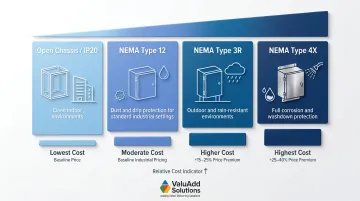
These ratings are non-negotiable for outdoor, wet, or corrosive environments common in oil and gas and water treatment applications.
Brand, Certifications, and Compliance
UL Listed, CE Certified, and IEEE 519-compliant units carry a price premium over non-certified equivalents. For industries with strict safety or grid compliance requirements, certification is non-negotiable.
IEEE 519-2014 establishes voltage and current distortion limits at the point of common coupling (PCC) — a critical specification for facilities running multiple nonlinear loads. Most major OEMs list UL, CSA, and CE compliance as standard; confirm which certifications your application actually requires before comparing quotes.
Communication and Integration Options
Soft starters with fieldbus communication cost more than standalone units. Eaton's communication modules list between $615–$1,238 depending on protocol (Modbus RTU vs. Profibus). System integrators building connected control architectures will find this capability worth the premium; for simple standalone applications, a basic unit without fieldbus will do the job at lower cost.
Full Cost Breakdown: Beyond the Unit Price
The soft starter unit cost is only the starting point—total cost of ownership includes installation, accessories, and ongoing operational expenses.
Initial Purchase
Base list prices typically exclude bypass contactors on some models—adding $100–$500+ depending on HP—though many modern units include integrated bypass as standard. Always verify what's included before comparing quotes.
Installation and Setup
Covers wiring, mounting, configuration, and commissioning. Bureau of Labor Statistics data (May 2023) reports an hourly mean wage of $32.20 for electricians in building equipment contractors. Actual contractor bill rates run higher once benefits (29.9% of total compensation per BLS data), overhead, and profit are factored in.
Medium-voltage installs require specialized contractors due to safety requirements and added complexity, pushing labor costs considerably above standard installations. The NECA Manual of Labor Units (2023-2024) provides specific man-hour estimates for enclosed magnetic motor starters across various NEMA enclosure types.
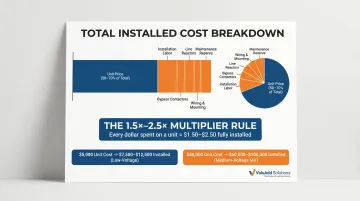
Rule of thumb: Total installed cost typically runs 1.5–2.5x the unit price, with medium-voltage installs at the higher end.
Accessories and Ancillary Components
These can add 20–40% to the base unit cost and are often overlooked when budgeting:
| Accessory | When Required | Notes / Spec Requirement |
|---|---|---|
| External Bypass Contactor | Emergency DOL starting or severe applications (rock crushing) | Must be fully AC-3 rated |
| Line Reactors | Multiple electronic starters on same supply | 1–5% impedance (typically 3%) |
| Control Power Transformers | Enclosed panels and MV systems | Included in engineered enclosures |
One way to reduce accessory costs: look for units with integrated bypass contactors. ValuAdd's RX2E, RX3E, and RX4E Series include full voltage-rated bypass contactors as standard, which removes one of the more common line items from the quote.
Maintenance and Repairs
Recurring costs. Soft starters have fewer moving parts than mechanical starters, but SCR assemblies, cooling components, and control boards require periodic inspection. ABB recommends "extraordinary" maintenance every three years, including visual inspections, firmware updates, and checking bypass relays/contactors. Medium-voltage units have higher service costs due to specialized components like vacuum contactors and protective relays.
Low-Cost vs. High-End Soft Starters — What's the Real Difference?
Low-cost and high-end soft starters both reduce motor in-rush current, but they diverge significantly on protection capability, build quality, and long-term reliability.
Performance and Protection
Budget units use 2-phase control to reduce in-rush peaks, but offer basic voltage ramp with limited adjustability and no closed-loop current limiting. Diagnostics are minimal, and fault logging is typically absent.
Premium units operate differently. A Siemens 3RW55, for example, offers adjustable current-controlled ramp from 125%–800% of rated current, full motor protection relay functions, and comprehensive fault logging. Protection features include:
- Phase loss/imbalance detection (5–40%)
- Ground fault protection (5–100% FLA)
- Programmable torque control to prevent mechanical shock per IEEE Standard 275
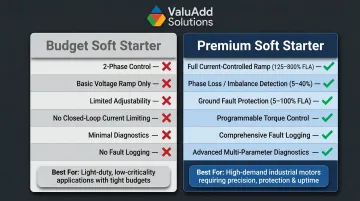
This distinction matters most where unexpected downtime carries high operational cost — oil and gas pump stations and municipal water treatment facilities being two clear examples.
Build Quality and Lifespan
The hardware differences between tiers are substantial:
- Budget units: Lower-rated SCR components, minimal thermal protection, standard enclosures unsuitable for harsh environments
- Premium units: Industrial-grade components, conformal-coated PCBs, certified enclosures (NEMA 4X, IP66) rated for demanding conditions
These hardware choices directly affect longevity. MTBF (Mean Time Between Failures) measures statistical error-free operation at 40°C based on component failure rates — not absolute service life — but higher-quality components improve reliability in practice.
Long-Term Value
Even premium soft starters allow 2–4x rated amperage in-rush during startup — a meaningful reduction from DOL starting (5–8x FLA), but still enough to cause cumulative mechanical wear over time. Units with tighter current control reduce this stress further, making them more cost-effective over a 5–10 year horizon in high-cycle applications like frequent pump starts or conveyor systems.
For critical applications, ValuAdd's MVE-P Series and CFMVRMX Series offer smooth stepless acceleration that eliminates torque spikes, protecting couplings and shafts while cutting long-term maintenance costs.
How to Budget for the Right Soft Starter (and Avoid Costly Mistakes)
Start with Application Requirements, Not Price
Define these parameters before comparing prices:
- Motor HP, voltage, and full-load amperage
- Duty cycle (starts per hour)
- Environment (indoor/outdoor, corrosive, washdown)
- Communication integration needs
- Criticality of application (downtime tolerance)
Specifying to the correct HP tier and enclosure rating prevents buying the wrong unit and costly field modifications.
Account for Total Installed Cost, Not Just Unit Price
The unit price is only part of the equation. Budget for bypass contactors (if not integrated), line reactors (if multiple starters on same supply), wiring, labor, and any required enclosure upgrades.
Use the 1.5–2.5x multiplier as a planning tool: a $5,000 soft starter will likely cost $7,500–$12,500 fully installed, with MV installations trending toward the higher end.
Avoid the Three Most Common Budgeting Mistakes
1. Skipping certifications and protection features: Entry-level units often lack phase imbalance detection, ground fault protection, or proper enclosure ratings. Those savings vanish after the first motor failure — or when you're forced to add external protection components after installation.
2. Ignoring maintenance costs: High-HP and medium-voltage units require periodic inspection of SCR assemblies, cooling systems, and bypass contactors. Budget 2–5% of unit cost annually, with MV units at the higher end.
3. Over-specifying for non-critical loads: For warehouse fans or non-essential conveyors, a standard unit without fieldbus communication or advanced diagnostics works just as well at half the cost. Match the spec to what the application actually needs.
Conclusion
Soft starter costs range from under $200 for small low-voltage units to over $30,000 for large medium-voltage systems. This wide range reflects differences in HP rating, voltage class, protection features, and enclosure requirements. Knowing where your application falls in that range before specifying equipment prevents budget shortfalls at the procurement stage.
That purchase price, however, represents only 50–70% of total cost of ownership. Installation labor, accessories like bypass contactors and line reactors, and ongoing maintenance all factor into the real number. A correctly specified, certified unit with appropriate protection features routinely outperforms a cheaper alternative once you account for avoided downtime — in sectors like water treatment or oil and gas, even a single unplanned motor failure can cost more than the price difference between tiers.
Frequently Asked Questions
What is the price of starters?
Soft starter prices start around $150–$200 for small low-voltage units (5–30 HP) and can exceed $30,000 for large medium-voltage systems (600 HP+). Price depends heavily on HP rating, voltage class, and included features like bypass contactors, enclosure ratings, and communication protocols.
Is a soft starter worth it?
Soft starters pay off when you need to limit in-rush current, smooth acceleration, and reduce mechanical stress on startup. They cost less than VFDs but provide no speed control, so the right choice depends on whether your application needs variable speed or just controlled starting.
How does HP rating affect soft starter cost?
Higher HP requires larger SCR components and more robust thermal management, which directly increases unit cost. The jump from low-voltage (up to 600/690 V) to medium-voltage applications (2.3–13.8 kV) represents the largest single cost increase, often adding $10,000–$20,000+ due to specialized designs and safety requirements.
What is the difference in cost between a soft starter and a VFD?
Soft starters are generally 30–60% less expensive than equivalent-HP VFDs upfront. VFDs provide continuous speed control and more precise protection, which can reduce long-term mechanical wear and deliver energy savings in variable-load applications.
How much does it cost to install a soft starter?
Installation costs vary by HP and site complexity. Total installed cost typically runs 1.5–2.5x the unit price when accounting for labor, wiring, mounting, and configuration. Medium-voltage installs require specialized contractors and fall at the higher end of this range due to safety requirements and complexity.
Do soft starters require a bypass contactor, and does it add to the cost?
A bypass contactor carries full motor current after startup, reducing thermal stress on the soft starter's SCRs — most manufacturers either include it as standard or require it for continuous-duty operation. When purchased separately, expect to add $100–$500+ depending on HP rating and duty requirements.