
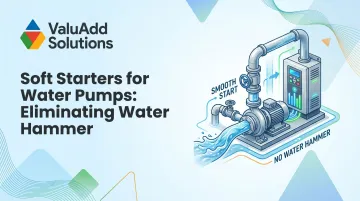
Introduction
Water hammer is a destructive pressure surge that plagues pump systems worldwide — cracking pipes, damaging valves, and causing costly unplanned downtime across municipal water treatment, industrial processing, and oil and gas facilities. According to surge pressure guidelines from the Hydraulic Institute, surge pressure rise must not exceed the internal design pressure by more than 10%, yet many systems experience transient spikes reaching multiples of normal operating pressure.
Water hammer has multiple causes — from rapid valve closures to power failures — but the most impactful and underutilized solution is the soft starter. Unlike mechanical mitigation devices that treat symptoms downstream, soft starters attack the root cause: sudden changes in fluid velocity.
TLDR
- Water hammer is caused by sudden changes in fluid velocity from abrupt pump starts, stops, and valve closures
- Pressure spikes can reach several times normal operating pressure, causing pipe bursts, joint failures, and equipment damage
- Soft starters prevent water hammer by gradually ramping motor speed up and down, eliminating the velocity changes that trigger surges
- Surge tanks, slow-closing valves, and air release valves complement soft starters in high-risk systems
- Long-term prevention requires proper soft starter configuration, routine inspections, and early-warning monitoring
What Causes Water Hammer in Pump Systems
Water hammer is a hydraulic shockwave that travels through a pipeline when fluid velocity changes suddenly. The physics follow a consistent pattern: when a moving water column is forced to accelerate or decelerate abruptly, its momentum change generates a pressure wave that propagates at the speed of sound in the liquid — 1,000 to 4,000 ft/s (300 to 1,300 m/s).
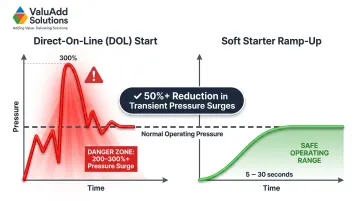
Those pressure spikes can exceed normal system pressure by 200–300% or more, overwhelming pipe ratings and destroying components.
Water hammer in pump systems has several distinct triggering scenarios. Identifying which one applies to your facility is the first step toward selecting the right mitigation strategy.
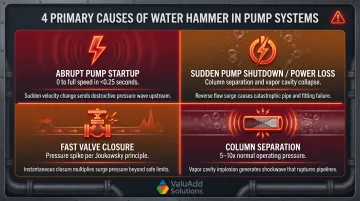
Abrupt Pump Startup (Direct-On-Line Starting)
Direct-On-Line (DOL) starting delivers full voltage to the motor instantly, causing the pump impeller to accelerate from 0 to full speed in less than 1/4 second. This creates a sudden high-velocity flow front that generates a downstream pressure surge. The result: a shockwave that slams into pipe walls, valves, and fittings with destructive force.
Typical scenarios include:
- Large centrifugal pumps in municipal water distribution networks
- Booster pump stations serving high-rise buildings or elevated zones
- Irrigation systems with long main lines
- Any system where pipeline length exceeds several hundred feet and pressure wave reflections amplify the effect
Sudden Pump Shutdown or Power Loss
When a pump stops abruptly — whether intentionally or due to power failure — flow momentum creates negative pressure zones downstream. These low-pressure regions can drop below vapor pressure, forming vapor cavities. When flow reverses and the cavity collapses, the result is a violent pressure spike often worse than startup hammer.
This phenomenon, called column separation, is especially dangerous in vertical pumping systems (deep wells, high-rise buildings) and long-distance transmission mains.
Check valves that slam shut on flow reversal compound the damage. The reversing fluid gains speed before the valve closes, causing catastrophic impact at closure.
Fast Valve Closure
Rapidly closing a gate or butterfly valve stops flow abruptly, generating a pressure surge governed by the Joukowsky principle: the faster the valve closes and the higher the flow velocity, the greater the pressure spike. Even a valve closure that takes just 2–3 seconds can produce damaging surges in systems with high flow velocity or long pipe runs.
Common scenarios include:
- Manual operator error during system adjustments
- Failing automated valve actuators that close too quickly
- Undersized control valves that must close rapidly to achieve flow cutoff
- Emergency shutdown procedures that prioritize speed over controlled deceleration
Column Separation and Vapor Cavity Collapse
Column separation can also occur mid-pipeline in systems with significant elevation changes or where pump discharge pressure drops below vapor pressure. Vapor pockets form at high points or slope changes, then violently implode when pressure is restored.
This compounding cause — often triggered by one of the above events — tends to produce the most severe damage in high-head or long-transmission-main systems.
Research shows that column separation events can produce pressure rises that far exceed the predictions of the Joukowsky equation, with recorded spikes reaching 5–10 times normal operating pressure in severe cases.
What Happens If Water Hammer Is Ignored
Repeated pressure surges cause progressive, cumulative damage. Each cycle creates micro-fatigue in pipe walls and joint gaskets, leading to leaks, burst pipes, cracked fittings, and valve seat erosion. Documented case studies in industrial pumping systems show catastrophic failures resulting in hundreds of thousands of dollars in emergency repairs and lost production time.
Beyond pipe damage, the hydraulic shocks ripple through every connected component:
- Bearings and mechanical seals wear faster under repeated hydraulic shock loads
- Motor winding insulation degrades from torque transients at each start/stop event
- Check valves fail prematurely from repeated slamming, requiring frequent replacement
- Unplanned downtime and emergency repairs drain maintenance budgets and disrupt operations
Water hammer also creates direct safety hazards. In pressurized industrial systems, sudden pipe failure can flood equipment areas and contaminate water supplies through backflow during negative pressure events. Ruptured pipe sections pose physical risks to nearby personnel.
Warning Signs You're Experiencing Water Hammer
Water hammer often gives early, observable warnings before causing structural damage. Operators should recognize these signs:
- Audible banging or thudding at pump start/stop or valve operation — often misattributed to loose pipe supports
- Visible pipe movement, vibration, or rattling at supports and hangers immediately after pump cycling events
- Recurring small leaks at flanged joints, threaded fittings, or valve packing that worsen progressively — a sign of fatigue cycling from repeated pressure spikes
How Soft Starters Eliminate Water Hammer
A soft starter's ability to control motor acceleration and deceleration directly addresses the root physical cause of water hammer: sudden velocity change. Rather than mitigating symptoms downstream, soft starters prevent the pressure surge from forming in the first place.
Controlled Ramp-Up: Gradual Acceleration at Startup
Soft starters use Silicon Controlled Rectifiers (SCRs) to progressively increase the voltage — and therefore torque — delivered to the pump motor. Instead of accelerating the impeller from 0 to full speed in milliseconds, advanced pump-control algorithms extend the ramp time to 5–30 seconds or longer, depending on system parameters.
The hydraulic result: Flow velocity in the pipeline increases gradually, eliminating the abrupt velocity front that generates startup water hammer. The pressure rise becomes a slow, manageable ramp rather than a shockwave. Studies show that soft starters equipped with dedicated pump control algorithms significantly reduce pressure spikes compared to DOL starting, often cutting transient pressure surges by 50% or more.
ValuAdd's MVE-P Series medium voltage soft starter supports motors from 110 A to 1,200 A at voltages ranging from 2.3 kV to 15 kV. Programmable ramp times extend up to 30 seconds at 400% Full Load Current, giving facilities precise control over acceleration profiles for their specific pipeline characteristics.
Controlled Ramp-Down: Gradual Deceleration at Shutdown
Many water hammer incidents occur at shutdown, not startup — and most operators don't realize their system lacks adequate protection. A quality soft starter provides a programmable deceleration ramp (soft stop), slowing the pump gradually so flow velocity decreases smoothly. This prevents column separation, vapor cavity formation, and check valve slam.
This feature is especially critical in:
- Long-distance water transmission mains where momentum is highest
- High-head pumping systems with significant elevation changes
- Multi-pump systems on a common header where shutdown sequencing is complex
ValuAdd's soft starters, such as the RX3E Enclosed Combination Soft Starter, include adjustable voltage control deceleration designed specifically for pump applications. This controlled ramp-down capability is essential for facilities seeking to eliminate shutdown water hammer and extend equipment life.
Electrical and Mechanical Benefits
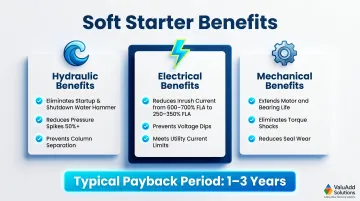
Beyond water hammer prevention, soft starters deliver significant electrical and mechanical benefits. DOL starting typically generates inrush currents of 600-700% of Full Load Amperes (FLA), causing severe voltage dips and thermal stress on motor windings. Soft starters reduce this to 250-350% FLA, cutting inrush current roughly in half.
Key benefits include:
- Reduced stress on motor windings, extending motor life
- Lower voltage drops on electrical distribution systems, preventing disruption to other equipment
- Elimination of torque shocks on couplings, seals, and bearings
- Compliance with utility starting-current limits (often capped at 500-600% FLA)
These combined benefits — hydraulic, electrical, and mechanical — make soft starters a cost-justifiable investment. Industry data shows that the payback period for soft starters in water pumping applications typically ranges from 1-3 years, factoring in avoided water hammer damage, reduced maintenance, and lower energy costs.
Other Prevention Measures That Complement Soft Starters
In high-risk systems — long transmission mains, high-pressure networks, or pumps with large stored kinetic energy — soft starters work best as part of a layered mitigation strategy. Three complementary measures target the remaining failure modes: valve slam, pressure wave energy, and column separation.
Slow-Closing Check Valves and Actuated Valves
Slow-closing non-return valves and motorized actuated valves with adjustable closing times prevent slam-induced water hammer at pump discharge. Non-slam check valves close before reverse flow gains momentum, eliminating the destructive impact that standard check valves produce when they slam shut.
Surge Tanks and Pressure Vessels
Surge tanks (open standpipes) or closed surge vessels (hydropneumatic tanks) absorb pressure wave energy by allowing a small volume of water to expand into a pressurized air cushion. This dampens the shockwave before it travels through the system. Surge tanks are particularly valuable in systems where power failure scenarios cannot be addressed by soft starters alone.
Air Release and Vacuum Break Valves
Air release valves at high points prevent vapor pocket formation (column separation) by admitting air when pressure drops below atmospheric. This reduces the severity of cavity collapse events. Combination air valves that both release air during filling and admit air during low pressure are critical for preventing negative pressure intrusion and contamination.
Tips for Long-Term Water Hammer Prevention and Control
Sustained water hammer protection requires ongoing attention to system configuration and operational practices. Follow these best practices:
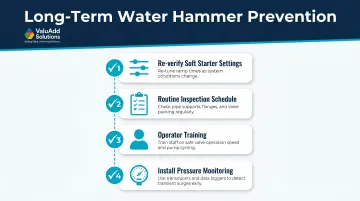
- Re-verify and tune soft starter ramp time settings as system conditions change — pipe additions, pressure zone shifts, or pump replacements can alter transient behavior and render commissioning settings inadequate
- Implement routine inspection schedules for pipe supports, flange joints, and valve packing on a documented basis — early detection of fatigue damage prevents catastrophic failures
- Train operators on manual valve operation speed and pump cycling practices. Many water hammer events stem from human error, not equipment failure
- Install pressure transducers or data loggers at pump discharge and critical pipeline nodes. Transient pressure data validates soft starter settings and surfaces new hammer sources before damage builds up
Frequently Asked Questions
What is a soft starter for a water pump?
A soft starter is an electronic motor control device that gradually increases voltage to the pump motor during startup and reduces it during shutdown. By controlling acceleration and deceleration, it prevents the abrupt speed changes that cause water hammer while reducing mechanical and electrical stress on the system.
Do soft starters for water pumps really work?
Yes, soft starters are proven and widely deployed across municipal, industrial, and commercial pump systems. Controlling acceleration and deceleration ramp times directly eliminates the sudden velocity changes responsible for pressure surges — and industry standards explicitly recommend soft starting for systems prone to water hammer.
What is better for a water pump: a hard start or a soft start?
Soft starting is preferable for pump systems of any significant size. Hard (DOL) starting maximizes water hammer risk, inrush current, and mechanical shock, while soft starting eliminates these issues. DOL may only be acceptable for very small, short-piped pumps with negligible water hammer risk.
What causes water hammer in pump systems?
Water hammer is caused by sudden changes in fluid velocity. The main triggers are abrupt pump startup or shutdown, rapid valve closure, and column separation. All involve instantaneous velocity changes that generate pressure shockwaves traveling through the pipeline at the speed of sound.
Can a soft starter completely replace other water hammer protection devices?
Soft starters handle the most common causes — startup and shutdown transients — with high effectiveness. Complex or high-risk systems (long transmission mains, high heads, multiple pumps) may still need surge vessels, slow-closing valves, or air release valves, particularly to cover power failure scenarios.
How do I set the ramp time on a soft starter to prevent water hammer?
Ramp time depends on pipe length, fluid velocity, and system pressure — longer pipelines generally need longer ramps. Start with manufacturer guidelines (typically 10-30 seconds), then use pressure transient measurements at commissioning to fine-tune the setting for your application.