Introduction
Selecting the wrong disconnect switch for a solar installation is one of the fastest ways to fail an inspection. The wrong type, incorrect rating, or improper placement triggers NEC violations, equipment damage, and safety hazards that stall projects and drive up costs. In commercial and industrial installations, those mistakes mean rework, re-inspections, and schedule overruns.
AC and DC disconnects are not interchangeable — they differ in voltage handling, arc interruption requirements, sizing calculations, and code compliance. This guide breaks down those differences so electrical engineers, system integrators, and facility managers can select the right switch, place it correctly, and keep installations inspection-ready.
Key Takeaways
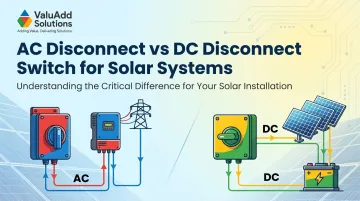
- DC disconnects are installed between solar panels and the inverter; AC disconnects sit between the inverter and the utility grid.
- Both types are mandatory under NEC Article 690 for grid-tied solar systems in the United States.
- DC's continuous current flow demands arc suppression hardware, making DC disconnects more complex than their AC counterparts.
- NEC sizing requires multiplying Isc × 1.25 for current rating and Voc × 1.25 for voltage rating on DC disconnects.
- Most solar systems require both; the real decision is selecting the correct specs for each position in the circuit.
AC Disconnect vs DC Disconnect: Quick Comparison
| Aspect | DC Disconnect | AC Disconnect |
|---|---|---|
| Location | Between solar array and inverter input | Between inverter output and utility meter or service panel |
| Current Type | Direct Current (DC) | Alternating Current (AC) |
| NEC Governing Articles | NEC 690.8, 690.13, 690.12 | NEC 690.10, 690.13 |
| Typical Voltage Ratings | 600VDC, 1000VDC, 1500VDC | 120V, 240V, 480V AC |
| Typical Current Ratings | 32A–250A+ (based on array size) | Based on inverter continuous output |
| Arc Interruption | Complex — requires specialized contacts and arc chutes | Simpler — AC naturally crosses zero 120 times/second |
| Environmental Requirements | IP65/IP66 or NEMA 4X (outdoor proximity to array) | NEMA 3R minimum (exterior wall mounting) |
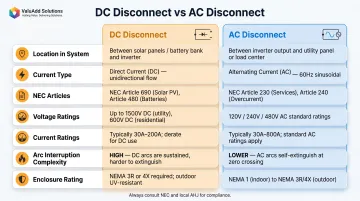
Location and Arc Interruption
The DC disconnect sits between the solar panel array and the inverter input — the first isolation point in the power chain. The AC disconnect comes after the inverter, positioned between its output and the utility meter or service panel, serving as the final shutoff before grid connection.
Where they diverge most sharply is arc interruption. Direct current flows continuously without crossing zero, sustaining hotter arc plasma that demands specialized silver-tungsten contact materials and magnetic blowout coils to extinguish safely. Alternating current crosses zero 120 times per second in a 60 Hz system, naturally collapsing the arc — which is why AC disconnect hardware is mechanically simpler and generally less expensive than its DC counterpart.
Ratings and Code Requirements
Selecting the right ratings matters — undersizing either disconnect creates a code violation and a safety hazard.
For the DC side, NEC 690.8 requires the disconnect to handle 125% of the maximum circuit current. In practice, this puts most residential and light commercial DC disconnects in the 32A–100A range, while larger commercial arrays may require 250A or more. Voltage ratings (600VDC, 1000VDC, or 1500VDC) must match the array's open-circuit voltage under worst-case cold-temperature conditions.
On the AC side, NEC 690.10 ties sizing directly to the inverter's continuous output current. Single-phase systems typically operate at 120V or 240V; three-phase commercial installations run at 480V AC. Unlike DC ratings, AC disconnect sizing is more straightforward because the inverter itself defines the maximum output.
Enclosure and Environmental Standards
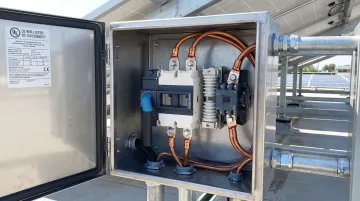
DC Disconnect: Requires outdoor ratings (IP65, IP66, or NEMA 4X) due to typical installation proximity to the array. ValuAdd's SIRCO MOT DC ESS and INOSYS LBS UL 98B, for example, carry IP65/IP66 ratings and are built for sustained exposure to weather, UV, and temperature swings common at rooftop or ground-mount array locations.
AC Disconnect: Often installed on exterior walls near utility meters; requires NEMA 3R minimum rating. Must be visible and accessible to utility personnel and first responders per IEEE 1547-2018 requirements.
What is a DC Disconnect Switch?
A DC disconnect switch interrupts direct current electricity flowing between the solar panel array and the inverter. Solar panels inherently produce DC electricity, making this disconnect the first control point in the power chain.
The DC Arc Challenge
DC current's continuous flow creates a critical technical challenge. Unlike AC current, which oscillates and crosses zero 120 times per second, DC maintains constant directional flow without natural zero-crossing points. When breaking a loaded DC circuit, the resulting arc is continuous, hotter, and far harder to extinguish than AC arcs.
Quality DC-rated switches address this through:
- Silver-tungsten contact materials — tungsten's melting point of 3,422°C provides superior resistance to arc erosion compared to standard copper contacts (1,085°C)
- Magnetic blowout coils — generate fields that physically stretch arcs away from contacts into arc chutes
- Arc chutes with de-ion grids — break arcs into smaller segments and cool plasma temperatures
Using an AC-rated switch on a DC circuit violates NEC 110.3(B) and creates serious safety hazards, including contact welding, housing melt-through, or catastrophic arc flash events.
Correct sizing is just as critical as the switch rating itself.
NEC Sizing Requirements for DC Disconnects
NEC 690.8 requires DC disconnects to be rated for at least 125% of the array's short circuit current (Isc):
Sizing Formula:
- Minimum Current Rating = Array Total Isc × 1.25
- Minimum Voltage Rating = Array Open Circuit Voltage (Voc) × 1.25
Example Calculation: For a commercial array with 300A total Isc and 800V Voc:
- Minimum current rating: 300A × 1.25 = 375A
- Minimum voltage rating: 800V × 1.25 = 1000VDC
Temperature derating factors must be applied when ambient installation temperatures exceed standard conditions.
Beyond sizing, the switch type itself varies depending on string configuration and system design.
DC Disconnect Variations
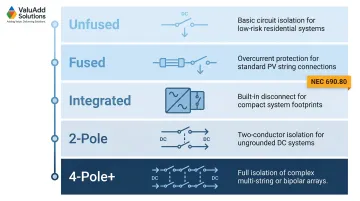
DC disconnects come in several configurations based on system requirements:
- Unfused — standard isolation switches without integrated overcurrent protection
- Fused — required when more than two parallel strings are present, per NEC 690.80
- Integrated — built into some inverters; local AHJ approval determines acceptability
- 2-pole — suited for single-string applications
- 4-pole or higher — required for multi-string installations
Use Cases of DC Disconnect
DC disconnects are universal in grid-tied and off-grid solar systems, with specifications scaling by system size:
| Parameter | Residential (5–20kW) | Commercial / Industrial |
|---|---|---|
| Typical Current Rating | 32A–63A | 125A–250A+ |
| Voltage Rating | 1000VDC | 1000–1500VDC |
| Pole Configuration | 2-pole | 4-pole, 6-pole |
| Enclosure Rating | NEMA 3R | IP65/IP66 or NEMA 4X |
Manufacturing facilities, processing plants, and oil and gas operations require industrial-grade DC disconnects rated for harsh environments. Products like the SIRCO MOT DC ESS (up to 1500VDC, 2000A) and INOSYS LBS UL 98B (750–1500VDC, 10–1200A) meet these demands with Class E2 Load Break compliance and IP65/IP66 enclosure ratings — specifications that satisfy NEC requirements and hold up in demanding field conditions.
What is an AC Disconnect Switch?
An AC disconnect switch interrupts alternating current traveling from the solar inverter to the utility grid or facility electrical service. After the inverter converts DC power from panels into AC, the AC disconnect serves as the final shutoff point between the solar system and the grid.
Why AC Disconnects Are Simpler
AC current reverses direction and crosses zero 120 times per second at 60 Hz. This natural zero-crossing allows the arc formed during switching to extinguish automatically each half-cycle. Standard safety switch designs—including common circuit breakers and pullout switches—work reliably on AC circuits without requiring the specialized arc suppression mechanisms needed for DC applications.
Sizing and NEC Compliance for AC Disconnects
NEC 690.10 governs AC disconnect sizing, requiring conductors between the inverter output and building disconnect to be sized to the inverter's rated output current. Overcurrent protection must be located at the inverter output.
Common AC Disconnect Implementations:
- Backfed breaker in the main service panel
- Standalone safety switch mounted between inverter and utility meter
- Integrated into facility switchgear for large commercial installations
Placement and Accessibility Requirements
IEEE 1547-2018 mandates a "readily accessible, lockable, visible-break isolation device" between the utility grid and distributed energy resource. AC disconnects must be:
- Mounted in readily accessible locations for utility personnel and emergency responders
- Typically installed on exterior walls near electric meters
- Clearly labeled with "SOLAR DISCONNECT" signage and system information
- Capable of being locked in the open position
- Visible to confirm physical separation
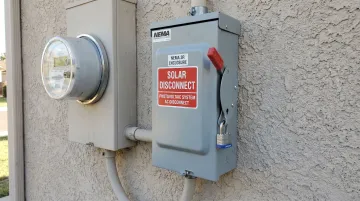
Utilities enforce strict interconnection requirements. For example, PG&E's Rule 21 requires visible verification of separation and 24-hour accessibility without keys or security clearances.
Use Cases of AC Disconnect
Any grid-tied solar installation requires an AC disconnect for safe inverter isolation from the utility. During fires, floods, utility maintenance, or emergency response, first responders depend on rapid system de-energization — making proper disconnect placement a life-safety issue, not just a code requirement.
Large facilities with multiple inverters or three-phase solar systems require three-pole AC disconnects rated for combined inverter output current. These are typically integrated into main switchgear or service entrances.
Research from IEEE confirms that rapid de-energization enabled by properly specified AC disconnects measurably lowers incident risk for emergency responders at solar-equipped facilities.
For three-phase commercial installations, the SIRCO UL 98 C from ValuAdd supports three-phase AC applications up to 800VAC with current ratings from 400A to 1000A — covering the output range of most demanding commercial solar inverters.
AC vs DC Disconnect: Which One is Right for Your System?
For any grid-tied solar system, both AC and DC disconnects are required under NEC Article 690. This is not an either/or choice. The real decision involves matching specifications, ratings, and configurations to each position.
Key Factors Driving DC Disconnect Selection
Number of PV Strings:
- Single or dual strings: 2-pole unfused disconnect
- Three or more parallel strings: Multi-pole fused disconnect required per NEC 690.80
Total Array Short Circuit Current:
- Multiply total Isc by 1.25 for minimum current rating
- Example: 200A Isc × 1.25 = 250A minimum rating
Array Open Circuit Voltage:
- Multiply Voc by 1.25 for minimum voltage rating
- Example: 800V Voc × 1.25 = 1000VDC minimum rating
Ambient Temperature:
- Apply derating factors when installation temperatures exceed standard conditions
- High-temperature environments require uprated switches
Installation Environment:
- Rooftop arrays near coastal areas: IP65/IP66 or NEMA 4X enclosures
- Ground-mount arrays in dusty conditions: IP65 minimum with dust protection
- Indoor combiner boxes: NEMA 12 may be acceptable
Key Factors Driving AC Disconnect Selection
Inverter Continuous Output Current:
- Size disconnect for inverter's rated continuous output per NEC 690.10
- Include safety margin for sustained operation
System Voltage:
- Residential: 120V or 240V single-phase
- Commercial/Industrial: 480V three-phase common
Pole Count:
- Single-phase systems: 2-pole
- Three-phase systems: 3-pole required
Utility Requirements:
- Dedicated exterior disconnect often required when inverter is more than 10 feet from main service panel
- Must meet IEEE 1547-2018 visible-break and lockable requirements
Situational Recommendations
Choose 1500VDC-rated DC disconnect when:
- Designing commercial or utility-scale systems with large series strings
- Maximizing system efficiency through higher voltage operation
- Working with newer inverter technology supporting 1500VDC input
Select fused DC disconnect when:
- System has more than two parallel strings
- Local AHJ requires individual string overcurrent protection
- Maximizing personnel safety during maintenance
Use standalone AC disconnect with NEMA 3R/4X enclosure when:
- Inverter is located more than 10 feet from main service panel
- Utility requires exterior shutoff point
- Local fire code mandates rapid shutdown access
For Industrial Facilities: Oil and gas operations, manufacturing facilities, and processing plants face stricter requirements than commercial rooftop installations. Industrial-grade disconnects must satisfy both NEC Article 690 and facility-specific safety standards, including NEMA Type 4X or 12 enclosures, UL Listing, and in many cases motorized remote operation capability for high-amperage DC circuits. ValuAdd supplies UL Listed, NEMA-compliant disconnect components rated for these demanding environments.
Real-World Specification Error
Industry inspection records document a common error: system integrators specifying AC-rated safety switches on the DC side of commercial solar installations. In one documented case, a 400kW commercial rooftop installation used a standard AC-rated switch between the combiner box and inverter. During the first maintenance shutdown six months after commissioning, the switch failed catastrophically when opened under load—the sustained DC arc welded the contacts and melted portions of the polycarbonate housing.
The resolution required complete switch replacement with a properly rated UL 98B-listed DC disconnect featuring magnetic blowout coils and silver-tungsten contacts. The specification error cost the integrator $8,500 in parts and labor, plus three days of system downtime.
Conclusion
DC and AC disconnect switches serve different points in the solar power flow chain and are both mandatory components, not competing choices. The correct approach matches each disconnect to specific electrical conditions at its system location—DC-rated hardware with proper arc suppression on the panel-to-inverter circuit, and AC-rated hardware with appropriate service ratings on the inverter-to-grid circuit.
For engineers and system integrators, specifying disconnects correctly rated for voltage, current, arc interruption, and environmental exposure separates systems that pass inspection and operate safely for 25+ years from those that create liability. The most common errors in solar balance-of-system design come down to three avoidable mistakes:
- Undersizing disconnects for actual fault current levels
- Mismatching AC/DC ratings at the wrong circuit location
- Skipping NEC 690.8 sizing calculations entirely
Calculating correctly, verifying UL listings, and confirming environmental ratings before specifying keeps installations code-compliant — and keeps both personnel and equipment out of harm's way.
Frequently Asked Questions
Do you need a solar disconnect switch?
Yes, both AC and DC disconnect switches are mandatory for grid-tied solar installations under NEC Article 690.13. Most jurisdictions now also require rapid shutdown capability under NEC 690.12, making disconnect switches a code-required safety feature with no legal workaround.
What is the difference between AC and DC disconnects?
DC disconnects are placed between solar panels and the inverter to break direct current flow, requiring specialized arc suppression due to DC's continuous nature. AC disconnects are placed between the inverter and utility grid to break alternating current flow, which is simpler due to AC's natural zero-crossing characteristic.
What is a solar DC disconnect?
A solar DC disconnect is a safety switch that interrupts direct current traveling from the PV array to the inverter. It allows the array to be safely isolated during maintenance, emergencies, or rapid shutdown activation, and must be rated specifically for DC arc interruption.
What is the NEC code for solar disconnect?
NEC Article 690.13 requires a PV system disconnecting means for every solar installation. NEC 690.8 governs DC disconnect sizing (125% of array short circuit current), NEC 690.10 covers AC disconnect sizing, and NEC 690.12 mandates rapid shutdown functionality—all subject to local amendments.
Can you use an AC-rated disconnect on a DC solar circuit?
No, using an AC-rated disconnect on a DC circuit violates NEC 110.3(B) and puts your system at immediate risk. DC current's continuous (non-zero-crossing) nature creates sustained, hotter arcs that AC-rated contacts cannot handle — leading to contact damage, arc flash, or fire.
How do you size a solar disconnect switch?
For DC disconnects: multiply Isc by 1.25 for minimum current rating; multiply Voc by 1.25 for minimum voltage rating. For AC disconnects, size based on the inverter's rated continuous output current per NEC 690.10.